

The Mysterious 'Blue Hole' That Has Scientists Buzzing
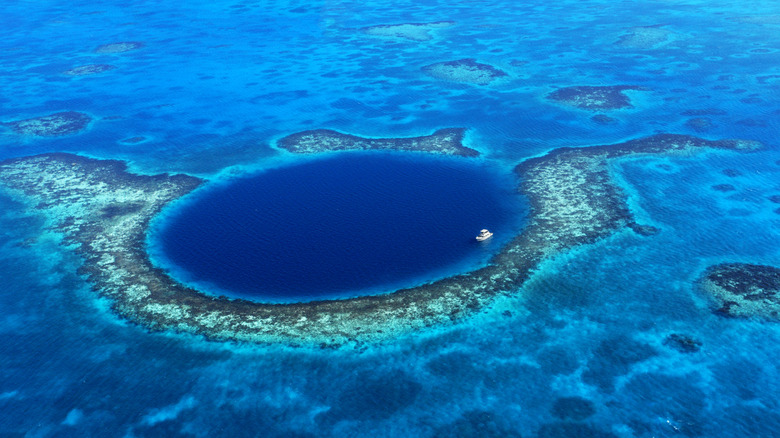
For people with "thalassophobia," or the fear of deep bodies of water, blue holes are something out of a nightmare. These massive vertical caves open up in the shallow waters near coastlines, but blue holes themselves are far from shallow. Belize has a famous Great Blue Hole that reaches 410 feet straight down, while Dragon's Hole in the South Chinese Sea drops nearly 1,000 feet from the ocean floor. Dragon's Hole was long considered to be the world's deepest blue hole, until a recent remeasurement of a blue hole near the Mexican-Belize border crowned a new winner.
In 2021, the Taam Ja' blue hole in Chetumal Bay was measured to have a depth of roughly 900 feet. But in December 2023, a second campaign to probe its depths returned with a record profundity of 1,380 feet, making it the true winner of the "the world's deepest blue hole." What's really exciting (and, perhaps, terrifying) about the discovery is that the scientists never even found the bottom, suggesting that the Taam Ja' blue hole could be much, much deeper.
"Blue hole" is an apt description. The presence of the Taam Ja' blue hole (or "deep water" in Mayan) was first alerted to scientists in 2021 by local fisherman, who reported a circular area of curiously calm water over a dark patch in the shallow waters of the bay. There, the sandy seafloor is only a few meters deep, while the circular mouth of Taam Ja' appears like an inky dark blue hole, suddenly dropping off at an 80-degree angle. The discovery is exciting for numerous fields of scientific inquiry, and even astrobiologists have joined the buzz to hopefully search Taam Ja' for extremophile life forms that can survive such an extreme and hostile environment.
How blue holes form and what lurks beneath
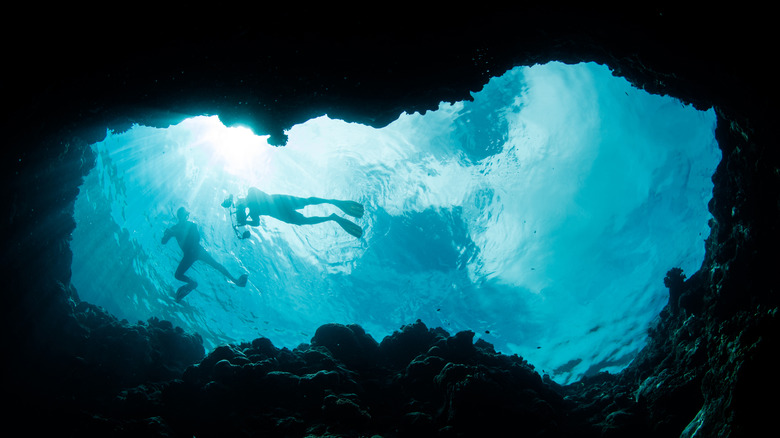
Blue holes are found in ocean waters today, but they formed on land when ocean levels were lower. In the past, ice ages locked water into towering glacial sheets, lowering the ocean levels by as much as 393 feet and exposing coastal areas to the air. During such periods, regions of soluble rock, such as limestone, were eroded by rain, forming cave systems. Now, ocean levels are higher (and still rising, in part due to the effects of global warming), and the caves are flooded. Thus, we get blue holes and other curious cavernous geological features.
Because blue holes offer marine life unique environments to evolve in, scientists have found an abundance of specialized species lurking in their depths. Sharks and other predators have been known to dive into blue holes to take advantage of the abundance. Thus, blue holes aren't completely closed off to the ecosystems at the surface, though the really deep and dark waters are largely cut off from life above.
As a result, in recent decades, scientists have discovered completely novel organisms in deep blue holes. For instance, in 2012, scientists reported colonies of unknown microbes feeding off sulfur compounds in the pitch-black deep of blue holes. Such compounds are usually toxic to life, so such blue hole discoveries often grab the attention of astrobiologists in their search for potential extraterrestrial lifeforms.
Life finds a way in the hostile darkness — and perhaps beyond our planet
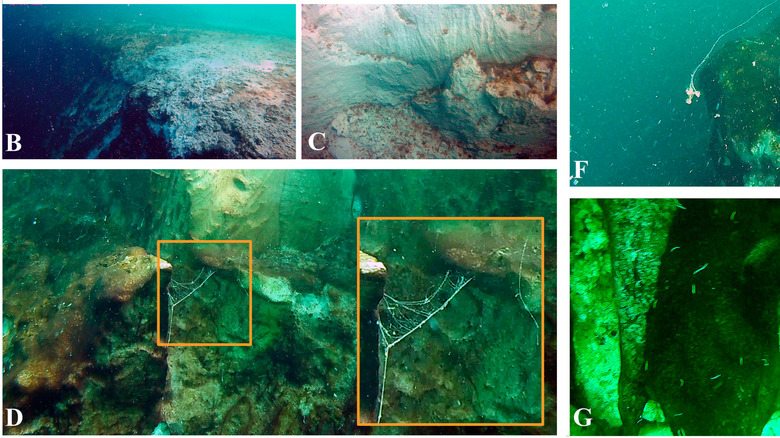
If life is able to adapt and survive in the high-pressure darkness of blue holes, it's possible that it could survive in similar conditions beyond our planet. Such is the guiding principle of astrobiology, the study of potential extraterrestrial life. The colonies of sulfur-consuming microbes discovered in 2012 offer just a glimpse into the adaptations of extremophiles, the organisms that can survive conditions otherwise considered deadly to most life forms.
Beyond just surviving, some extremophiles can thrive without the tether of the photosynthetic energy sources that provide the foundation of Earth's food chain. One thing is for certain, there are no plants deep in the Taam Ja' blue hole. At over 1,000 feet deep, light simply can't penetrate the increasingly pressurized water. But there's still hope. As discovered deep in the darkness of the Pacific Ocean, some extremophiles are able to bypass the sun's energy and use the energy provided by hydrothermal vents. Without further probing, it's still unknown if hydrothermal vents are present in Taam Ja'.
Adding to the hostility of Taam Ja's deeps, the water is anoxic at a certain depth, meaning it's free of oxygen. However, microbes in other blue holes have been discovered breathing hydrogen sulfide in place of oxygen. To astrobiologists, such alien-like adaptations suggest that life could be lurking in places like the pitch-black subsurface of Jupiter's moon Europa or Saturn's moon Enceladus. But if we want more examples, someone is going to have to actually find the bottom of Taam Ja'.