

The Strange Mushroom That Makes You See Tiny People
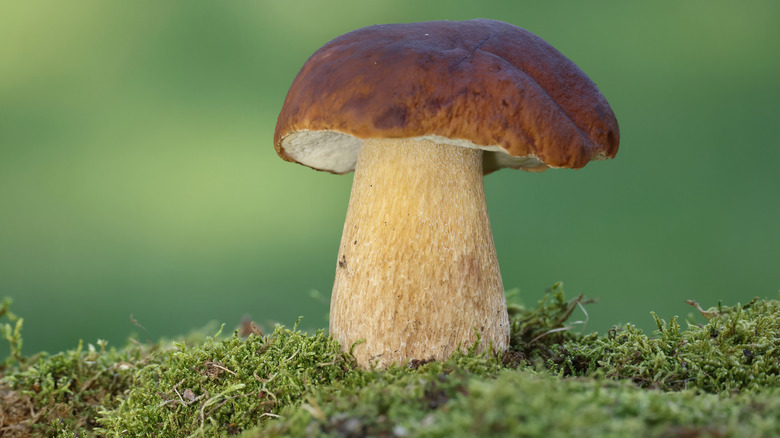
The hallucinogenic properties possessed by certain types of mushrooms have achieved significant notoriety thanks to counterculture movements and ancient medicinal practices. More than 200 mushroom species are currently known to cause psychedelic effects of some degree if ingested, but one particular fungus, and the visions of miniature people it induces, is proving especially challenging for scientists to understand.
In China's Yunnan Province, the summer months bring high temperatures, heavy rains, and a steady stream of patients showing up at hospitals to complain of the same disturbing symptom: Hallucinations of tiny human beings running all over every surface in sight. Reports like these have been coming out of the southern Chinese province for decades, but the mushroom species in question was not formally identified until 2015, when it was given the scientific name, Lanmaoa asiatica.
In Yunnan Province, locals have long known L. asiatica by the common name, "Jian shou qing," which means "see hand blue," a reference to the fact that the mushrooms change color from yellow to blue if you pick them, due to oxidation. They are widely used in local cuisine, but they must be cooked for a long time, or else the diner is liable to start seeing "xiao ren ren" (the colloquial name for those little people). It's especially notable that the nature of the visions is so consistent, falling into a category of hallucinations that has a long history of perplexing scientists.
L. asiatica isn't like other hallucinogenic mushrooms

Hallucinations involving miniature people are called Lilliputian hallucinations, named after the fictional island of Lilliput from Jonathan Swift's "Gulliver's Travels," and its tiny inhabitants. The people pictured in these hallucinations tend to be a couple of inches tall, and are almost always seen in large numbers, sometimes in the thousands or even millions. Another common theme in Lilliputian hallucinations is that the little people are seen interacting with objects in the real-world environment, further blurring the boundaries of reality.
Lilliputian hallucinations have been linked to several health concerns including brain injuries, schizophrenia, as well as other hallucinogenic plants like belladonna (deadly nightshade). However, it's not a type of hallucination typically associated with mushrooms. The "magic mushrooms" made famous by counterculture figures contain a compound called psilocybin that causes their famous psychedelic effects. What makes L. asiatica confusing is that it doesn't contain psilocybin.
Over the past two years, Ph.D. student Colin Domnauer of the University of Utah has travelled to China, the Philippines, and Papua New Guinea to collect samples of L. asiatica and accounts from those who have eaten it. Chemical analysis of the species has revealed no known psychoactive compounds, so Domnauer believes that the force behind the mushroom's effects is a compound hitherto unknown to science. Domnauer is still searching for that mystery compound. In the process, he has identified four new varieties of Lanmoa mushroom, and aims to build a comprehensive database of all species in the genus.