

The Fascinating Way Bees Survive Winter
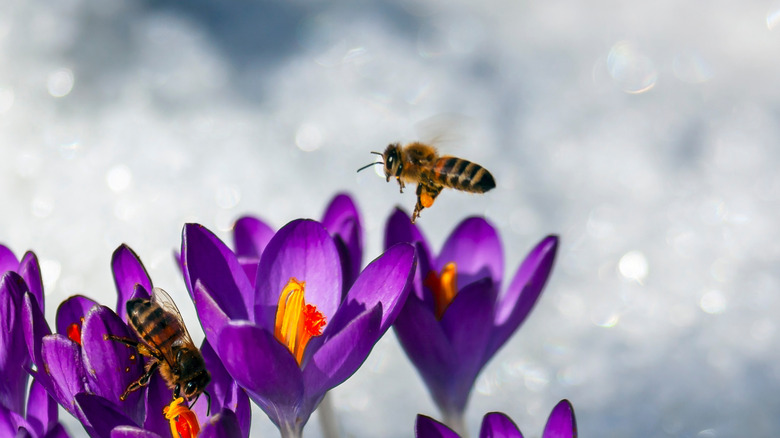
If you live in a climate where temperatures drop below freezing in the wintertime, you've probably wondered where all the insects go during the winter months. The answer depends on the critter. Some, like certain mosquitos, hibernate in a metabolic state called diapause. Other species may migrate south to escape the temperature drop, such as the famous monarch butterfly. Many others simply die off, leaving their eggs behind to repopulate the ecosystem once the ice thaws. But honeybees have a unique adaptation that requires neither hibernation nor migration: honeybees shiver all winter long to generate their own heat.
In the winter, honeybees cluster around their queen and vibrate their bodies, which burns calories and, consequently, generates body heat. They also rotate their positioning around the queen, swapping places with those on the outside in order to make sure none bear the brunt of the cold outer shell for too long. Of course this process requires food energy to sustain for months at a time. For that very reason, honey bees store extra honey for the winter, just like squirrels and chipmunks stash away nuts. While honeybee nests might look like frozen, empty ice balls from the outside, they're actually quite cozy on the inside.
Bumblebees are also known to shiver to generate heat in freezing temperatures, though their practice isn't as well-coordinated as it is among honeybees. In severely cold climates, the bumblebee queen is usually the only member of the hive to survive the winter, nesting dormant in some well-protected leaf litter or other hidden nook. However, bumblebees have a high tolerance to cold and may employ their shivering technique to survive milder winters. It also helps that these bees evolved in the Himalayas, where they adapted to grow thick hair and fat insulating bodies.
Other species aren't as winter-ready as honeybees
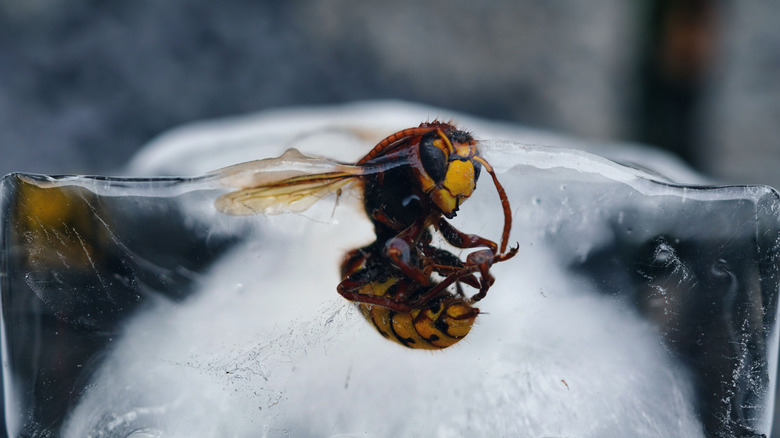
Among the wasps, bees, and ants that comprise the order Hymenoptera, honeybees' ability to raise their body temperatures by shivering is the exception to the norm. Other species typically die in cold winter months, though their queens may survive by hibernating. When this hibernative state is short-term, such as in the face of an autumn cold snap, it's called torpor. Their metabolisms and movements slow, conserving energy. In fact, when honeybees form their ball of vibrating heat, they too technically enter a state of torpor.
But for long-term endurance, some species go a step further than simple torpor. To survive the long winter months, many queen bees and wasps enter diapause. Diapause is more closely akin to what we typically think of as hibernation — their metabolic rate drops drastically (almost stopping entirely), movement stops, and much of their external body parts literally freeze solid. However, to prevent their vital organs from rupturing from ice crystals, many queen bees and wasps build up glycol in their blood (insect blood is called hemolymph), which acts as an anti-freeze.
Thus, other than the exceptions, most bees and wasps die in harsh winters. Even social wasps like yellowjackets will usually die, rather than enter torpor or diapause. But for those that do hibernate, survival isn't a guarantee. Queen bees and wasps require safe and relatively warm hiding spots to ride out the winter freeze, such as under leaves, logs, abandoned burrows, and any nook or cranny along house awnings and foundations. If such sanctuaries are disturbed, the vulnerable, half-frozen insect is unlikely to survive. Human activities and encroachment upon wild ecosystems have decimated insect populations, and the increasing lack of wild sanctuaries is likely a factor in their decline.