

One Big Reason Why Scientists Want To Clone Cows
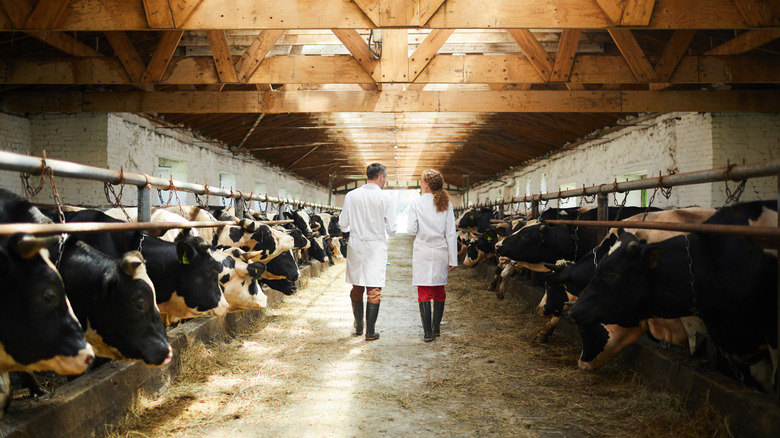
Cloning is nothing new. While many of us recall the 1997 case of Dolly the cloned sheep, scientists have been tinkering with cloning since the late 1800s. But early experiments were more akin to artificially splitting embryos to create identical twins. Nowadays, scientists are able to take the DNA from a dead animal and use it to create a genetically identical, fertile clone. Why would you want to do that? Apparently, to make higher-quality beef.
In countries like the United States, Canada, Australia, and China, scientists have developed ways to clone their finest livestock to "optimize the genetic pool" of their herds. For beef cows, the process takes several steps. First, the technicians compare the quality of various carcasses to find the highest-grade specimen. Then, they extract its DNA and use it to create a genetically identical zygote. The technicians next plant the growing embryo into a surrogate heifer, which eventually gives birth to an exact clone of that original, deceased, high-quality specimen. Finally, the process is repeated to produce one heifer clone and one bull clone. These two clones are then bred, producing high-grade offspring destined for the slaughterhouse.
Thus, "cloned meat" isn't actually harvested from a cloned animal. Instead, it's meat from the offspring of two cloned parents. Expectedly, high-quality, cloned breeding cattle will produce high-quality offspring. At least, that's the idea. While the offspring of cloned cattle produced, on-average, higher quality beef, the procedure can be inconsistent. For example, in an assessment of a beef-cloning project from researchers at West Texas A&M University, only one out of the seven calves harvested for testing achieved a prime grade rating. The other six were either "high choice" or "average choice." These numbers are still well above the industry standard, but many consumers are skeptical about the benefits of cloning.
Is cloned meat safe? The FDA seems to think so
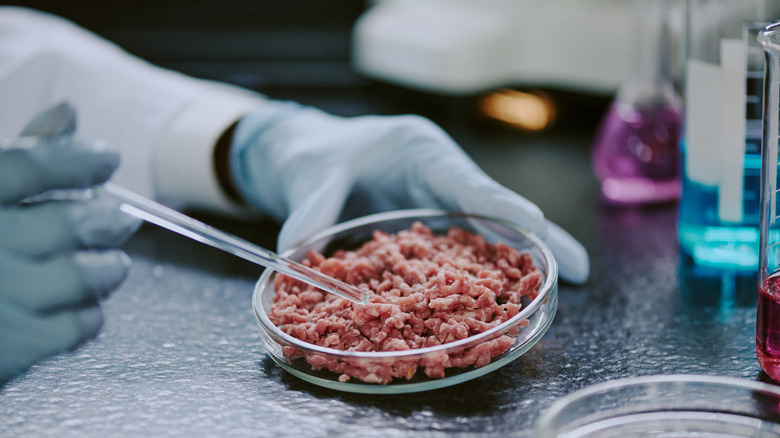
The FDA approved the use of cloned meat in the United States in 2008, but there's very little transparency about which specific products come from cloned sources. The FDA doesn't require sellers to label meat products from cloned animals, so it's difficult to determine the extent of the practice. As can be expected, the industry isn't going to volunteer to label its products as "sourced from cloned animals" if it doesn't have to.
A similar controversy has occurred in Canada within recent months. Announcements that cloned meats would soon be hitting supermarket shelves without specific labelling has stirred debates about the ethics and safety of consuming cloned beef, pork, lamb, and other meat sources. In an interview with Global News, food scientist Dr. Sylvain Charlebois of Canada's Dalhousie University asserts that the 25 years of science demonstrate that, "from a food safety perspective, there shouldn't be any concerns at all. There's actually a lot of literature on this issue."
However, Charlebois goes on to address the ethical problems surrounding cloned meats. The cloning process requires a lot of "trial and error" — that is to say, many cattle are killed in both the experimentation phase and production phase of the cloning enterprise. Some people have spiritual, religious, or ethical concerns about the treatment of animals. As Charlebois points out, Halal and Kosher meats are labelled to address ethical and spiritual concerns, so why not cloned sources? Furthermore, proponents of sustainable agriculture reject the industrialized farming practices altogether.
It makes sense why sellers are choosing to not label their products as "cloned meat." While high-quality meats may cheaper using cloning, many consumers would likely choose to pay the higher price for non-cloned sources. As always, the dollar decides.