

The Largest Dinosaur Footprint Site In The UK Was Discovered By Accident
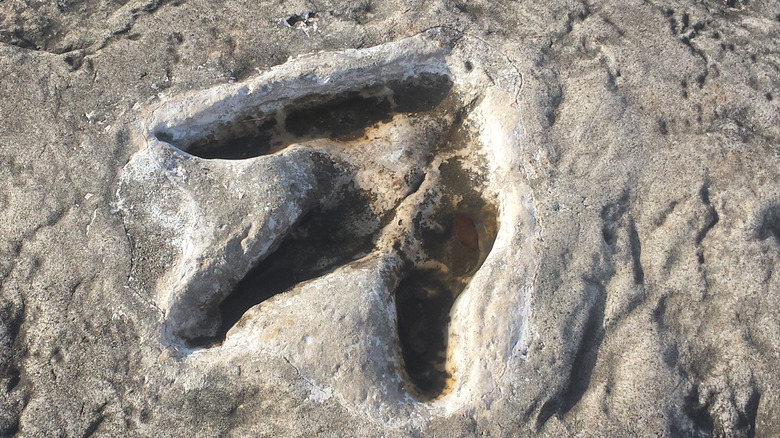
In early 2022, a quarry worker named Gary Johnson headed out for what he could only have assumed would be a standard day of work at Dewars Farm Quarry in Oxfordshire. But while Johnson was stripping clay from the quarry floor, he found a series of bumpy impressions in the ground unlike anything he'd seen before. They turned out to be one of the greatest paleontological finds in British history.
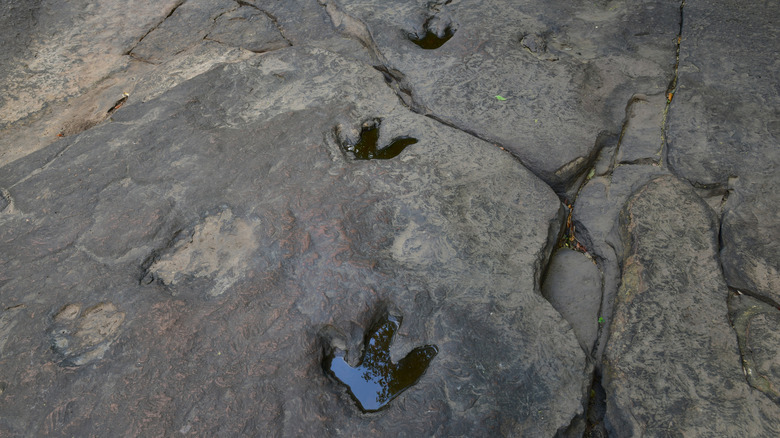
Dinosaur discoveries often happen in this fashion (the largest dinosaur ever discovered was accidentally found by a rancher), so give Johnson credit for quickly noting that the regular spacing of the marks indicated a set of footprints. The find was reported to the Oxford Museum of Natural History, and an excavation plan was put in motion. Over the summer of 2024, researchers from Oxford and the University of Birmingham led a survey of the site, and they uncovered roughly 200 footprints made by multiple species of dinosaur. They used aerial drone photography to build a 3D model of the whole site, digitally preserving it for long-term study.
In addition to the footprints, the survey team uncovered fossils from shells and plants, clues that indicate the area was once a muddy wetland. This is the perfect environment for capturing prehistoric footprints, as the dinosaurs' feet sunk deep into the soft mud and left very clear tracks as a result. With such well-preserved specimens, researchers have been able to piece together a portrait of Britain as it was over 150 million years ago.
Welcome to Jurassic Britain
The footprints found at Dewars Farm Quarry were made during the Middle Jurassic epoch, roughly 166 million years ago. Back then, the land that now forms the United Kingdom was broken up amongst several smaller island landmasses. These were located between 30 and 40 degrees north of the equator, well south of modern Great Britain, which lies between 50 and 60 degrees north. As a result of the lower latitude, the land was not as frigid as today's U.K. is so notorious for being. Annual temperatures were as high as 80 degrees Fahrenheit, and marine life flourished, as evidenced by fossil beds around the area. The location of the present-day quarry was at that time a lagoon surrounded by the muddy land where the footprints were formed.
It appears that dinosaur traffic was especially high in this area. 25 years before Gary Johnson stumbled across his spectacular find, a similar group of footprints had been discovered at Ardley Quarry, which is just over a mile away from Dewars Farm, and run by the same company: Smiths Bletchington. The Ardley tracks were photographed, but then buried as part of a construction project, preventing further study. Uncovering the tracks at Dewars Farm Quarry has reopened the case, so to speak, and this time around, scientists have much more advanced technology to study the site with. This new research has revealed what dinosaurs likely made the tracks, and even clues to how fast they were walking.
The tracks reveal multiple dinosaur species
During the first survey of Dewars Farm Quarry, researchers uncovered five distinct trackways, the longest of which stretched for nearly 500 feet. A second survey was done in the summer of 2025, and it uncovered an additional four sets of trackways, including one over a quarter of a mile long. From the very first glance, it was obvious that these footprints were made by at least two different dinosaur species.
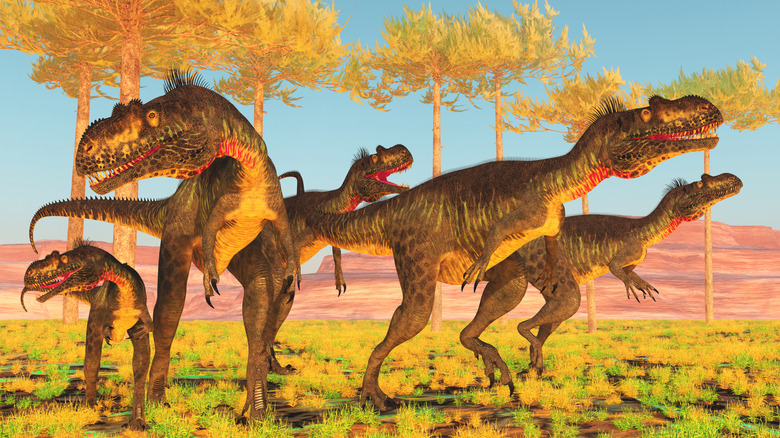
One of the trackways was made by three-toed clawed feet, which are a sure sign of theropods. Theropods are a group of bipedal carnivorous dinosaurs, the unique appearance of the Tyrannosaurus rex is probably the most famous and familiar. However, the tracks found at Dewars Farm Quarry appear to have come from a different theropod called Megalosaurus, which resembled T. rex, but was much smaller, and lived about 100 million years earlier. Megalosaurus is notable for being the first dinosaur ever classified by science.
The other tracks at Dewars Farm Quarry came from stone-swallowing sauropod dinosaurs, the group of long-necked herbivores that included Brontosaurus and Diplodocus. The research team believes that these tracks were made by a close genetic relative of Diplodocus called Cetiosaurus, which was around 60 feet long.
By studying the spacing of the footprints in each trackway, researchers believe they have found out how fast the dinosaurs were walking. They were evidently in no hurry, as both the Megalosaurus and Cetiosaurus were traveling around three miles per hour, which happens to be the average walking speed of an adult human being.