

The Big Reason Scientists Are Electrocuting America's Lakes
By their very nature, invasive species are hard to stop. There have been a few success stories; some island communities in the Caribbean and Pacific have successfully restored their native biodiversity by eradicating invasive rats, cats, and other non-native critters. However, such efforts on larger landmasses are exceedingly difficult. Numerous invasive species around the world have destroyed local ecosystems, so scientists often focus on minimizing the spread rather than attempting complete eradication. They've come up with some clever approaches, too, one of which is to blast infested lakes with electricity and see what shocked animals floats to the surface.
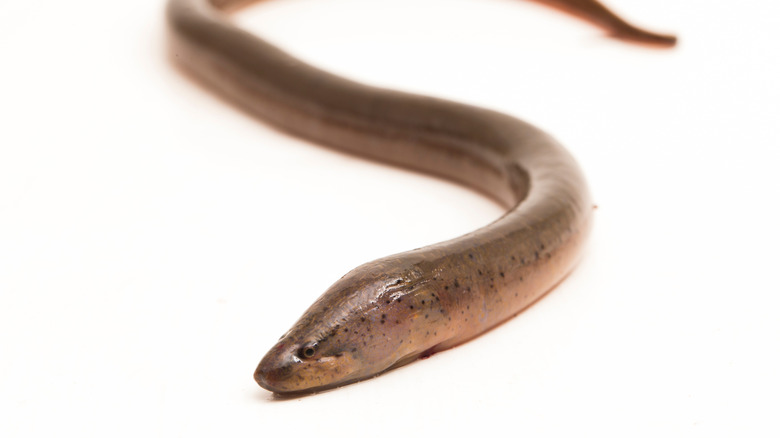
The Asian swamp eel is a freshwater fish similar in appearance to an eel. And, just like an eel, it's super slippery and hard to catch. That's partly why it's slipped through conservationists' fingers. Since its introduction, the Asian swamp eel has hopped from ponds to lakes, showing up as far north as New Jersey and as far south as the tip of Florida. The eel has done perhaps the most damage as an invasive species destroying the Florida Everglades, where, as mentioned in a study published in Nature, researchers from Florida International University have observed that "after the establishment of swamp eels in Taylor Slough (Everglades National Park) average fish and decapod richness declined by 25%."
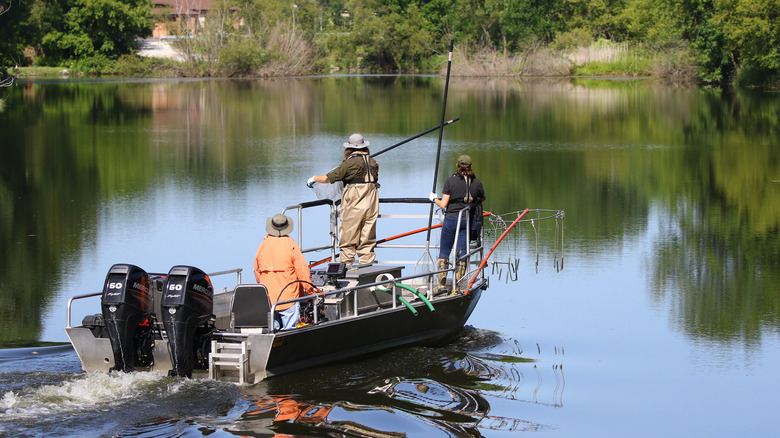
In Orlando, scientists have adopted a novel approach to studying the swamp eel's spread. By placing high-voltage electrodes in Lake Underhill and zapping the water, they can then net the stunned fish that float to the surface. Even with the swamp eels stunned, they're still slimy enough to often slip through the nets, though. Nonetheless, the caught specimens and the ones-that-got-away can provide scientists with vital population data. More importantly, the scientists can analyze the eels' diets and environmental tolerances, information critical for predicting where and what is threatened by the foreign invader.
Asian swamp eels aren't the only invasive species getting electrocuted
Invasive species spread in several ways. According to the United States Geological Survey, the Asian swamp eel was likely introduced to the continental United States via "an aquarium release, a fish farm escape or release, or release of specimens from the live food-fish market." Other invasive species devastating Florida's unique ecosystems arrived accidentally in boat ballast, like the Asian green mussel, or were intentionally and unwittingly planted for their aesthetics, like the Brazilian peppertree.
The USGS Wetland and Aquatic Research Center (WARC) is partially funding the electrocution of lakes in the hunt for Asian swamp eels, though. But the scientists from WARC are also focused on hunting another two species that have spread with similar tenacity: the Cuban tree frog and alligatorweed. All three species have inundated the southeastern United States, and scientists studying Asian swamp eels often pull up equal parts alligatorweed in their nets.
How these invasive species have hopped across ponds and lakes is far from a mystery. Hurricanes are one of the biggest spreaders of invasive species in the southwestern United States. Flooding and winds caused by hurricanes can wash native species into new locations, and the increasing intensity of hurricanes due to climate change is only making the problem worse. Once-isolated ponds and lakes now have annual "corridors," where eggs, seeds, and entire adult organisms can spread. Hurricane Helene, for example, is estimated to have spread 222 non-native species to a wider range, while Hurricane Milton relocated up to 114. About half of those non-native species are considered invasive. Thus, efforts to track the spread and study the species aren't in vain, even if that means cranking electricity into lakes.