

Why Death By Blue-Ringed Octopus Is One Of The Worst Ways To Die
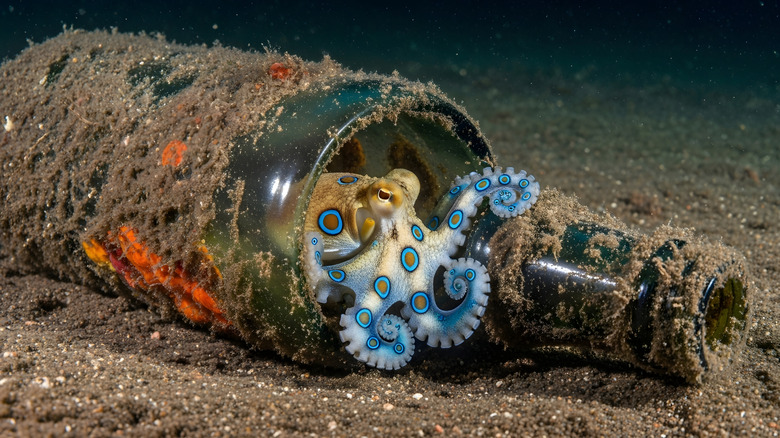
It's hard to resist picking up a blue-ringed octopus. Palm-sized, delicate-looking, and adorned with stunning iridescent blue rings, they're like small gemstones to be found among the coral reefs, tidal pools, and shallow coastal waters of the Pacific and Indian Oceans. But simply picking one up can be a deadly mistake, since their saliva contains a neurotoxin called tetrodotoxin (which some dolphins use to get high). Should the tetrodotoxin enter the bloodstream via a bite from the octopus' beak, it can kill a human in just a matter of terrifying, agonizing minutes.
As soon as the blue-ringed octopus' tetrodotoxin enters the bloodstream, it begins its neurotoxic effects. This starts by blocking nerve impulses from firing, which prevents muscles from contracting. Essentially, the muscular system is gradually paralyzed. At this stage, the victim may vomit repeatedly, become dizzy and disoriented, struggle to stand, and lose their vision. They may remain conscious, though increasingly unable to move. Finally, once the neurotoxin reaches the heart and diaphragm, breathing slows to a stop and oxygen is cut off. Typically, fatalities result from respiratory failure.
As deadly as the blue-ringed octopus' tetrodotoxin is, human deaths are rare. The Australian Institute of Marine Science reports that only three deaths from blue-ringed octopus bites have ever been confirmed (though some scholars have speculated the actual number may be higher). Part of the reason for so few deaths is because it very rarely bites. The blue-ringed octopus has a mild nature, only displaying its full iridescent blue colors when it feels especially threatened. In cases where a bite does occur, victims often have access to rapid medical treatment. There's no antidote for the blue-ringed octopus' tetrodotoxin, but emergency medical services may prevent cardiac arrest by placing the victim on a ventilator.
How one of the smallest octopuses became the most venomous
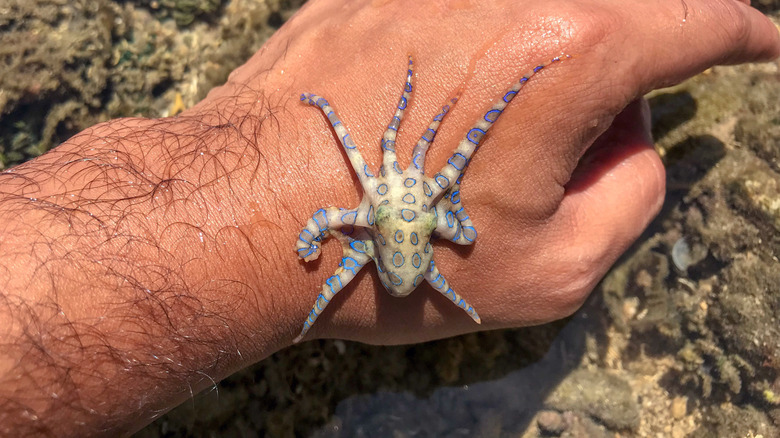
Each of the four named species of blue-ringed octopus carry the deadly tetrodotoxin in their saliva. All octopuses contain venom to some degree, though experts believe the blue-ringed octopus is the most venomous of the group. In fact, the blue-ringed octopus is one of the most venomous creatures on Earth, including both land and sea. So why the need to have such a potent neurotoxin coursing through its body? There are two reasons: defense and offense.
Tetrodotoxin provides a fantastic defense system for tiny, snack-sized octopuses. The blue-ringed octopus is only a few inches across, depending on the species, so it's constantly assailed by larger predators among the coral reefs, tide pools, and shallow waters where it lives. Any predator that swallows it gets poisoned, while any predator that delays long enough to get bitten is almost instantly envenomated. For quick-learning and observant predators, the sudden flush of bright-blue rings are a warning sign that the tiny octopus is not on the menu.
As small as it may be, the blue-ringed octopus is also a fearsome predator — at least to small shrimp, hermit crabs, and other tiny crustaceans. Its prey are often fast-moving and hard-shelled, so the tiny octopus needs its venom to act fast to quickly immobilize potential escapees. Octopuses are some of the most intelligent animals on earth, and the blue-ringed octopus is no exception, using tactician-like thinking to ambush its victims, crack their shells with its beak, and dribble venomous saliva into the hole. With the aid of deadly neurotoxins, they can procure a meal within several seconds. Clearly, the blue-ringed octopus is adapted to a world entirely alien to human beings. It's best to keep your distance.