

Scientists Played Music For Cows And Made A Fascinating Discovery
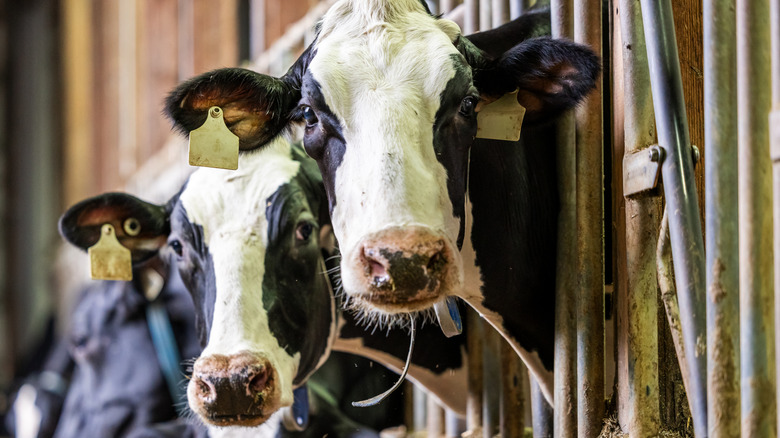
Two scientists walk into a barn. They have a mission: discover the musical preferences of cows. This might sound like a joke, but in 2001, Adrian North and Liam MacKenzie fitted several cow sheds with speakers and played music. These researchers played songs by artists ranging from Simon and Garfunkel to Jamiroquai to Beethoven. They found that music had an important effect on cows, namely, the songs they chose influenced how much milk the cows produced. It would seem these animals prefer a ballad.
The researchers chose these songs to observe how various tempos and volumes might alter milk production. The songs which seemed to result in the most milk were slower, like "Bridge Over Troubled Water" and "Everybody Hurts" by R.E.M. More upbeat songs like the Beatles' "Back in the U.S.S.R." played less well with the animals. For those who might be interested, Modern Farmer created a playlist based on the cows' favorite songs according to the study. But what is the science behind this? Are cows uniquely musical or is there something about music that transcends species?
Please don't stop the moo-sic: songs create a better environment
Dairy farms rely on milk production to thrive. One of the biggest determinants of milk production appears to be the environment in which the cows live. In fact, a 2019 study showed that only 30% of milk production is based on genetic factors. The other 70% relies on environmental factors, including nutrition and management. This means that maintaining a healthy and comfortable space for cows can go a long way in sustaining a farm.
Music is a great source of environmental enrichment, and there are several reasons that a calming environment can improve milk production. First, studies have found that playing music for cows can alter certain hormonal levels that play a key role in lactation. For instance, certain music has been shown to reduce cortisol (a different class of chemicals from catecholamines) in cows, which is a stress hormone. Increased stress can lead to impaired lactation and can also result in a weakened immune system, leaving the animal more susceptible to illness. Additionally, some music has demonstrated an increase in serotonin, which plays an important role in milk production.
A review published in 2025 analyzed 18 studies over the past decade to provide an overview of the effect that music has specifically on dairy cows. They demonstrated that music with a slower tempo and a volume of less than 70 decibels (much lower than the decibel level of a jet) largely improved milk production. However, some studies in this review yielded no significant effect of music. Therefore, more studies should be conducted in order to demonstrate whether this is a consistent result.
The effects of music on human health

Cows are not the only ones who enjoy good music from time to time. Many humans turn to music for its effect on concentration or when trying to improve their mood. Hours of content exist on various music-streaming platforms with playlists featuring lo-fi and classical music for studying. Different types of music have been shown to increase or decrease heart rate, meaning that music can be used to regulate our autonomic nervous system.
The field of music therapy exists to use music as a tool in promoting overall health and has yielded some promising results. Studies have found that music can improve cognition, promote neuroplasticity, and help manage pain. Similar to cows, music has also been shown to reduce stress. Although some amazing discoveries have been made within this field, it is important to note that music itself is highly variable. Therefore, standardizing physiological and psychological effects can be difficult. Future studies will hopefully continue to provide a clearer picture of music on the brain.