

Scientists Say This Asteroid Will Miss Earth And May Strike The Moon Instead
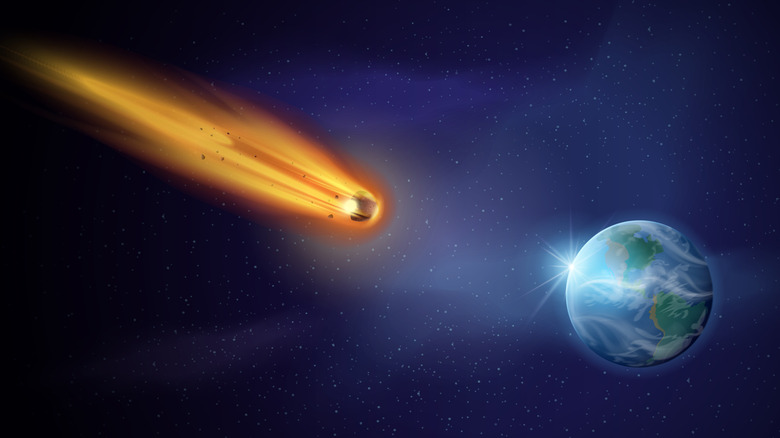
It's now well-accepted that a meteor killed off the dinosaurs, so it's no wonder why many people worry about an apocalyptic demise from celestial artillery. Indeed, the geological record is full of massive asteroid impacts, and several such impacts have caused mass extinction events. To make matters worse, 2025 witnessed an interstellar comet enter the solar system, and astronomers were embarrassingly late in spotting it. Now, the latest blip on the radar may pass uncomfortably close to home.
2024 YR4 is an asteroid first detected in 2024 which alerted sky gazers for its seemingly Earth-bound trajectory. Fortunately, a collision with the Earth has since been completely ruled out. However, projections give 2024 YR4 a 4% chance of colliding with the moon, which, while slim, is significant enough to cause concern. Of course, such projections cover a vast amount of space and time. The initial warning determined that the potential impact wouldn't occur until 2032, if at all. That gives us ample time to prepare for such an event, and scientists will certainly refine the data with its approach.
The object was detected on December 27th, 2024 via the "Asteroid Terrestrial-Impact Last Alert System," or "ATLAS." The Chile-based telescope scans the cosmos for potentially threatening asteroids, and its initial reports gave the 2024 YR4 asteroid a chance of colliding with the Earth that peaked at 3%. Further analyses by the European Space Agency quelled such fears, bringing the risk of a collision with Earth down to 0%. This was still enough to alert multiple space agencies to the asteroid's path. And while 2024 YR4 won't hit our planet, the unlikely but very real possibility of a moon collision could still be devastating.
Signs from space: How scientists monitor threats from the cosmos
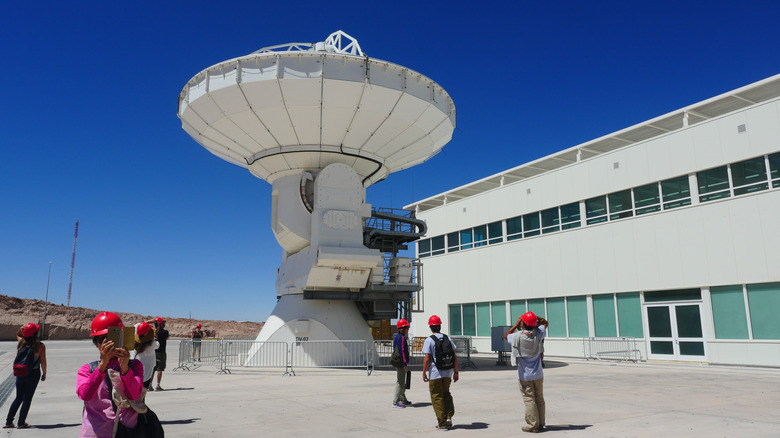
Astronomers have been using ground- and space-based telescopes to monitor the stellar medium for a humanity-ending space rock for decades. The current strongest detector is the Silla Observatory, which was built in the Atacama Desert of Chile where light pollution is minimal. There, the ATLAS program is in full effect, refining its data of the 2024 YR4 asteroid with every four-year swing of the rock's orbit that places us into sight of it.
Thus far, ATLAS scientists have determined the 2024 YR4 is around 53 to 67 meters (~175–220 feet) in diameter and made of silicates, placing it in the S-type asteroid class. Because of its immense distance away, scientists aren't sure if it's an aggregate of tiny pieces or if it's a single giant rock. Tellingly, YR4 has been detected rotating at a speed of around 19 minutes per rotation, which hints towards the asteroid being solid.
In a complex coordination effort, the ATLAS program works alongside NASA's planetary defense team and the European Space Agency. The organization of such a program is, admittedly, convoluted, but the overall objective is to catalog asteroids to keep tabs on potential threats. NASA's planetary defense team classifies over 38,500 asteroids as "potentially hazardous" out of a roughly 1.5 million registered objects (mostly in the asteroid and Kuiper belts). Considering the sheer quantity of space stuff zipping around the solar system, perhaps 2024 YR4 isn't quite as unique as it would appear.
Could we survive a meteor strike?
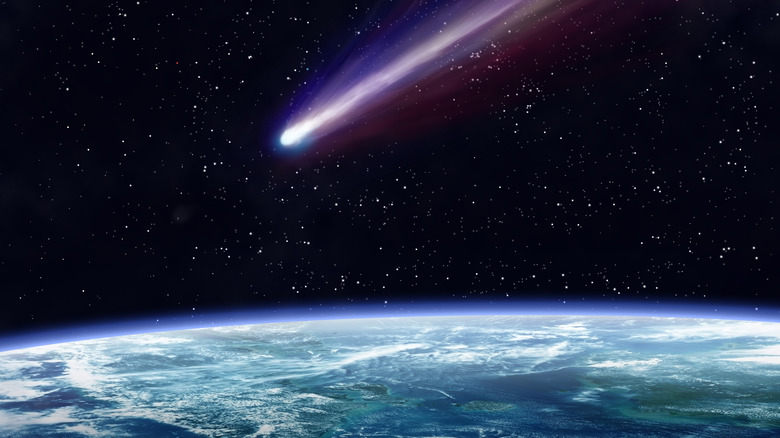
As established, the asteroid 2024 YR4 has a near-zero chance of hitting the Earth, though it could potentially impact the moon. Still, it's not unheard of that an asteroid should become a meteor and strike the Earth. Science-fiction movies lead us to believe that such an event could be avoided by blasting the incoming object with some kind of explosive missile. Unfortunately, these objects are travelling at such high velocities and possess such great masses, that redirection would likely require more than a single, well-aimed rocket.
Such a scenario is extremely unlikely. Based on the trajectory maps from organizations like ATLAS, we're safe for at least a century. Still, the European Space Agency states that "planet killers" — or asteroids more than half a mile wide — could surprise us. In such a case, there are two options for deflecting such a massive celestial shell: nuclear bombs or high-speed impactor rockets. NASA actually tested the latter method in the 2022 DART mission (at a cost of $325 million), which basically smashed a rocket into the asteroid Dimorphos.
The mission successfully deflected the asteroid's orbit by 33 minutes, which proved that it is indeed possible to protect the Earth from incoming asteroids by pushing them out of our path. However, the asteroid that killed the dinosaurs was quite a bit bigger than Dimorphos. Dimorphos measured around 665 feet wide, while a "planet killer," at roughly 5,000 feet wide, could require the equivalent of over 1,000 DART missions to deflect such a beast. Luckily, no such asteroid has been detected. Our current biggest threat, the 2024 YR4 asteroid, is only around 200 feet across. For now, our biggest threat is ourselves, not space rocks.