

Disturbing Things That Would Happen To Your Body After Death On The Moon
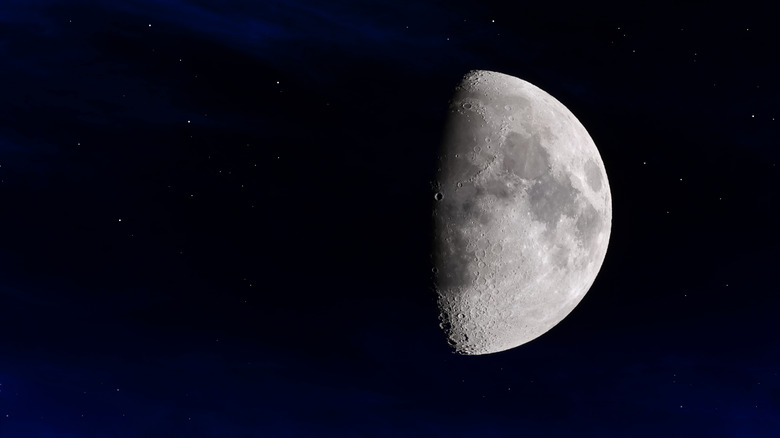
Thinking of your own death is unsettling no matter where you envision it happening, but dying outside the comfort of your home planet would be an especially disturbing demise. To date, only three people have officially died outside the confines of Earth's atmosphere; they were Georgi Dobrovolski, Vladislav Volkov, and Viktor Patsayev, the crew of the Soviet Soyuz 11 spacecraft. While returning from Salyut 1, the world's first space station, in 1971, the craft suffered a valve leak that suffocated its passengers. However, Soyuz 11 still made it back to Earth, and the bodies of the cosmonauts were cremated and interred at the Kremlin. We've yet to see what happens when a dead body is left in space, but we can make some pretty strong assumptions as to what would happen on the moon based on the science of human decomposition.
What happens to the body after death is heavily dependent on environmental factors, which is why death on the moon would play out way differently than on Earth. For instance, the rate at which a dead body turns cold has a lot to do with the temperature of its surroundings. Due to the moon's lack of atmosphere, temperatures there reach extremes unlike anything on Earth, ranging from 250 degrees Fahrenheit in the sunlight down to -208 degrees in the dark (and -410 in some of the deepest craters). Each blistering day and frigid night on the moon lasts approximately two weeks, so decomposition would depend largely on when you died in relation to this cycle. But that's not the only factor at play.
How the moon's extremes would affect decomposition
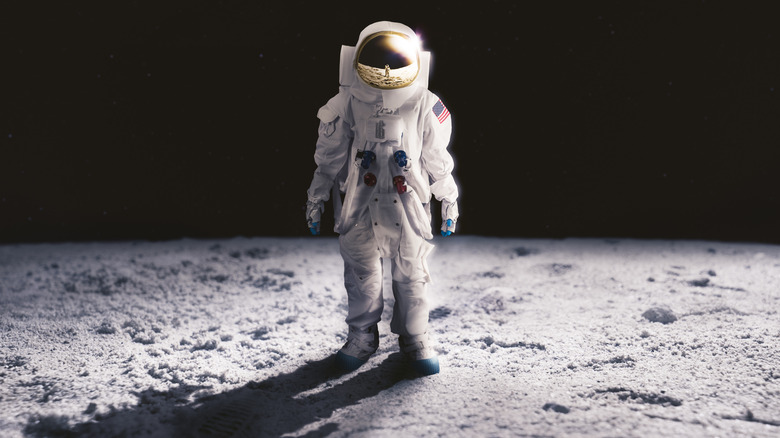
The heat of the lunar day would cause fast decomposition, while the chill of the lunar night would freeze a dead body like a cryogenic chamber. However, it's important to remember that you aren't the only organism involved in your own demise. Decomposition is largely driven by bacteria that live in and around the body, and the moon's extremes would have an equally extreme effect on those lifeforms. Of course, the moon has no lifeforms of its own, so the only bacteria available for decomposition would be the ones already within your own body. If you died during the lunar night, the cold would freeze those bacteria and prevent them from doing their job, but if you died during the lunar day, the bacteria could begin the process of decomposition as they would on Earth. However, they would soon run into another problem: dehydration.
A dead body left on the moon would lose all of its moisture at a rapid rate. There is so little in the way of atmospheric gas on the moon that the surface is basically in a vacuum, and without any air pressure, all of the water inside the body will evaporate. Since the body of an adult human is roughly 60% water, this dehydration would ultimately shrivel up your corpse like a raisin. That's not all, as the loss of water would also deprive whatever bacteria live inside you of hydration, ultimately killing all of them, too.
Death on the moon might be similar to mummification
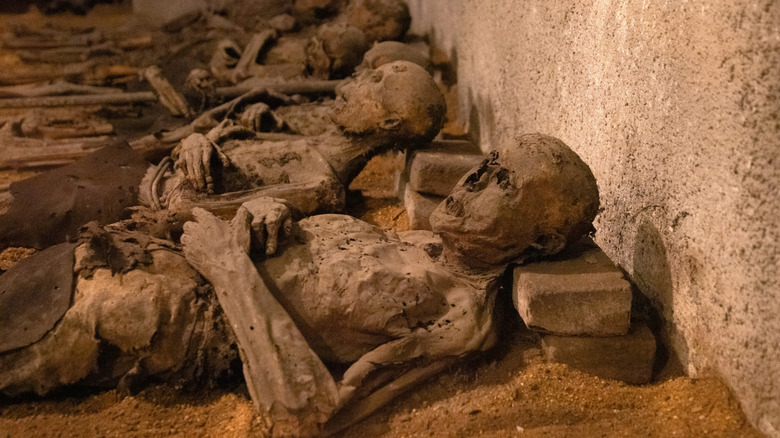
The total dehydration of the body would ultimately halt the decomposition process entirely by killing all the bacteria in the body. If you were to die during the lunar day, some decomposition would begin to occur before this happened, but the body would be unlikely to decompose completely. Instead, your corpse would become a lot like a mummy. In fact, the ancient Egyptian ritual of mummification may be the best earthly analogy for death on the moon, as the process was all about removing moisture from the body for preservation. To accomplish this, embalmers would cover a corpse in a special type of salt called natron (Na2CO3), which pulls liquid out of the body. This process would take over a month to dry out a mummy, but the moon's natural environment would do it much faster.
Conditions on the moon would most likely keep a dead body preserved far longer than it would be on Earth, although the dramatic swings in temperature with the lunar day and night cycle could cause freezing damage to the tissue over time. The other big factor to consider is radiation, which is much stronger on the moon than it is on Earth thanks to the absence of atmosphere. Radiation on the moon could be extreme enough to break down parts of a dead human body, but this would happen over a long, long period, and it's entirely possible that your bones would remain intact for millions of years.