

This Scientist Has A Bold Prediction For The Next Dominant Animal Species

We may receive a commission on purchases made from links.
With the risks imposed from a rapidly shifting climate, human extinction has been on the mind of some evolutionary biologists. What the world might look like if human civilization ceases is complete speculation, but some interesting hypotheses have emerged. When thinking about what might replace humans within the evolutionary hierarchy, one might lean towards a "Planet of the Apes" scenario, in which other primates dominate. However, one scientist has a rather interesting prediction of who will be the human successor: the octopus.
Oxford University professor and podcaster Tim Coulson studies the effects of changes in predation on ecosystems. His work has led him to study areas such as Yellowstone National Park, streams in Northern Trinidad, and an island in the Outer Hebrides. In his recent popular science book, "The Science of Why We Exist: A History of the Universe," Coulson presents an expansive examination of how humanity as we know it came to be. He has likewise explored ideas of the future beyond humanity.
Making waves in the field of evolutionary biology, Coulson has made the case for octopuses as the next dominant group in the absence of humans. He has postulated that these creatures possess a unique ability to fill this niche due to their intelligence, communication skills, and dexterity. Although perhaps highly underrated in popular opinion, are octopuses actually poised to take the mantle (pun intended) of humanity?
What sets these creatures up for future success?
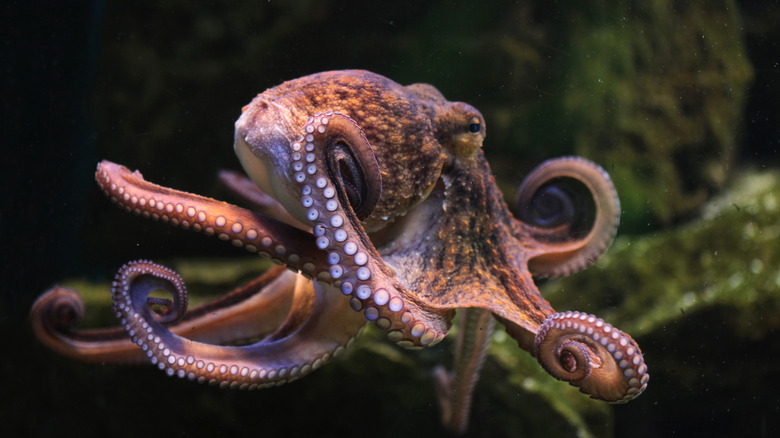
Coulson is undeniably correct that octopuses are fascinating and unique. Part of their distinctive intelligence stems from the peculiar makeup of their nervous system. Octopuses possess the highest brain-to-body ratio of any invertebrate (animals without a backbone). But the distribution of their nervous system is possibly the most fascinating part of their structure: Their central nervous system is essentially decentralized.
Although they do have a central brain residing between their eyes, the majority of their neurons are distributed across their eight arms. Basically, each arm has its own large neural network, almost serving as a mini-brain, that enables autonomous movement. Without any input from the central brain, its arms can move, smell, and taste. Additionally, octopuses are remarkably adept problem solvers. They have been shown to solve puzzles and employ complex methods to be effective hunters. Their intelligence has even led them to become remarkable escape artists, such as Inky, who broke out of his aquarium enclosure and managed to make his way into the sea.
Coulson also emphasized their impressive dexterity as an advantage. Without bones, much less opposable thumbs, octopuses maintain spectacular control over each of their limbs. Due to their muscular hydrostatic structure, they have superb flexibility of movement, allowing them to exhibit complex tool usage, like fashioning armor out of coconuts. But could their impressive intelligence and dexterity allow them to form complex civilizations comparable to humans?
Planet of the Octopuses: Can octopuses dominate?

Although Coulson presents a very interesting possibility for the future if humans become extinct, it is purely speculative. He expresses that, although non-human primates are also intelligent and dexterous, whatever force might result in the destruction of the human species is likely to also affect them. This is because humans share an environment with non-human primates. So, if a climate disaster were severe enough to end humanity, chances are it would also lead to the extinction of other primates.
The octopus, of course, resides in the sea. However, this doesn't preclude this species from the consequences of a changing climate. A 2024 study showed that warmer water temperature resulted in higher embryonic mortality for the cephalopods. Of course, the effects of warming water depend on their variation from ideal habitat conditions. For example, warming water temperatures led to an octopus population boom in the United Kingdom. Additionally, while some research has demonstrated impressive adaptability in octopuses, researchers emphasize that the changing climate could lead to negative cumulative impacts.
While certain outcomes of climate change are different between terrestrial and aquatic life, both could experience population loss. Moreover, the average lifespan of an octopus is short, with a common octopus living for up to two years. And, even though octopuses can communicate and even work together with other aquatic species, they are mostly solitary creatures. These characteristics make the formation of an Atlantis-like society more challenging.