

That Shiver Down Your Spine Might Be Trying To Tell You Something

Imagine you are alone one evening, enjoying a peaceful cup of tea and reading the latest Stephen King novel by the light of a lamp. Suddenly, you hear a prolonged creak in the floorboards. Looking up for the source of the sound, you find that whatever made it must be beyond the dim light of your lamp, just out of sight. Goosebumps prickle up on your skin, and a faint chill runs down your spine. This scenario is probably somewhat familiar, as humans experiencing chills in a heightened emotional state is a common experience. Of course, there is a scientific process underlying this phenomenon, and it appears to exist as an evolutionarily advantageous response to warn you of a threat.
Like increased heart rate when you are anxious or butterflies in your stomach when excited, chills are simply a physical expression of a feeling. Typically, goosebumps appear, and our hair stands on end. This is a beneficial response for some evolutionary ancestors of humans, as raising fur can make them appear larger. Think about a dog that is intimidated and growling. The fur along its back starts to poke up as it signals whatever is frightening it, whether a stranger or a vacuum cleaner, to retreat. Thus, those goosebumps and shivers are an ingrained response to a perceived threat.
Unpleasant chills: When shivers could be a response to danger
A lot of the body tends to function automatically, without conscious input or direction, and a fear response is no different. When faced with a scary situation, from a jump scare on TV or while listening to a spooky podcast, the sympathetic division of the nervous system kicks in. This is part of the autonomic nervous system, which regulates involuntary functions, such as heart rate and digestion.
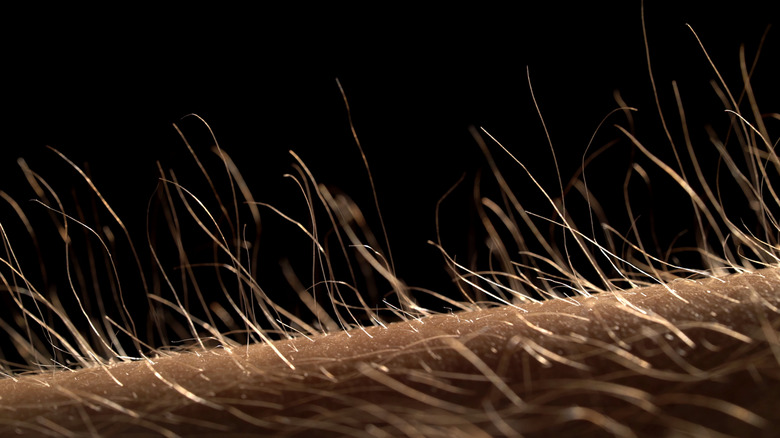
During the activation of the sympathetic nervous system, neurochemical messengers are released, such as cortisol and adrenaline. These have many downstream effects, including increased blood pressure and dilation of blood vessels near the skeletal muscle, to prepare the body for action. In this process, the muscles surrounding individual hair follicles, known as arrector pili, constrict. As a result, the hairs along the body are forced to stand up straight, and we get those chilly little goosebumps.
Now, being spooked isn't the only time that goosebumps and corresponding spine shivers occur. It is also a frequent sign of getting cold. Again, this is a leftover function from evolutionary ancestors. In animals with thick coats of fur, this process would help retain heat by trapping air close to the skin and essentially thickening its insulating layer. Although this specific function is not particularly helpful to humans, the sudden feeling of coldness does induce a sympathetic response, given the plunging temperature's threat to survival, in which adrenaline is released. Therefore, some overlap exists in the physiological responses to fear and cold weather.
Pleasant chills: Why does your favorite song also give you goosebumps?

Sometimes chills show up when you are neither cold nor afraid. For instance, have you ever had goosebumps when looking at your favorite painting or listening to a beautiful piece of music? This sensation might feel very distinct from those mentioned above, as it is usually quite pleasant and a response to something beautiful. These aesthetic chills are associated with the release of dopamine, a neurotransmitter involved in reward.
Although the exact mechanism of how dopamine release is connected to chills is unknown, there are some compelling hypotheses. Primarily, dopamine can interact with some of the same receptors that adrenaline does. Therefore, at high concentrations, dopamine could activate certain adrenaline receptors, potentially leading to a similar sympathetic response as mentioned above. Interestingly, the people who have this response to music have been shown to have higher neurological connectivity, particularly between a part of the brain associated with feelings and the part of the brain that processes auditory information.
It is fascinating, the degree to which art can have a profound physiological effect. Music and scary movies can both induce chills, whether by releasing dopamine and signaling pleasure or by triggering adrenaline release and generating a sense of fear. Next time that you are listening to a scary story or stunned by the beauty of a film, think about how your physiology is reflecting those feelings back to you.