

7 Strangest Deep-Sea Discoveries
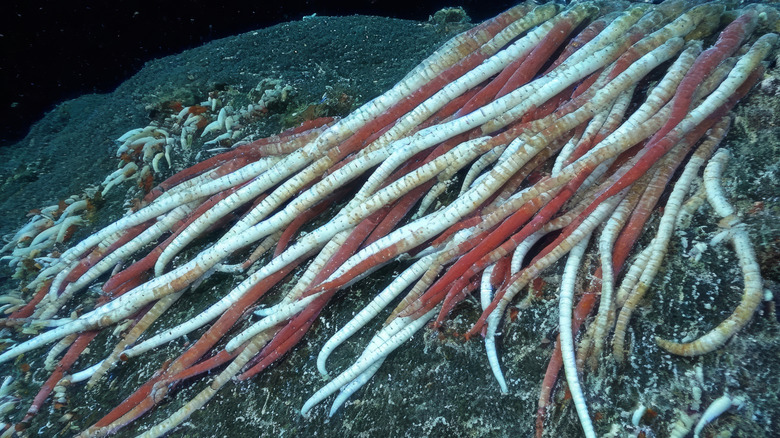
The invention of new technology in recent decades, such as remote controlled cameras and advanced sampling techniques, allows marine biologists to study animals and provides them the opportunity to explore further than ever before. In hostile environments that are at immense depths and extremes of temperature or pressure, robotic machines allow research to be done without the danger it would previously have posed.
Between 2017 and 2025, the percentage of the ocean floor that had been mapped rose sharply from 6% to 26%, and these efforts have already led to some strange and wonderful discoveries. From carnivorous sea angels to transparent glass octopuses, there are many weird and intriguing organisms surviving far deeper than most of us could imagine. With newly discovered underwater mountains and hydrothermal vents providing shelter and even nutrition for the creatures that live near them, our understanding of the deep ocean is increasing enormously with every new marine expedition. Let's take a look into the depths of the ocean at seven of the strangest deep sea discoveries.
Giant 'mountain' more than 5000 feet tall
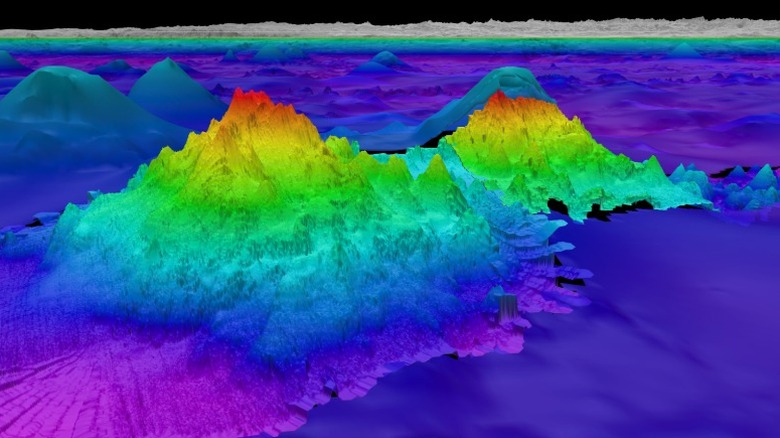
You would think that a "mountain" measuring more than 5,000 feet in height would be pretty hard to miss, but in 2023, scientists discovered a seamount of that size that had previously gone unnoticed. The following year, a further four were discovered on a trip from Costa Rica to Chile, with the tallest reaching an incredible 8,796 feet in height.
It is thought that there are more than 100,000 seamounts over 3,000 feet in size that have yet to be explored, and they are a crucial part of the ecosystem for creatures who live in the ocean's depths. Like most marine mountains, the enormous seamounts discovered by the Falkor (too) are likely to be extinct underwater volcanoes. They can have a big effect on the underwater environment, creating and altering waves and currents, and improving the food supply for the many varieties of fish and other organisms who live there.
The tallest of the recently discovered seamounts is three times the height of the Burj Khalifa, which at 2,716 feet is the world's tallest building. The fact that natural structures of this magnitude could have been hiding in the depths, undetected for so long, is a reminder of just how vast the oceans are, and how much there still must be to uncover.
Whole ecosystems living near (and hiding under) hydrothermal vents
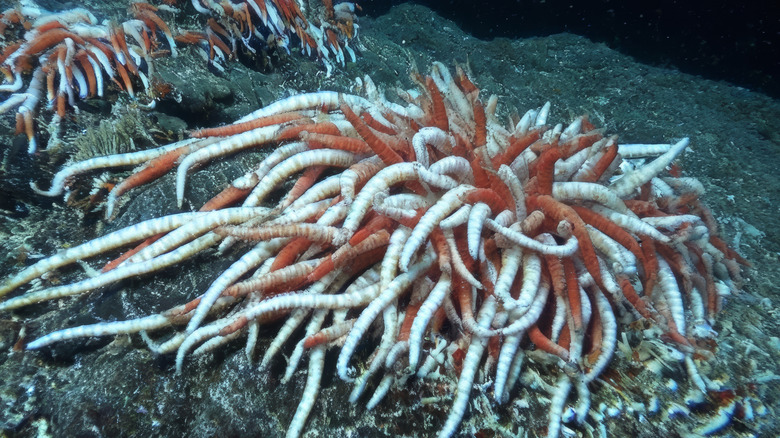
Hydrothermal vents are underwater features caused by volcanic activity deep below the surface of the water. Scientists have studied them since they were first discovered in 1977, and they were surprised to find previously unknown organisms living close by.
The conditions around hydrothermal vents are extreme, with temperatures even reaching (and sometimes exceeding) 700 degrees Fahrenheit, but the water that spews from them is packed with nutrients, which may account for the huge array of marine life. While the existence of these deep sea ecosystems has been known for decades, in 2023, a team of researchers decided to look below the hydrothermal vents, and they were astonished by their findings. In addition to the creatures living above the vents, scraping the ocean floor revealed a host of further organisms living directly under the volcano site. These organisms are thought to get their nutrients from the chemicals found in the deep water, rather than relying on sunlight, which wouldn't penetrate far enough to reach them.
Giant tube worms (Riftia pachyptila) were a particularly strange find beneath hydrothermal vents. These unusual creatures can grow up to 10 feet in length, and fully grown specimens, as well as larvae, were found under the sea bed. These kinds of fascinating creatures living in such a hostile environment give marine researchers a glimpse at the complex systems that exist even beneath the ocean floor.
Sea angels
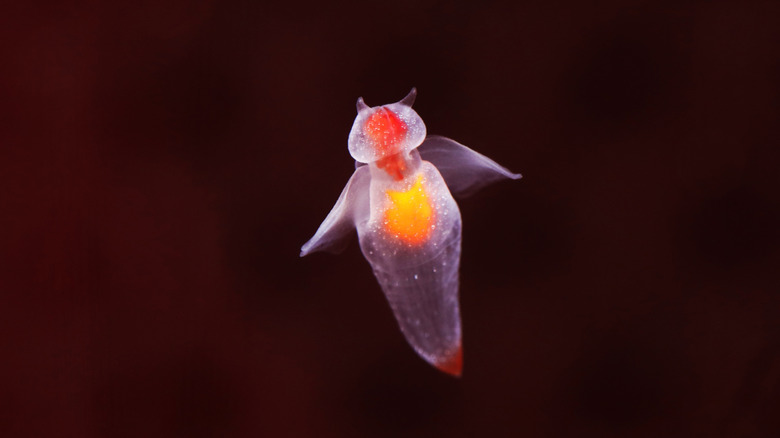
Whatever you picture in your head when you hear of an aquatic creature called a sea angel, you won't be disappointed when you see an image of it. These unique marine organisms are actually a type of sea slug, but that name doesn't do justice to their celestial appearance.
Typically found up to 2,000 feet deep, though reaching depths of almost 6,000 feet on occasion, sea angels are mollusks with transparent bodies that give them an eerie, almost ethereal look. The "foot" that many other gastropods use to move around has evolved into a pair of swimming aids that resemble wings, further cementing their appearance as angels of the deep.
Their biology is also intriguing, though their behavior is not quite an angelic as their name suggests. They have in-built "scooping" tools known as buccal cones, allowing them to capture and eat shelled creatures very efficiently. They even use this technique to eat their evolutionary cousins, known as sea butterflies, in a less-than-angelic display of predation. To keep themselves safe from becoming lunch themselves, sea angels release a substance that keeps other fish at a distance. Some tiny creatures even use this to their own advantage by swimming closely beside them to feel the benefit of the repellent compound.
Glass octopus
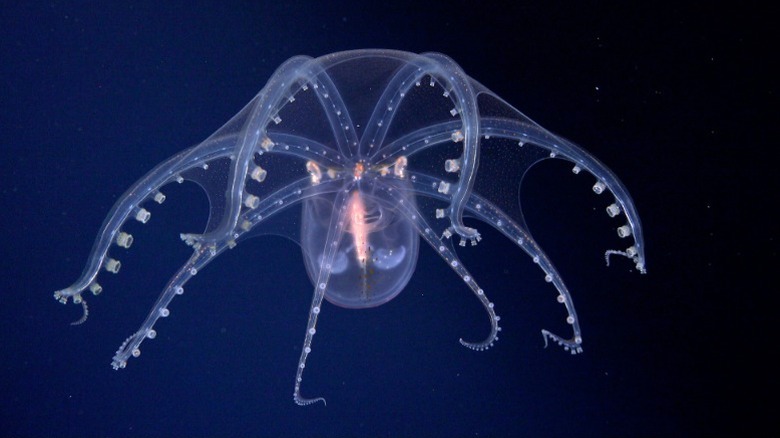
The name of this sea creature alone gives you a glimpse of how strange and mystical it must be, and the deep sea images of it don't disappoint. The glass octopus (Vitreledonella richardi) is a rare cephalopod that lives approximately 3,000 feet deep and is so-named for its see-through body that gives it a beautiful, fantasy-like appearance.
The video taken of the glass octopus gliding through the ocean in 2021 by the Schmidt Ocean Institute was incredibly rare, as most previous samples of the creature had been found after they had been eaten by predators. The video shows the octopus in all its glory, with its eyes and optic nerve visible through its translucent body, as well as its digestive system. As well as making it incredibly unique in appearance, the transparency of the glass octopus gives animals like it some evolutionary advantages, too. "Invisibility" is their super power, and acts as a type of camouflage to prevent predators from detecting them. The glass octupus' expertise in this area is likely one of the reasons it has taken many years to capture one on camera, and how the it has successfully kept itself out of the ocean limelight for so long.
A Golden 'orb' that collapsed on itself as soon as it surfaced
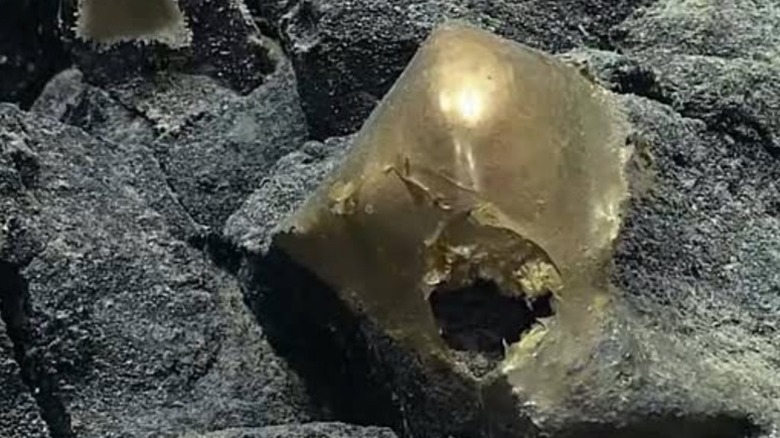
The next discovery on our list has echoes of a sci-fi movie to it, and scientists still don't really know what it is. In a video captured by the National Oceanic and Atmospheric Administration (NOAA) and posted by the Wall Street Journal at the time of this odd discovery in 2023, one scientist can even be heard joking, "I'm pretty sure this is how the first episode of the 'X Files' started."
The discovery in question is a smooth, gold-colored "orb" that was found stuck to a rock approximately 2 miles under the water, near Alaska. On discovery, it contained a substantial hole on the surface, leading the team that found it to assume it is an egg of some kind, but unlike any they had seen before. The large size of the supposed egg, around 4 inches in diameter — and its solitary nature — makes it unique compared to eggs that are usually found in the deep sea.
The object was removed carefully using a robotic arm, and although it seemed to have a solid, albeit delicate structure under water, it collapsed in on itself when taken to the surface. Researchers have still not been able to confirm exactly what the unusual golden object is, but have confirmed that it is a biological entity. Suggestions range from the original assumption of an egg to a sponge or piece of coral, but for now, the strange orb will remain a secret of the vast, mysterious depths of the ocean.
Giant siphonophore
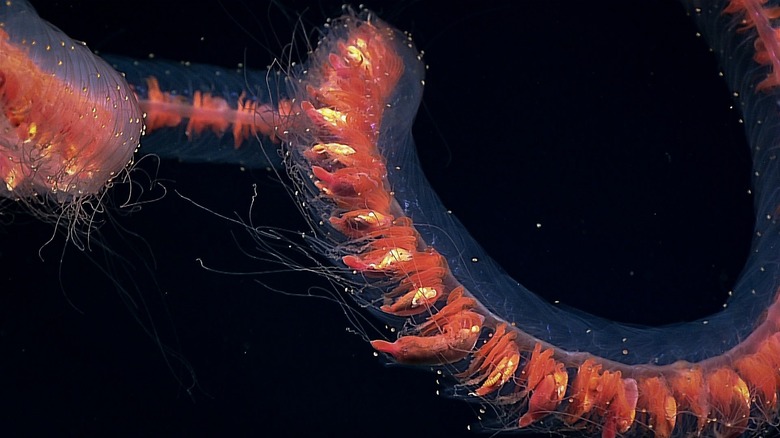
When asked what the longest animal on the planet is, you may confidently give the answer of the blue whale. However, in recent years, a new species has been discovered that threatens to steal the title, though it beats the whale only in length and not size overall. The giant siphonophore can measure up to 150 feet long, almost 40% longer than the largest ever blue whale, which clocked in at a comparably tiny 108 feet.
Although it begins life as a single organism, the giant siphonophore is made of a colony of many individual organisms, which all have different functions. The "buds" clone themselves and create new parts that contribute to different vital tasks, including feeding, movement, and growth. A Portuguese Man O' War is another example of a siphonophore, though it looks at a glance like a jellyfish.
Despite its seemingly innocent rope-like appearance, the giant siphonophore is an efficient predator, and has been seen creating spirals with its long body to trap other sea creatures with its stinging tentacles. Much is still relatively unknown about this strange creature, but given its potential to break world records, the race to discover more of them will be heating up.
Snailfish swimming deeper than we thought possible
Sometimes it is difficult to get our heads around the numbers when we hear about the deep ocean: Just how deep does it go? The average depth of the ocean sits around 12,000 feet deep, but at the bottom of the deepest ocean trench, the Mariana Trench, it reaches a staggering 35,876 feet. For context, this is 23% deeper than the height of Mount Everest.
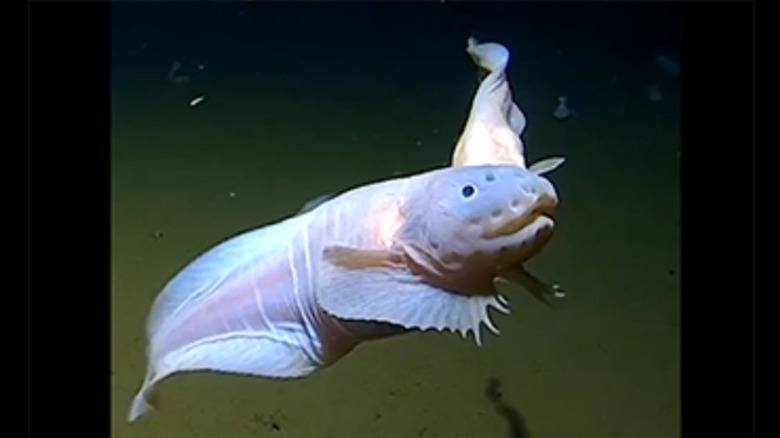
Of course, the pressure at those depths means that animal life could not survive; however, a recent expedition has found fish swimming much deeper than was previously thought possible. In the Izu-Ogasawara Trench off the coast of Japan, snailfish were filmed at more than 27,000 feet deep. This is around the maximum hypothetical limit that scientists have calculated a fish could survive, and is nearly 500 feet deeper than the previous discovery in 2017.
The snailfish, Latin name Pseudoliparis, is known to live in extreme environments, and it has adapted to become one of the animals capable of surviving the incredible depths, referred to as the Hadal Zone. Its bones are softer than other fish living higher up, which allows it to survive the intense pressure found near the very bottom of the ocean. Remarkable discoveries such as this remind us how resilient organisms can be when faced with hostile environments, allowing science to understand a little better the extremities of our known world.