

The One Thing Humans Must Do To Avoid Extinction, According To Stephen Hawking
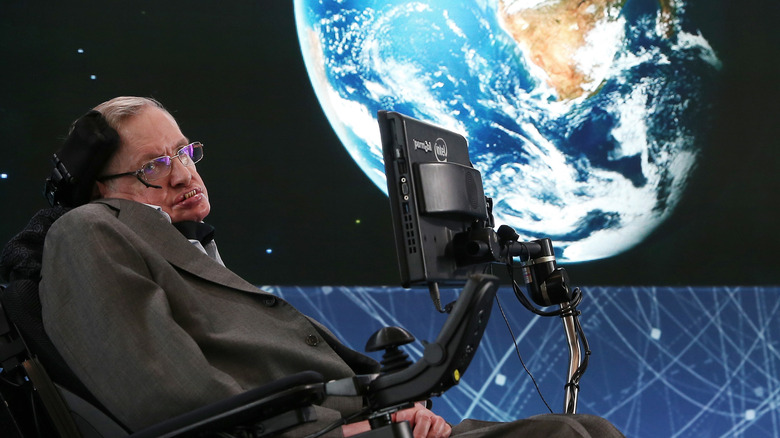
Stephen Hawking was one of the brightest scientific minds in history, but he wasn't the best guy to hang out with if you were looking for levity. The late physicist had a bit of an obsession with the grim subject of human extinction, and over the course of his career, Hawking predicted the end of the world in numerous terrifying ways. As far as avoiding the complete demise of our species, he had one piece of advice, but it's hardly a simple solution. In a 2001 interview with The Telegraph, Hawking put the matter bluntly, stating "I don't think the human race will survive the next thousand years, unless we spread into space." For many, this solution came across as both unrealistic and defeatist, but to Hawking, it was a simple matter of practicality.
Hawking's warning might best be explained through the old adage, "don't put all your eggs in one basket," except in this case, the basket is Earth and the eggs are us. "There are too many accidents that can befall life on a single planet," the physicist told The Telegraph. Some potential fates are already in motion, like the impacts of climate change, which threaten our food and water security and increase the severity of natural disasters. There are also the risks of nuclear weaponry, deadly disease outbreaks, or even a comet colliding with Earth. Hawking also acknowledged that colonizing space would be immensely difficult, but that's all the more reason to start working on it right now.
How Hawking proposed we colonize space

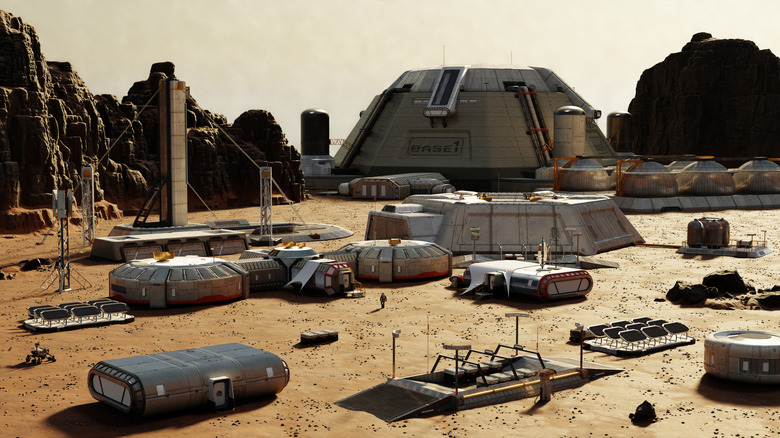
When Hawking spoke of humans spreading into space, he wasn't just talking about colonizing the moon and Mars. To him, those were just a starting point, because staying within our solar system at all still puts us at too much risk. No matter what happens regarding climate change or nuclear warfare, the eventual expansion of the sun will make the inner planets too hot for life to survive. In a lecture for NASA's 50th anniversary, Hawking laid out a timeline for gradual expansion away from Earth, beginning with building bases on the moon and Mars by the end of the century, but then expanding to the moons of outer planets in the century after. These incremental developments would be done with the goal of advancing space technology to the point that we could travel beyond the solar system.
If colonizing Mars sounds like a lofty goal, establishing settlements beyond the solar system is all but impossible. Critics of Hawking's proposal point out that the nearest solar system to our own is Alpha Centauri, which is just over 4 light-years away. With the rockets NASA has developed to date, that journey would take roughly 50,000 years, whereas Hawking didn't think we'd survive even another 1,000 here on Earth. The physicist's proposal for beating this obstacle is straight out of science fiction: warp drive. Based on Einstein's theory of relativity, Hawking proposed that we could warp spacetime to create shortcuts between points in the cosmos.
Hawking thought aliens could pose a challenge to space colonization
While many critics pointed out the technological gaps in Hawking's proposal to colonize space, the physicist himself saw a different obstacle: aliens. Hawking believed that the existence of life on other planets is all but guaranteed based on mathematical probability.
In his NASA lecture, Hawking compared critics of space colonization to Europeans in 1492 who derided Columbus's journey as a wild goose chase. That chase ultimately led to some of the largest and most influential settlements on Earth, including New York, Mexico City, and São Paolo. Hawking wondered if the next generation of such settlements would come in another solar system, but in other interviews, he used the same analogy in a much less hopeful way, one that should give us pause about settling other planets.
Near the end of his life, Hawking spoke more and more of the potential danger that aliens could pose to humans. He warned against trying to contact aliens because any civilizations advanced enough to receive those communications would likely have superior technology to our own, and if they came to Earth, they could do to all of humanity what Europeans did to Native Americans. For Hawking to suggest humans do just that to other planets seems uncharacteristically shortsighted, but when you're trying to save a doomed species, there may be little to do but grasp for straws.