

Dogs Tilt Their Heads For A Reason Most Owners Miss
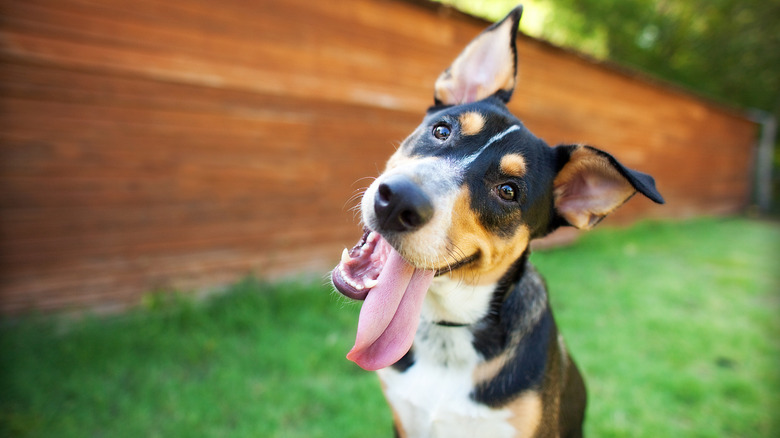
One of the cutest things is when a dog tilts its head. That little wrinkle above its eyes, the asymmetrical perk of the ears, that adorably confused-looking expression: All of it is pure delight. As with most stereotyped behaviors, though, there is a functional purpose for this. Dogs often appear to do this when they hear a particular sound, such as a squeaked toy or an odd noise on the television or someone saying their name through a phone. After all, there is generally a point to this cuteness overload: It appears to help them hear and process significant stimuli.
You have probably heard that dogs have more sensitive ears than humans and know not to make loud, high-pitched noises around an anxious puppy. However, while their hearing is certainly strong, they generally have particularly long outer ears. This is the furry part of the ear that extends out from their head and is called the pinna. It serves as a funnel for sound and helps direct noises to the inner ear.
Due to its shape, the outer ear does increase the effect of directionality. For instance, the pinnae in dogs with pointy ears create a small auditory barrier from behind, while dogs with ears that fold over the front have this barrier in the opposite direction. In some dogs, such as particularly floppy-eared hounds, the pinnae can cover the entire ear canal. This leads to the theory that dogs tilt their heads to optimize their ability to detect sounds.
Right tilt vs. left tilt
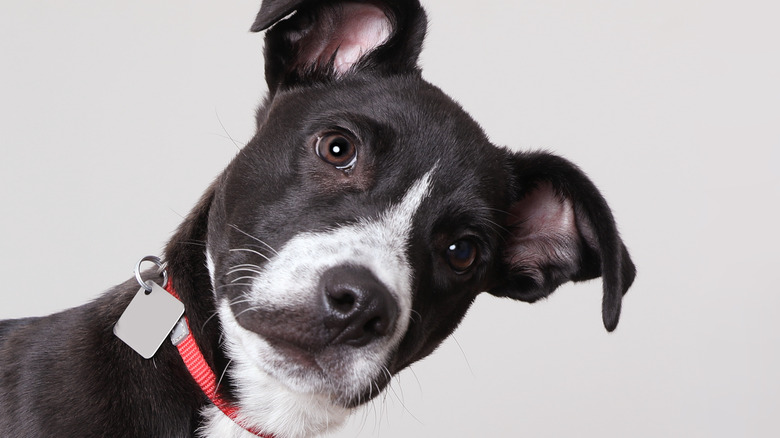
Some studies in the past couple of decades have also introduced the possibility that dogs use this as a way to process certain stimuli in a particular brain hemisphere. Some neurological functions are lateralized, meaning that they are performed on one side of the brain as opposed to the other. For instance, the right hemisphere is more specialized in processing certain tonal information (e.g., whether a sentence was sarcastic or said with excitement). Whereas the left hemisphere is more specialized in linguistic comprehension (e.g., the meaning of words).
A 2014 study published in Current Biology suggested that dogs show similar linguistic lateralization to humans, in which they biased processing things like varied tone in the right hemisphere, while processing neutral language in the left hemisphere. They made these conclusions based on the direction of head tilt. Because input to the brain is processed contralaterally — for instance, touch on your left side is processed in the right side of your brain — a left head tilt would indicate an attempt to process these auditory cues with the right hemisphere.
In this study, when neutral intonation was used for words that these dogs were familiar with, they would tend to tilt their heads to the right. Whereas, positive inflection used with meaningless words would cause the dogs to tilt their heads to the left. So, head tilt might convey more than just an attempt to optimize hearing, but also neurological processing of those sounds.
Other reasons for head tilt
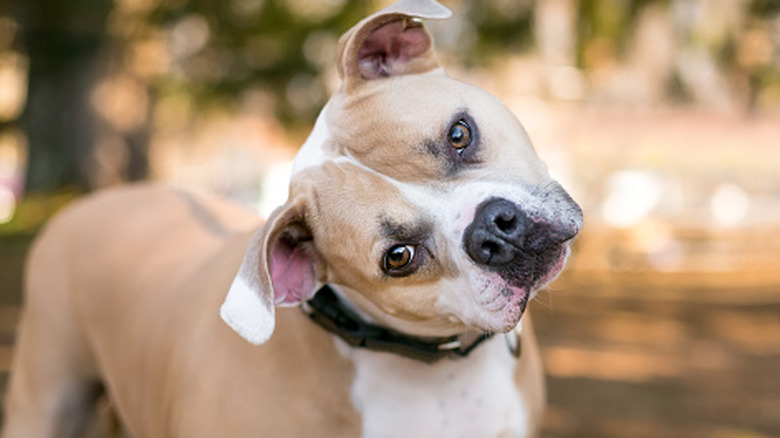
Another study from 2022 suggested that head tilts helped with recall in especially gifted dogs. In canines who had exhibited strong abilities in memorizing words associated with specific objects, the researchers found that they tilted their heads more often in response to these words than dogs who did demonstrate these same skills. The authors concluded that head tilts were indicative of processing the meaning of particular commands, and the behavior was channeled by dogs when attempting to process and recall a word's interpretation.
It might be surprising to discover how much of language dogs seem to understand. While their language-comprehension skills are still more limited than those of most humans, they can generally learn to make word associations. Similarly, they can learn to associate human responses with behaviors. With this principle, you could inadvertently be encouraging certain behaviors, including a head tilt. If you get excited and fawn over your dog when they tilt their head, this could create positive feedback and cause them to perform a head tilt more often.
Animal behavior can be difficult to interpret. In addition to the fact that they cannot communicate their reasoning or feelings, humans have a tendency to anthropomorphize (assign human characteristics to non-humans). Thus, people cannot know exactly the purpose of their dog's idiosyncrasies, but these controlled studies can provide an idea.