

Flushing With The Toilet Lid Open: Science Explains The Controversy
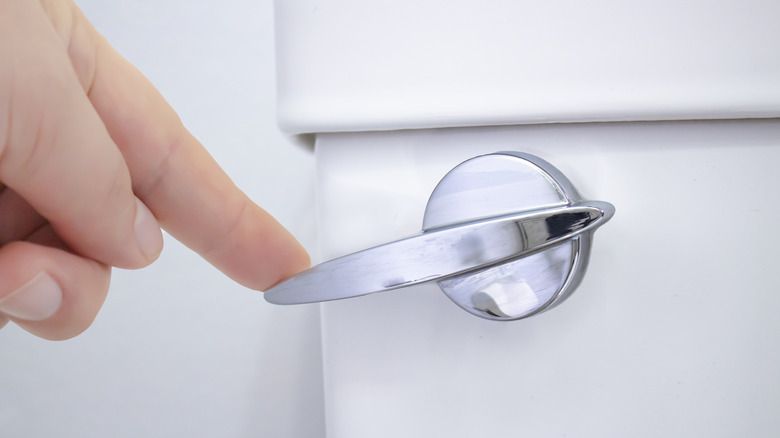
Many of us have heard the horrifying rumor that flushing with the toilet lid up can cause toilet water to land on our toothbrushes. But with all the talk, it's difficult to separate fact from fiction. Perhaps that's the reason researchers from the University of Arizona put the rumor to the scientific test. They designed a study to examine how flushing the toilet with the lid raised contaminates other bathroom surfaces. The results of the study, published in the American Journal of Infection Control, tell an unexpected story.
Previous studies had already demonstrated that bacterial pathogens could spread into the air from a toilet flush, but this 2024 study shows that viral pathogens can propagate into the air, as well. Most alarmingly, it demonstrates that placing down the lid appears to have a negligible effect on the spread of viral pathogens. In fact, the researchers state plainly, "We show toilet lid closure prior to flushing does not mitigate cross-contamination." This is mostly due to toilet seats having plenty of gaps for aerosolized water (and the urine or fecal matter suspended in it) to escape.
To make matters worse, the study also demonstrated that using a toilet brush without disinfectants to clean the bowl doesn't prevent the spread of contaminants, either. When cleaning a toilet, disinfectant is absolutely necessary to kill the bacteria of fecal waste from spreading to other bathroom surfaces. Astronauts are lucky enough to be able to eject their waste into the vacuum of space, but on Earth, the flushing process blasts particles into the air and, very possibly, onto your toothbrush. It's best to keep your toothbrush stored away from your porcelain throne.
It's still a good idea to lower the lid
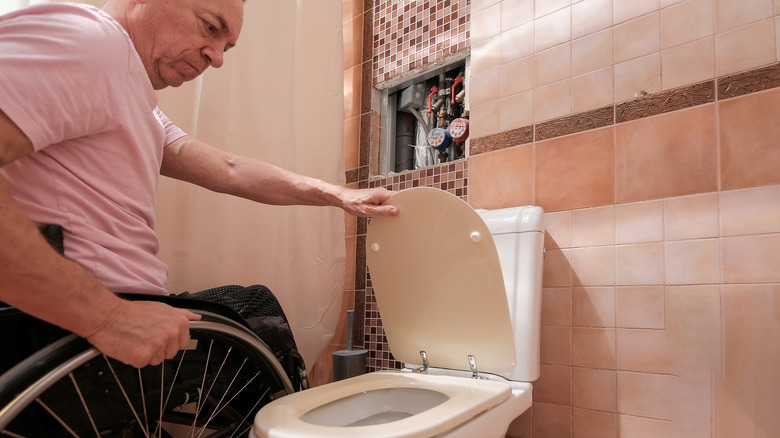
The finding that closing the toilet lid does little to stop the spread of contaminants may be disappointing for those in the fight against germs, but it's possible that doing so still helps to a minor degree. The research demonstrates that closing the lid changes the direction of the "plume" of aerosolized toilet water, even if it doesn't significantly reduce the volume of particles that spread throughout the bathroom. Bacterial and viral pathogens may still find their way into your bathroom air, but closing the lid should keep them from jumping directly skywards.
Certain bacteria have proven themselves to be exceedingly resilient, and viral pathogens are even smaller and harder to track. The microscopic size of viruses allows them to travel via tiny water droplets, meaning viruses can travel from a toilet to a sink (or toothbrush) with ease. That's why closing the lid does little to stop the spread of toilet-water pathogens from jumping into the air after a flush, but it's still a good practice to follow. There are certain organisms that are notoriously difficult to kill, including bacteria, so any measure to prevent their spread is worth it.
Fortunately, the only real risk of contaminated toilet water entering your body comes from direct consumption. In other words, most viral pathogens would have to be inhaled, whereas most bacterial pathogens would have to be ingested. It might seem gross, but even though flushing a toilet sprays toilet water around a bathroom, it's still unlikely that the germs would find their way into your or a family member's system. Just keep your toothbrush and contact lenses stored away from the open air, and you should have little to worry about.