

The Biggest Unanswered Questions About How Life Began On Earth
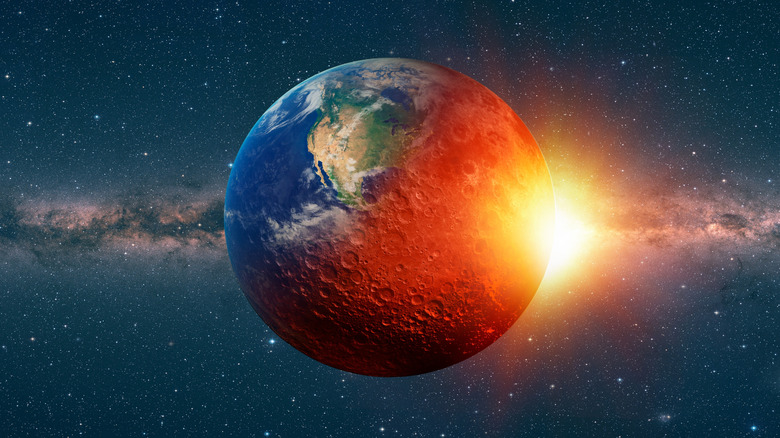
Learning about the past is usually easier than predicting the future, but deciphering the earliest history of life on Earth seems to be an exception to the rule. Of course, we're not entirely in the dark about the origins of life. There are plenty of theories, general ideas, and ballpark figures about how and when life on Earth started — along with multiple competing, compelling ideas on what caused this development. Still, even the time frames of the emergence of life don't always line up. As you're about to find, some theories in this article place the origin of Earth's life hundreds of millions of years before others.
The research on the origins of Earthly life is ongoing. New theories and information turn up every once in a while, challenging previously accepted ideas and disrupting the status quo. In 2022, for instance, scientists made a surprising discovery that life may not have begun in the ocean as previously thought ... but in ponds instead. As ideas challenge each other, new mysteries arise while answers to older ones begin to take form. In this article, we've collected the hottest questions about how life began on Earth.
Why it's so difficult to figure out how life on Earth started

Science's notables have been known to throw their hat in the ring when it comes to the end of the world, or at least all life on it. Sir Isaac Newton had a surprisingly complicated prediction for the end times, and Stephen Hawking predicted many ways that the world would end. The famous minds aren't the only ones at it, either. Researchers have been able to predict the exact year all life on Earth will end, but they still have surprisingly few concrete answers to the burning question of how life began on our third rock from the sun.
This is because the beginnings of Earth's life are surprisingly tricky to pin down. For something to count as life, it needs three interconnected characteristics: It has to be be able to feed, reproduce, and hold together as a living entity.
We've known from the 1950s that life consists of proteins and nucleic acids that, in turn, contain various complicated chemicals. Science has even managed to replicate many parts of the process of their creation. However, it's not just a matter of cold chemistry. Scientists are still figuring out just how to create the conditions for all of life's three properties to occur at the same time in a way that leads to life. Until that happens, any theory about the exact way life could have gotten its start on Earth will quite obviously remain unverified.
Did the Late Heavy Bombardment play a role in creating life on Earth?
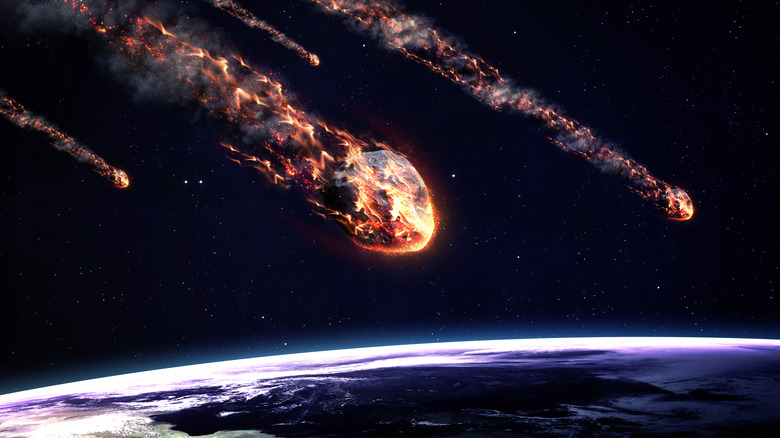
A whole bunch of asteroids striking the Earth in a comparatively short succession might seem like a full-on world-ending scenario. However, there have been theories that indicate that an asteroid bombardment might actually be associated with the creation of life on Earth.
The aforementioned scenario concerns a brutal period called the Late Heavy Bombardment (LHB) some 4 billion years. It bombarded the entire solar system (including Earth) with a series of massive meteorites. This destructive era is thought to have been near the time when first signs of life on our planet started appearing, which naturally makes LHB an interesting component in the whole "life on Earth" conversation.
However, this theory isn't without issues. There is evidence suggesting that Late Heavy Bombardment may never actually have happened, for one. It's possible that LHB is actually nothing more than misinterpreted data from the moon rocks the Apollo missions brought in to Earth for analysis. Even if it did actually happen, there's a chance that LHB wouldn't have been able to wipe out all pre-existing life on Earth, which also calls its role in influencing Earth's early life into question.
How difficult was it for early life to survive?
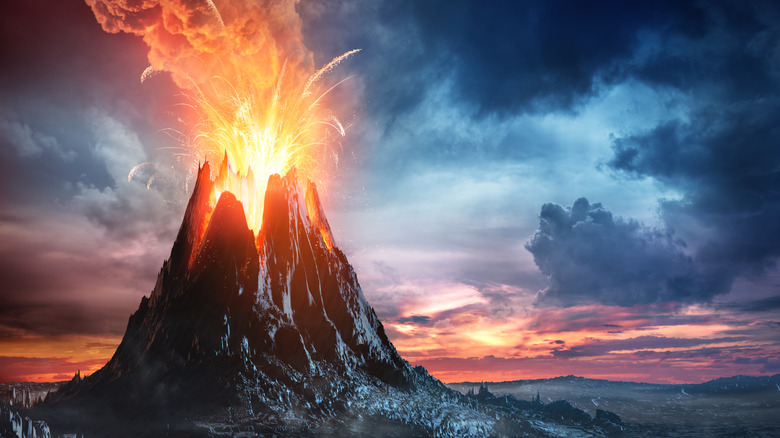
The environment for Earth's early lifeforms was brutal, to the point that we still don't have a clear idea of what it had to endure. We know Earth is around 4.5 billion years old and the oldest fossils we've found date back to 3.7 billion years ago, but Earth could potentially have hosted life as early as 4.3 billion years ago.
However, being technically livable meant radically different things back then than what we might imagine today. Research into the last 2.5 billion years of our planet indicates that Earth was a wildly inhospitable place for far longer than we've thought. Apart from the other things discussed in this article, it appears that the vast majority of Earth's early-game lifeforms have had to deal with one major issue: Massive levels of dangerous ultraviolet radiation, which didn't lower into current levels until around 400 million years ago.
Because Earth may have had significantly more oxygen in its atmosphere than it was believed to, early life could've had to deal with as much as 10 times the amount of UV radiation we do. This radiation does more than increases chances of skin cancer in humans: It weakens proteins, which are major construction blocks of life. This means that early life may have had to endure destructive radiation along with all the other environmental issues, which puts a whole new spin on the concept of "survival of the fittest."
Is the Panspermia theory viable?
Panspermia is one of the more interesting and hotly contested theories about the origin of life on Earth. According to it, life on our planet didn't actually get its start on Earth. Instead, early lifeforms traveled to Earth from elsewhere, aboard space bodies containing microbes that survived the difficult trip. It makes a certain amount of sense, too. The arrival of a meteorite with of extraterrestrial microbes could potentially explain how life was able to take root so quickly on Earth despite the young planet's aggressively difficult conditions.
There is some evidence to support the theory that terrestrial life may not have started on Earth, though it's far from conclusive. On the other hand, the idea of panspermia has its detractors. Criticism against panspermia points out that if life had arrived to Earth from space, we'd still be finding traces of such life in meteorites that crash on Earth or the moon. Despite this, the panspermia theory continues to have its proponents.
Did life start only on Earth or in other places in our solar system, too?
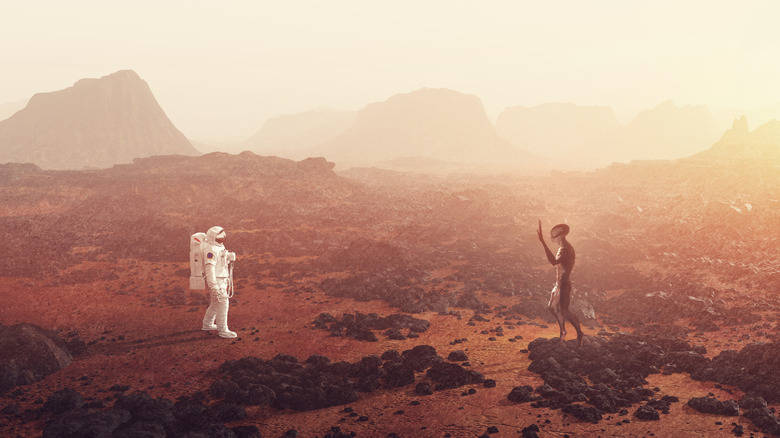
The possibility of the aforementioned panspermia theory being true actually ties the origins of life on Earth to the potential existence for extraterrestrial life in our very own solar system. In fact, the concept is interesting enough that NASA has gotten in on the research action with a project known as Search for Extra-Terrestrial Genomes, or SETG for short. SETG doesn't just explore the concept of life being delivered on our planet from elsewhere, either. The project is also interested in finding out if early life could have left Earth during the early turmoils of our planet and ended up elsewhere.
SETG is looking at the idea that life may have arrived from elsewhere in space, and posits that the space object shrapnel flying around the solar system back in the day may have "exchanged" life between various places in our solar system that have the potential to sustain it. This includes not only Mars, but several interesting moons.
One of Jupiter's moons, Enceladus, is known to have an ocean inside its icy crust, and another one, Europa, likely has one as well. Meanwhile, Saturn's largest moon Titan has an atmosphere and a weather system, and NASA is gearing up for a 2028 mission that will send an exploration rotorcraft called Dragonfly to investigate its potential for life.
Was the moon created when life on Earth started?
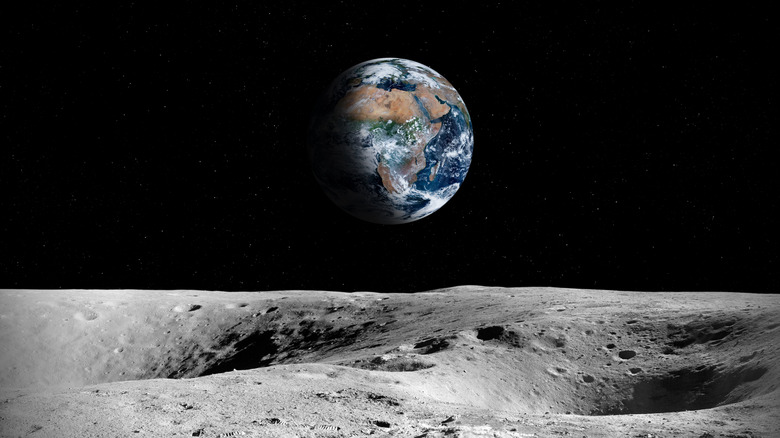
One particularly interesting theory about life beginning on Earth posits that the same event that created the ideal conditions for life on our planet might also have given Earth its nearest neighbor and sole satellite: the moon. Per this theory, a planet called Theia smashed on Earth around 4.4 billion years ago, when Earth was still taking shape. Theia would have been roughly the size of Mars, so the impact would have been absolutely massive. As part of the aftermath, some of the debris that this clash of the planets sent flying around would eventually have become the moon.
However, the moon isn't the only thing Theia may have given us. Should this theory be correct, the brutal clash of planets also provided Earth with much of its carbon, as well as nitrogen and sulfur. Since life isn't possible without any of these elements, the Theia collision would have provided us with both the moon ... and, potentially, the crucial ingredients of our very lives.
Did Earth's life come from Mars?
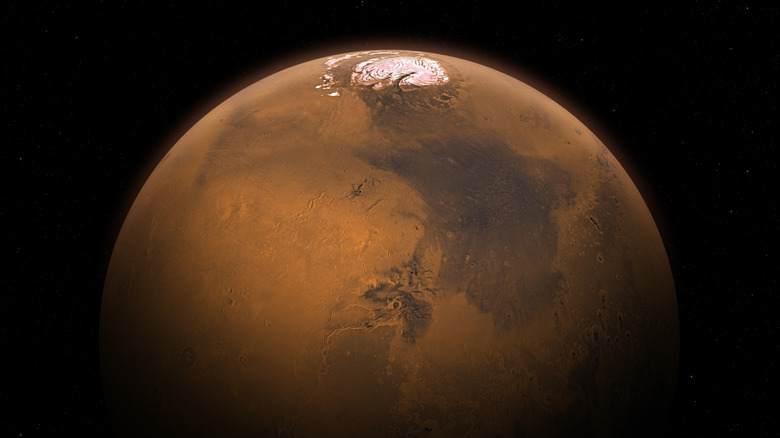
Pop culture has been feeding us stories about Martians for ages. But what if we were the real Martians all along?
We've looked into the panspermia theory, which suggests that life on Earth arrived aboard space objects that crashed into our planet. With NASA trying to discover life on Mars, the red planet is a logical first port of call when it comes to potential origins of a panspermia-style origin for Earth's life. As it turns out, there is some potential evidence supporting the idea that Earth's life may indeed have come from Mars. In 2013, Steven Benner of The Westheimer Institute for Science and Technology in Florida put forth research that back in the day, Mars had some very important building blocks for life that Earth likely lacked — molybdenum and boron. "This form of molybdenum couldn't have been available on Earth at the time life first began, because 3 billion years ago, the surface of the Earth had very little oxygen, but Mars did," Benner said (via Space).
The research also pointed out that both boron and RNA molecules fare far better on dry land than in water, and since Mars already had dry areas when Earth was still covered by water, Mars would be a more logical starting point for life. However, Benner's study is still very much a theory, so while compelling, the question of whether life on Earth could actually have come from Mars remains unproven.
Was life created by intense lightning storms?
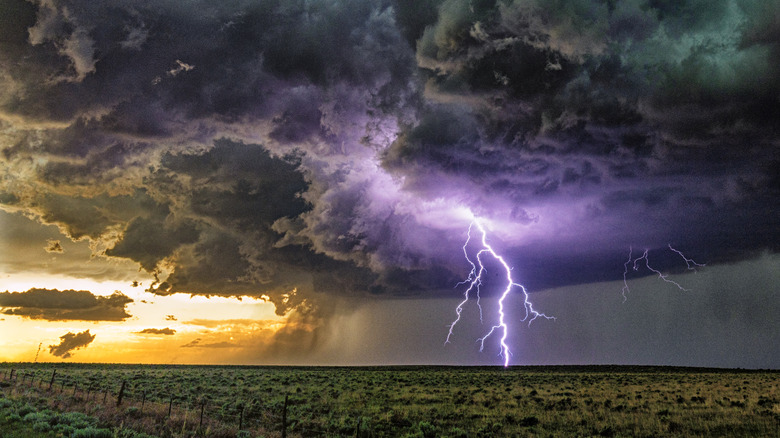
The search for the origin of life ultimately boils down to the question of what sort of event can create life. Science has been looking at one potential spark that's quite literal: early Earth's wild lightning that, along with UV radiation, could have propelled early life to come together in just the right way.
We've known since the 1950s that electricity can help amino acids — which are essential components of life — form in simulated conditions of Earth's early atmosphere. The real question is where all that lightning could have come from, since the icy conditions of early Earth weren't really conductive to big lightning storms.
One possibility is that the lightning was related to young Earth's prolific volcanic activity. Volcanic ash clouds can be absolute lightning hotspots — and indeed, scientists have already found that that volcanic lightning can convert volcanic gases into amino acids. This interesting discovery suggests a possibility that the beginning of life on Earth was not only an important development, but also an extremely cool one.
Was all life created from RNA?
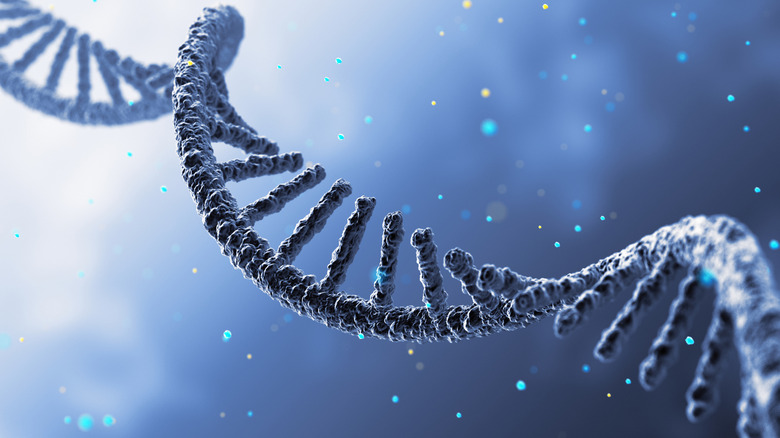
The RNA World Hypothesis is something of a hot topic in the scientific community, and ot has prompted catty headlines from its detractors. Ultimately, it's all about how DNA and RNA differ, applied to the eternally contentious "origin of life" conversation.
The genetic material compounds DNA (deoxyribonucleic acid) and RNA (ribonucleic acid) are both important and omnipresent aspects of life, but a cell's DNA actually stores information while RNA is more about applying that information. According to the RNA World Hypothesis, earliest life forms didn't need DNA at all. Instead, they got by on RNA alone, and ribonucleic acid only later relinquished its position as a genetic material storage to the more stable DNA.
Since DNA is generally accepted to be the be-all and end-all of life's crucial components, the RNA World Hypothesis became a hot potato subject after it was proposed in the 1960s and eventually named by Harvard biologist Wally Gilbert in 1986. The key issue with this theory is that even if RNA could self-replicate like DNA can — and it seems that very short strands of RNA can indeed do so — it might not be sturdy enough to provide a basis for life by itself.
Did all life begin around hydrothermal vents?
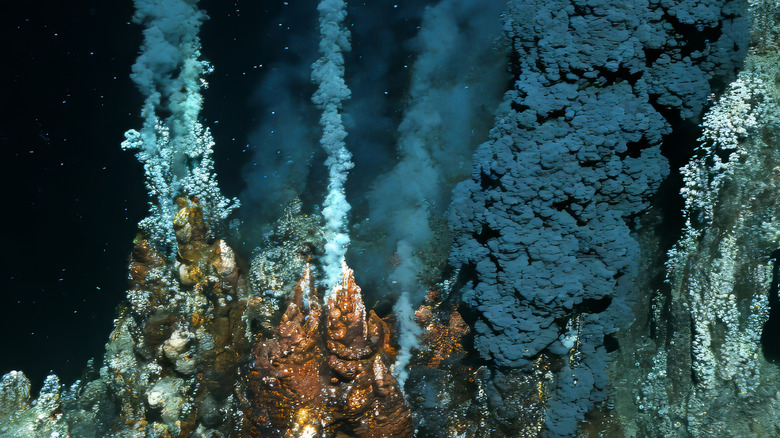
Hydrothermal vents are noted hubs of underwater life. They spew warm water and nutrients from Earth's deeper crust into the cooler water around them, which is attractive to many organisms that can deal with the chemicals and the temperature. As a result, areas near hydrothermal vents can have amazing ecosystems that thrive in the mineral-rich environment.
A key attribute of a life form that can thrive near a hydrothermal vent is a process called chemosynthesis, which enables it to use toxic chemicals like hydrogen sulfide for sustenance. Since hydrothermal vents may have been around for billions of years and young Earth had an abundance of these chemicals that would be dangerous to lifeforms such as humans, some researchers suspect that the very first ecosystems may have centered around hydrothermal vents.
In fact, one of the many, many theories about early life on Earth posits that life could actually have begun in hydrothermal vent-like conditions. According to the Iron-Sulfur World Theory by Günter Wächtershäuser, geothermally heated water, pressure, and various dissolved gases could interact with early Earth's metals to create a very rudimentary and short-lived lifeform.
What's LUCA and how is it important to early life on Earth?
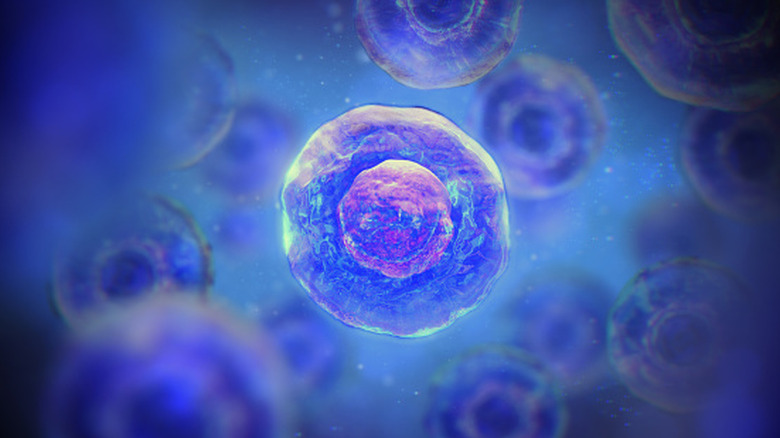
To know just how life started on Earth, we'd also need to know precisely what sort of organism started it all. This progenitor of every single lifeform that has existed after it is known in the scientific circles as LUCA, which stands for "last universal common ancestor."
LUCA, of course, did exist at some point in Earth's distant past, but apart from it being a single-cell organism that resembled a bacterium, details get a touch hazy. Traditionally, LUCA's emergence has been placed somewhere around 3.8 billion years ago. However, some of the more recent research has indicated that LUCA (and a number of other organisms that failed to create a similarly impressive family tree) could have been around as early as 4.2 billion years ago.
Of course, even assuming that everything we currently know about LUCA is completely accurate, it's only a part of the formation of life as we know it. While determining its true nature is a notable step in the study of how Earth's life started, LUCA is not the first known organism by any stretch of imagination — just the idea that happened to stick.
Could humans use the secrets of life on Earth to create life themselves?

It's one thing to wonder just how life on Earth started. However, it tends to be paired with another, closely associated question: If we figure out precisely how it happened, could we make it happen again?
Scientists are already actively looking into ways to recreate the conditions that can create life on Earth. In 2019, a research team from University College London managed to simulate the conditions of deep-sea hydrothermal vents to create rudimentary protocells that aren't quite living, but could potentially lead to the creation of living organisms. Another experiment at the Ludwig Maximilian University of Munich managed to create organic catalyst molecules by simulating the chemical conditions in Earth's early atmosphere after a meteorite impact. Again, not quite life, but something that might potentially facilitate it.
These and other studies have kept researchers busy trying to replicate the ways life may have started on Earth, and potentially kick-starting life of their own while they're at it. If they actually manage to pull it off one day, the story of life on Earth is going to get a new, very interesting chapter.