

The Hair Myth Scientists Want People To Stop Believing
We may receive a commission on purchases made from links.
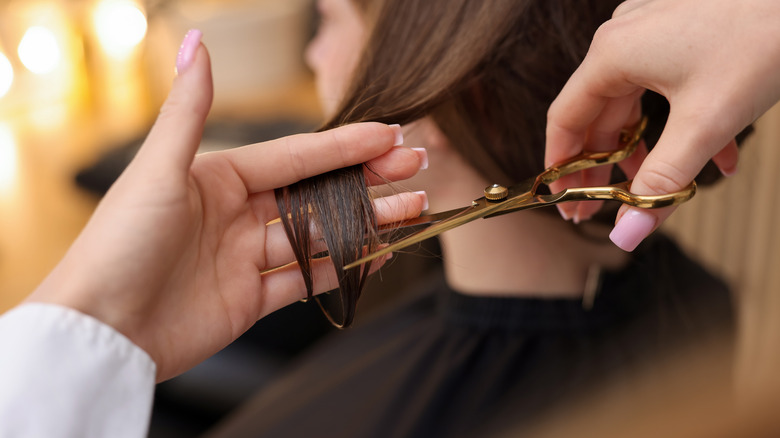
Have you ever gotten a haircut that you instantly regretted? Possibly you opted for the post-breakup bangs or misnegotiated the length of a short trim with your barber. This could inspire you to desperately seek all advice that could quickly regrow hair. It might have even been suggested that you go back to the barber more frequently because you heard that trimming helps hair to grow faster. Unfortunately, this is a myth. However, this does not mean that you should neglect trims on your journey to long, flowing locks. There is a reason this myth exists; it's just not what you think.
Hair, however tragically, does not grow from the ends. It grows from the roots. Each hair follicle is embedded in your skin and hair is formed by keratinizing new cells within the hair bulb. This causes these cells to harden and die, but as new cells continue to form, these keratinized cells are pushed out, and that is what we see as hair. Therefore, because your ends are composed of dead cells, you cannot possibly create growth there.
So, why would people think that regular trims increase hair growth? Well, the ends of your hair can become especially fragile since they are the oldest part, and styling and exposure wear away at the protective outer layer of the hair, known as the cuticle. This is when split ends pop up, forming knots and frayed edges. Left unattended, these can lead to hair breakage and undo some hard-earned length.
The phases of hair growth
Though some marketed hair products might try to suggest otherwise, split ends cannot be repaired. However, further damage can be avoided by cutting off these ends, thereby preventing breakage or pulling out hair when combing through those pesky tangles. Therefore, while trims cannot accelerate hair growth, perhaps counterintuitively, they can help reduce loss of any gained length.
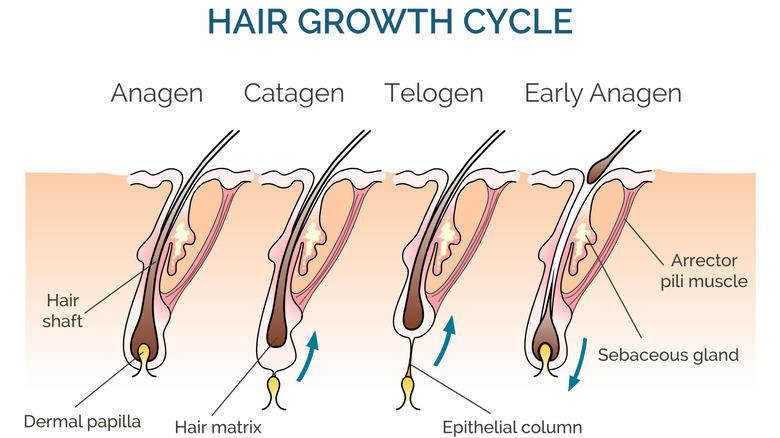
Hair growth has three important phases. The first is known as the anagen phase, in which the hair fiber is formed, and active growth takes place. This can last up to several years. Next is the catagen phase that serves to transition the hair into a resting period. Here, the hair follicle regresses and detaches from the dermal papilla, a group of unspecialized stem cells that signal cell formation that promotes hair growth. During this phase, which lasts only a few weeks, the hair shaft loses some of its thickness.
Finally, there is the telogen phase (also known as the resting phase), wherein the hair is no longer growing. New hair forming at the follicle will then push this hair out, causing it to shed, which is sometimes referenced as a fourth stage called the exogen phase. At any given time, most of your hair is in the anagen phase, while 10–15% is in the telogen phase.
Promoting hair growth
Hair grows faster in people with longer anagen phases. While this is mostly genetically predetermined, there are some clinically supported ways to promote hair growth. First, there is minoxidil (commonly known as Rogaine), an over-the-counter topical treatment for the scalp. The exact biological mechanism through which minoxidil works is unknown, but it appears to shorten the telogen phase, which can induce hair follicles that are dormant into an early anagen phase, stimulating growth.
Another method that has shown some promise is red light therapy. Research has indicated that longer wavelengths of light can induce stem cell growth. Red light therapy can also promote dilation of blood vessels, which could improve the delivery of necessary nutrients to the hair follicles. This is similar to a suggested mechanism for minoxidil, as it also causes vasodilation. Prescription medications exist as well, but these are typically treatments for health-related hair loss and probably won't be prescribed to treat breakup bangs.
Overall, while regular trimmings don't lead directly to hair growth, they do help maintain healthy hair and prevent breakage. The frequency of needed haircuts does depend on your hair type, so pay attention to when your hair starts to fray or consistently knot. This is a sign to head back to the salon or learn to trim your hair at home.