

One Big Reason Why Plane Turbulence Is Getting Worse
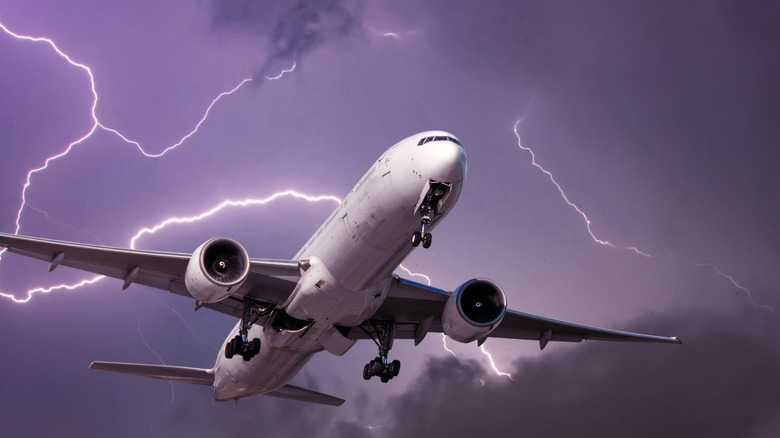
Experts are warning that plane turbulence could get worse by the year, but for those who are long-time fliers, the trend may seem obvious. Just as many people in the United States recall snowier winters in the past, many frequent fliers also claim there was once less turbulence during flights. While anecdotes of more snow "back in the day" aren't strongly supported by the data, the upward trend in turbulence is. As you might have guessed, anthropogenic climate change is the biggest culprit for the increasingly bumpy ride.
In 2024, researchers from the University of Toulouse analyzed historical atmospheric models and discovered that the climate conditions that cause severe plane turbulence have been increasing over the past decades, and those conditions are projected to get worse. Some areas of the Earth's skies were shown to be more sensitive to the changes, particularly in East Asia. Still, the scope of the study was in the northern hemisphere, where several other "hot spots" of increased turbulence were found, including North America.
Since satellite data collection started 40 years ago, severe turbulence in the North Atlantic has increased by around 55%. There are still many unknowns — different models often give different predictions — nonetheless, climate scientists are virtually unanimous that climate change will likely cause an increase in severe turbulence across the world, and that's not even their most daunting predictions for the ever-warming future. For instance, in a BBC interview with atmospheric scientist Paul Williams from the University of Reading, Williams stated that severe turbulence events will double or even triple in the coming decades. That puts passengers and crewmembers in danger, though there are some who hope engineering airplanes to be more "turbulence-proof" may save air travel.
Pockets of turbulent air rarely kill, but they can cause serious injuries
Severe turbulence is no joke. Rough estimates place the number of turbulence-related deaths since the 1980s in the single-digits, yet hundreds of documented turbulence-related injuries have put people in the hospital for broken bones, heart attacks, sprains, spinal injuries, and more. Crewmembers are the most susceptible to such injuries, since they're usually the last people onboard to buckle up after assisting passengers.
The technical definition of severe turbulence is any up-and-down movement of a plane that applies a force greater than 1.5 g's to the occupants of the plane. This occurs when a plane passes through a pocket of variable-density air. These pockets are usually detectable, as they're easily identified within storm clouds. You might think flying around storm clouds is the obvious solution, but it's not so simple. As global warming increases extreme weather events, it's also expected to increase the strength and frequency of storm clouds. That could mean greater risk-taking, as pilots brave the storms. Or, it could also mean greater fuel costs and air "traffic jams," as pilots circumnavigate stormy skies.
But there's another type of turbulence that's harder to detect. "Clear-air turbulence" occurs when a plane hits pockets of variable air density around the clear skies of the jet stream, like invisible eddies in a stream of air. As global warming heats up the seas and skies near the equator, the temperature differences in the jet stream's lower and higher latitudes become more extreme. Such differences amplify the strength of the jet stream, and, in turn, increase the strength and frequency of its "eddies."
Engineering won't solve all the problems of global warming
Turbulence is extremely unlikely to take down an aircraft. A 747's wings can bend upwards of 25 degrees without breaking, and even severe turbulence is highly unlikely to push a wing to its breaking point. Turbulence virtually never takes down a large commercial passenger jet, and the numbers of turbulence-related crashes have dropped drastically since the 1960s. Instead, the majority of turbulence-related injuries are due to the bumping and jumping felt by passengers inside the plane.
In small planes, however, the risk of a turbulence-caused crash isn't zero. Some engineers have looked to the animal kingdom for solutions. One 2020 study from the University of Southampton discovered how barn owls maintain stability in turbulent winds by absorbing the wind forces in their wings. The researchers suggest that this mechanism could be implemented in small aircraft by adding suspension systems to the wing joints. Other engineering solutions include using high-tech sensors and AI to adjust wing flaps in real time to counteract turbulent winds.
For large aircraft, there's little need for further engineering. Meteorologists and pilots use computer weather modeling, satellite data, and reports from other aircraft to avoid turbulent air. This might not be reassuring for those of us constantly misled by weather forecasts, so it's hard to put faith in a science that feels like simple guesswork. But the stats don't lie: It's estimated clear-air turbulence can be accurately forecast around 75% of the time, which is a lot better than the guesswork of the past. Perhaps curbing global warming at the source is the only solution left, and that includes reducing the massive carbon footprint of air travel.