

Why The World's First Transatlantic Internet Cable Is Being Pulled From The Ocean
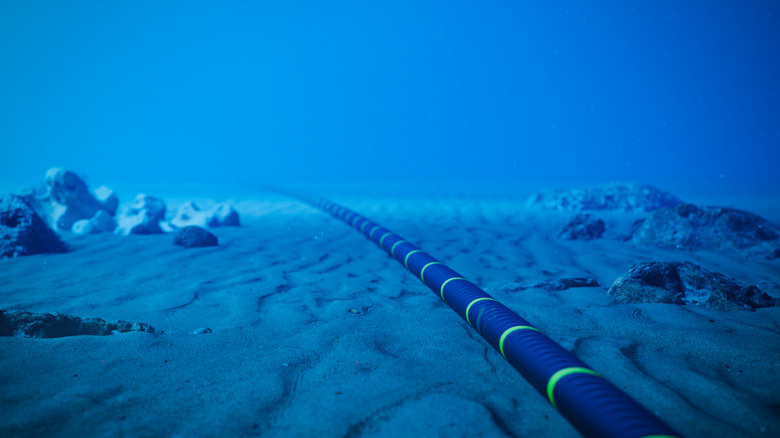
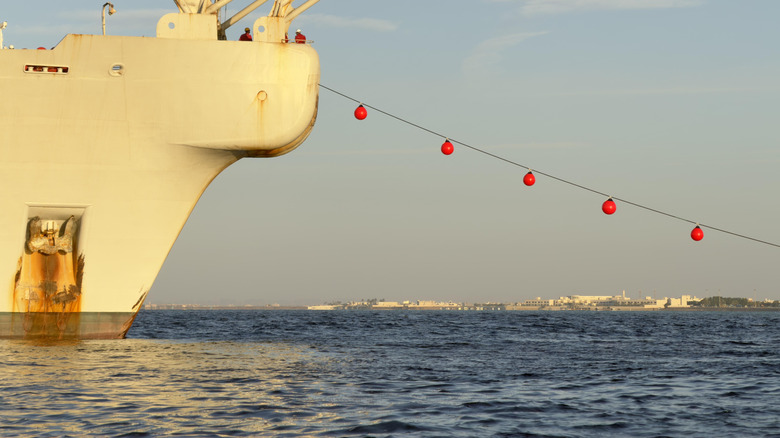
Off the coast of Portugal, an internet cable has rested for nearly 30 years. In 1988, when it was initially installed, the TAT-8 was the very first undersea fiber optic cable. While thoroughly influential, the cable experienced damage that would become far too expensive to repair, leading it to become inoperative back in 2002. This process of eventual disuse has occurred for many undersea cables, yet most have remained on the ocean floor. In fact, around 2 million kilometers (~1.2 million miles) of these cables are no longer in operation and have still not been removed. The Subsea Environmental Services has been tasked with removing and recycling TAT-8, providing space for new, functional cables to be laid.
While often referred to as an internet cable, the TAT-8 was actually implemented for the use of telephone communication, with TAT standing for Trans-Atlantic Telephone. The groundbreaking technology, however, has expanded in use and become the backbone of high internet speeds and global communications. Installation of the TAT-8 was funded by AT&T, France Telecom, and British Telecom to improve communication between the United States and Europe. This was such an enormous feat that the renowned sci-fi novelist, Isaac Asimov, spoke over a video link that was broadcast in London, New York City, and Paris to announce its operational status. He referred to the event as "this maiden voyage across the sea on a beam of light."
Fiber optic technology and a new era of communication
As Asimov so beautifully alluded to, fiber optic technology converts electrical information into light. Digital data from audio and visual cues are converted into light signals, which are modulated by intensity or the light turning on and off at certain frequencies. Say you are communicating with your friend on FaceTime. On one end, your image and voice are converted into binary digital code and then translated into light signals. These signals travel at the speed of light through the optic fiber network and reach your friend's phone. Then, those light signals are rapidly converted back to digital data, which are revealed as your voice and image.
Fiber optic technology was pioneered by scientists Charles K. Kao and George Hockham in the 1960s. They discovered that, by using highly purified glass, light could be successfully transmitted across extraordinary distances, allowing information to be carried farther than researchers had previously imagined. Though this technology would not become instrumental in rapid internet communication until decades later.
The precursor to the modern-day internet was a system called ARPANET, which was created by the Department of Defense's Advanced Research Projects Agency to enable communication between research facilities and Federal agencies. This project utilized copper lines that were already in use for telephone communication. Of course, there are many disadvantages of copper wiring, including its susceptibility to corrosion and electrical interference, resulting in a poorer signal. Fiber optic technology allowed for longer transmissions, less interference, and higher data capacity.
The challenges of undersea fiber optic cables
Over 3.5 million kilometers (~2.8 million miles) of subsea cabling has been laid since the 1850s. Of this, nearly two-thirds are no longer in service. Fortunately, there does not appear to be a significant impact from these abandoned cables on marine life, so leaving them as they lie is not likely to pose a great threat to the environment. However, the materials within these cables are incredibly valuable and exceptionally difficult to recover.
Between 150 and 200 damaging incidents occur to subsea cables each year. Most of these (roughly 80%) are due to human error, such as fishing and anchoring. About 10–20% of damage occurs through natural hazards, such as currents or earthquakes. To settle a common myth and defend an often-maligned fish, sharks are not to blame, and the popular idea that they are using these cables as chew toys is likely an urban legend. In recent years, however, a growing concern has been the deliberate destruction of cables by national governments during conflict.
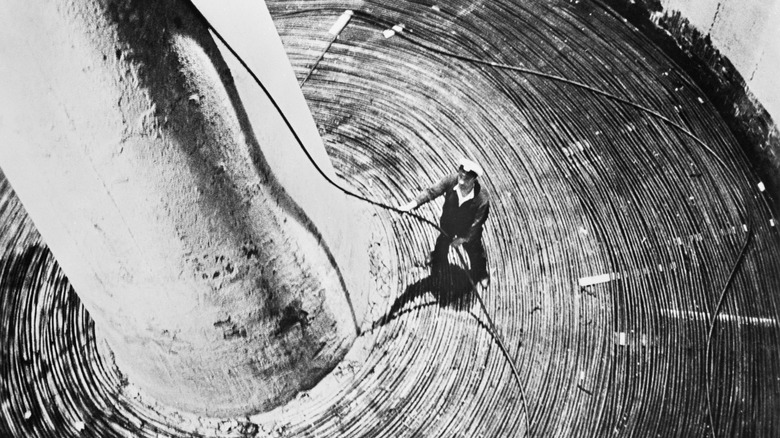
As mentioned above, removing decommissioned subsea cables is a very tedious task. Due to the fragility of several elements within fiber optic cables, including glass fibers, they cannot be coiled by machine. That means these cables have to be lifted while someone coils them by hand. This is done in eight-hour shifts, segmented into 30 minutes of coiling followed by 30-minute breaks to prevent dizziness. Moreover, an early hurricane season has already delayed TAT-8 recovery, and its removal from the ocean is ongoing.