

The Scientific Reasons Coke Tastes Better At McDonald's
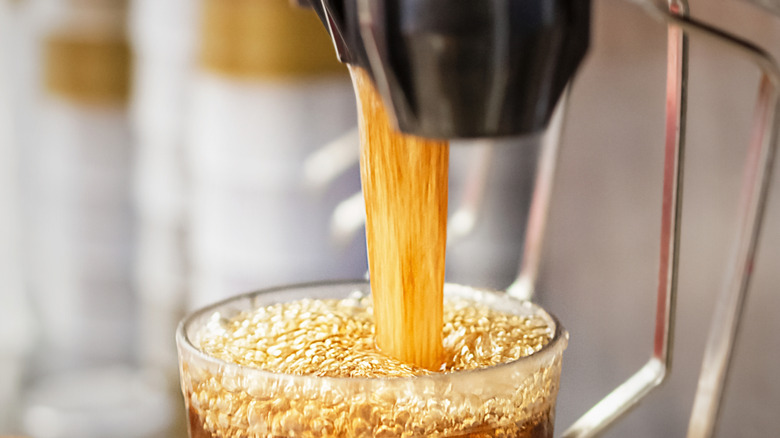
Whether its paired with hot, salty fries or quenching a summer thirst, Coke from McDonald's just seems to taste better. McDonald's says its Coke tastes better because it follows strict guidelines on mixing soda syrup and filtered water and carefully control its soda dispenser temperature. McDonald's even says that its straws, which are wider than typical straws, play a role. While the jury is out on straw diameter, there are clear scientific reasons at work behind these guidelines that help make McDonald's Coke so refreshing.
The water McDonald's restaurants use to make its fountain drinks, or more specifically what substances are dissolved in the water, is crucial. Each restaurant relies on sophisticated filters to remove compounds that could affect the water's smell and taste. This gives a blank canvas for making the perfect soft drink. The second scientific reason is the temperature that soda dispensers are kept at. Temperature can strongly affect how thirst-quenching a drink feels and how sweet it seems. Similarly, temperature directly influences how fizzy a soda is.
What's in the water affects its taste
Nearly 90% of a McDonald's Coke is water, so the quality of the water used to make a fountain drink can make or break its taste. Tap water in the U.S. must meet standards set by the U.S. Environmental Protection Agency to ensure it is safe to drink, even if it may not smell or taste good. The taste of drinking water varies around the country thanks to chemicals used to disinfect it and the dissolved minerals in the water.
Cities use chemicals like chlorine to kill germs in water and make it safe to drink, however, chlorine has a distinctive smell and taste that could be detected in fountain drinks. Dissolved minerals also affect water quality. Water with large amounts of dissolved minerals is known as hard water, while water with little to no mineral content is called soft water. Dissolved minerals can influence taste in large enough concentrations, as can metals leaching from pipes or storage tanks. Sodium, sulfate, chloride, and potassium can make water taste salty while copper, iron, and zinc yield a metallic or bitter taste.
To ensure the quality of its drinks, McDonald's filters water to remove chlorine, dissolved minerals and metals, and other substances that can affect water taste. Other restaurants also filter the water they use, but McDonald's is so particular about water that the fast-food giant created its own water quality standards. Depending on local water quality, restaurants may use filters that rely on reverse osmosis or hollow fiber filtration and even use pre-filter devices to eliminate sediments.
The reasons Coke tastes better cold
With pure water in hand, McDonald's restaurants can then mix it with concentrated syrup and CO2 to make its final product. The ratios of water, CO2, and syrup affect how drinks taste. A typical ratio of water to syrup is five parts water to one part syrup. McDonald's even optimizes its mixture to account for dilution from melting ice. The restaurant chain also targets precise levels of carbonation for its soft drinks. However, temperature is vital for getting the right taste and fizz in fountain drinks.
A cold drink stimulates temperature-sensing nerves in the mouth and throat, affecting how a drink tastes. Cold also increases saliva flow, changing sensitivity to taste. At the same time, cold suppresses our sense of sweetness. A warmer Coke would thus taste sweeter than a cold one. A soft drink's carbonation is also affected by temperature. A soft drink at room temperature can hold far less carbon dioxide than a cold drink. A warmer drink would thus be less carbonated. To ensure it hit the targeted temperature, McDonald's pre-chills water and syrup before it gets to the soda fountain. Getting the right mix of pure water, syrup, and carbon dioxide at just the right temperature is what gives McDonald's Coke its taste.