

The World's Only Shoreless Sea Is Full Of Aquatic Life
We may receive a commission on purchases made from links.
The Sargasso Sea is a beautiful and unique expanse of water that creates a safe habitat for hatchling turtles and teems with other thriving aquatic life. It is the only sea that lacks a shore, because its boundaries are not defined by land. Four surrounding currents form the perimeter: the Gulf Stream to the west, the Canary Current to the east, the North Atlantic Current to the north, and the North Atlantic Equatorial Current to the south. Held by these strong currents, the Sargasso Sea is a refuge of calm waters and quiet winds – a place of romanticized peace for the weary sailor.
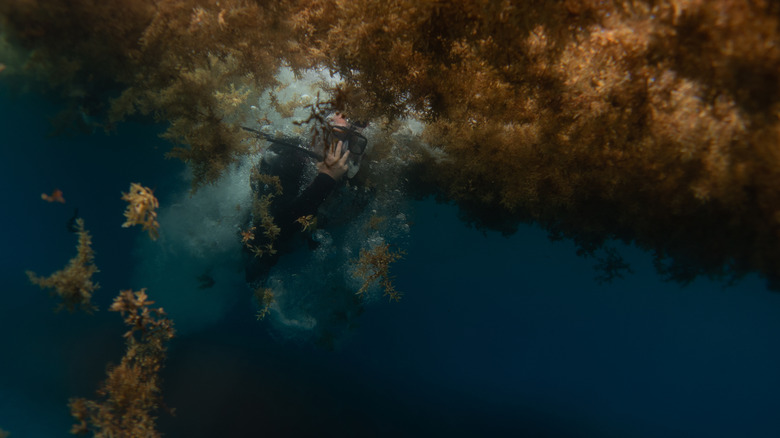
This fabled sea derives its name from the rich seaweed that characterizes its surface, called Sargassum. In his classic novel "20,000 Leagues Under the Sea," Jules Verne describes journeying through the Sargasso Sea as "...a perfect meadow, a close carpet of seaweed, fucus, and tropical berries, so thick and so compact that the stem of a vessel could hardly tear its way through it." Those "tropical berries" are actually little pockets filled with gas, which allow Sargassum to float.
Its unique structure provides an abundant floating ecosystem, lending food and protection for many aquatic species. Sargassum was designated as an essential fish habitat in the ocean. This means that many marine species would perish without this habitat. Unfortunately, climate change has diminished the availability of this aquatic utopia, and human waste swept into the Sargasso Sea can result in injury and even death of marine life.
The Sargasso nursery
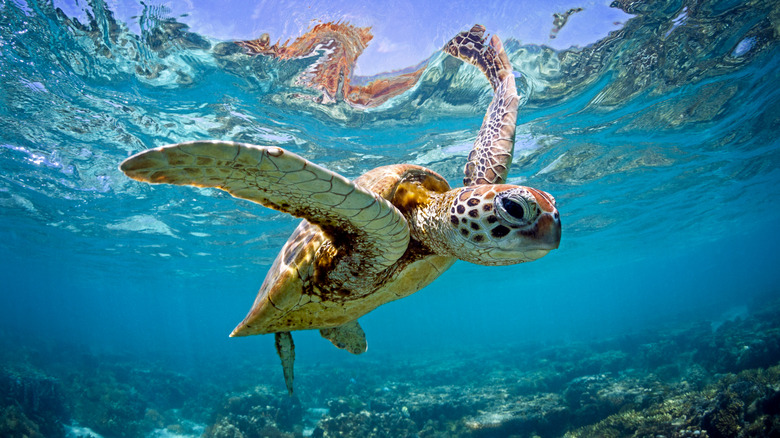
Of the many animals that rely on the current ecosystem of the Sargasso Sea are, perhaps most notably, green sea turtles. After hatching on the Floridian shores, green sea turtles take off to the ocean, where they spend a few years maturing before finding their way back to the coast as adolescents. This developmental period was previously referred to as the "lost years," as scientists weren't sure where the hatchlings would spend their formative years. But as reported in a 2021 study, researchers solved the mystery.
After making it beyond the shore, green sea turtles head to the Sargasso Sea, initially riding the current of the Gulf Stream. The mats formed by Sargassum make an ideal space to spend some time for these vulnerable little guys. The thick, floating algae provides an ecologically important advantage: protection from potential predators, holding the sea turtles aloft in what must feel like a lush forest. What's more, the space serves as a sort of turtle Candyland, where their edible surroundings supply them with plenty of readily available food.
Moreover, the dark golden-brown nature of the Sargassum facilitates greater absorption of sunlight. So, in addition to protection and food, the algae also act as a nice, warm blanket, producing an optimal temperature for the growing turtles. The discovery of this migratory pattern came after similar findings in loggerhead turtles, which also appear to journey through the Sargasso Sea during their "lost years." Given the important role that this habitat plays, these findings can provide insight for effective conservation methods.
A bit of romance
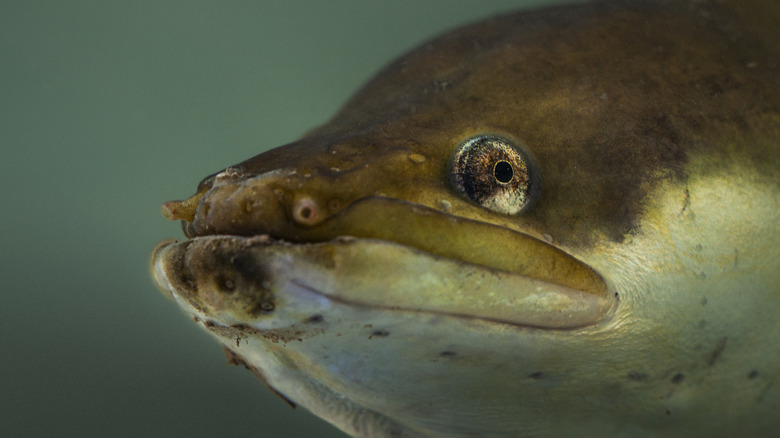
The European eel might have the sort of face only a mother could love, but they take one of the most remarkable journeys in their quest to mate, ending in the romantic, algal forest of the Sargasso Sea. Their story begins there as well. European eels are born in the Sargasso Sea before drifting towards Europe as larvae, a path that is over 6,500 kilometers (approximately 4,039 miles). This initial voyage takes around two years.
The eels mature along the coast of eastern Europe before making their way to fresh water via rivers, where they spend most of their lives. As they near their final stage of life, they develop sexual organs, and make the long journey back to the Sargasso Sea, where they breed and perish. Johannes Schmidt, the early 20th-century scientist obsessed with the European eel, said, "Altogether, the whole story of the eel and its spawning has come to read almost like a romance, wherein reality has far exceeded the dreams of fantasy" (via Nature). And, if you can believe it, Schmidt didn't even have the entire eel story back then.
Although these are just a couple of remarkable species that rely on the Sargasso Sea, there are many more. The complexity of this shoreless sea has made its study a complicated process, and plenty of mystery remains in those beautiful waters. However, a rich understanding can help equip us with the tools to protect vulnerable marine life and ways to maintain biodiversity.