

Science Explains The 'Teenager Smell' And Why It Smells Different
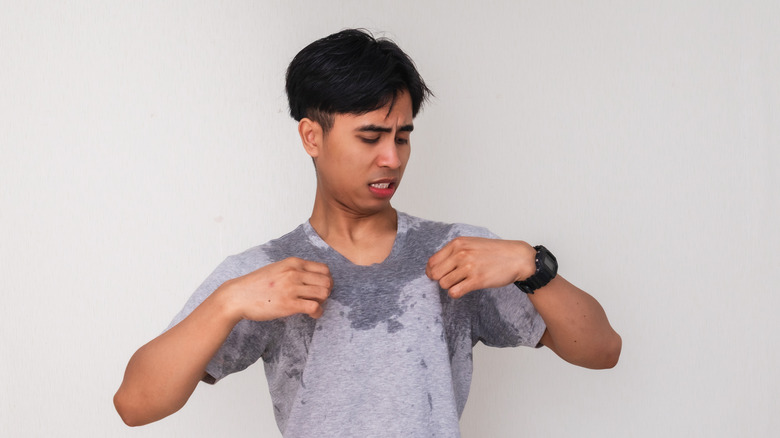
Puberty stinks. The changes are often uncomfortable for both males and females, as hormones flood through their bodies and trigger acne, painful growth spurts, and new emotional urges that are challenging to deal with. But parents of teenagers have to struggle, as well: Their growing children smell pretty darn funky. Worse yet, the "teenager smell" is a disappointing reminder that their babies are growing up, as it may conjure wistful memories of the intoxicating aroma that once wafted from their babies' innocent little heads.
Yet, while the "baby smell" has the evolutionary advantage of encouraging parents to keep their babies close, the "teenager smell" is likely more of an unfortunate side-effect of puberty than a survival tactic. In a 2024 study published in Communications Chemistry, German researchers analyzed the chemical profile of post-pubertal children. The short-and-sweet explanation for the "teenager smell"? Carboxylic acids. These volatile compounds smell similar to mature plums, goats, and cheese, and they were found emanating in much higher concentrations from post-pubertal children than from pre-pubescent children. The researchers also discovered that teenager sweat contains two naturally-occurring steroids that have a "musk-like" odor, adding to the cocktail of smells.
Curiously, the body odor of teenagers contains the same chemical compounds as that of pre-pubescent children. That means that the light, endurable body odor of young children still lurks in the armpits of teens, even if it's overpowered by the new influx of stinky teenager smells. Such smells all start with the sebaceous glands, which activate at the onset of puberty. The sebaceous glands secrete an oily substance called sebum in the skin, which helps retain moisture. When sebum breaks down in the presence of acidic sweat and bacteria, it produces the volatile compounds like carboxylic acids that are responsible for the "teenager smell."
Teenager funk: Unfortunate side-effect or evolutionary advantage?

It's well-established that the attractive "newborn baby smell" elicits a dopamine rush in the brains of parents, which helps bring parents and their vulnerable offspring closer together and facilitates the protection needed for an infant's survival. But could the unattractive "teenager smell" serve the opposite evolutionary purpose by pushing teens away from their parents? The "teenager smell" would certainly make it easier for parents to allow their teens to fly the nest and encourage self-reliance. Indeed, other animals have evolved to repel their offspring at the onset of sexual maturity based on changing smells, such as the stickleback fish.
Or perhaps stinky teenagers, being accustomed to their own malodors, may be able to partner up with other teenagers who are also unbothered by the sharp scent of their own puberty. Whatever the truth may be, such ideas remain firmly within the realm of speculation. What is known, however, is that puberty is a period of life when children become increasingly self-reliant and no longer depend as heavily on their parents' protection. This explains why teenagers can get away with smelling bad, while babies can't.
One commonly-held belief is that the "teenager smell" comes from pheromones. After all, many other animals release pheromones to attract mates, mark territories, and communicate. But unique pheromones require unique olfactory receptors, and it seems that human beings' apparently "useless" pheromone receptors (Jacobson's organ) have shrunk or, in many cases, have disappeared completely. Indeed, it wasn't until only recently, in 2025, that scientists were able to identify the first most convincing candidate for a volatile chemical that could qualify as a human pheromone. Yet, for those teenagers who are refusing to bathe in an attempt to "pheromone maxx," you can tell them that there's no scientific support behind the smelly trend.