

The Red Lightning You'll Never See Has A Mysterious Science
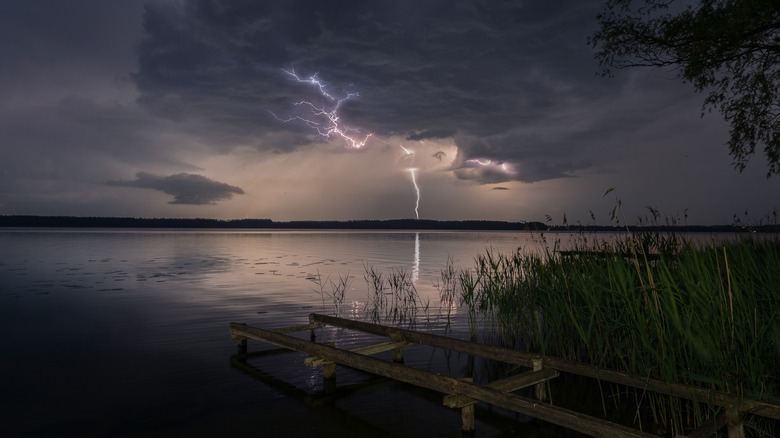
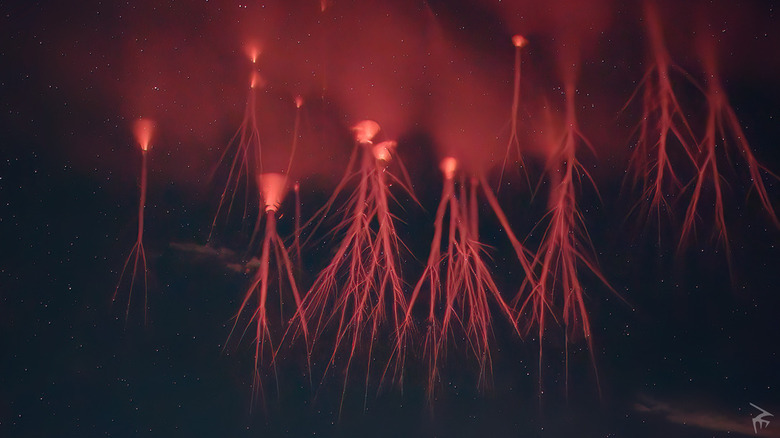
Lightning storms are a force of nature that inspire awe and have many other effects on humans. While most of the lightning we see in a thunderstorm is white, it's not uncommon to see flashes of blue, yellow, or purple lightning from time to time. However, there is a form of red energy flashes coming from the tops of thunderclouds that sometimes resemble an upside-down jellyfish. These flashes, known as red sprites, are something that most people never see. Red sprites are caused by processes that are still being studied and have wide-reaching effects we are just beginning to understand.
Red sprites are one of a family of phenomena known as transient luminous events (TLEs). During a thunderstorm, lightning occurs when electrical energy bounces around within clouds and between the cloud and the ground. The activity within a thunderstorm happens in a narrow slice of the atmosphere called the troposphere that reaches to between four and 12 miles above the surface. However, red sprites, some of which can be 30 miles wide, can reach more than 50 miles above the ground. Red sprites happen when a strong positively charged bolt of lightning strikes the ground and electrical charges move vertically throughout the cloud.
From legend to scientific fact
For many years the existence of red sprites and other TLEs was merely a legend. Pilots reported seeing them, but nobody had collected tangible evidence of their existence. This is partially because red sprites occur at the top of thunderclouds, making them hard to see from the ground. Red sprites also occur very quickly, lasting only a few milliseconds. The first confirmed sighting of red sprites came in 1989 when researchers at the University of Minnesota captured one while testing a low-light television camera.
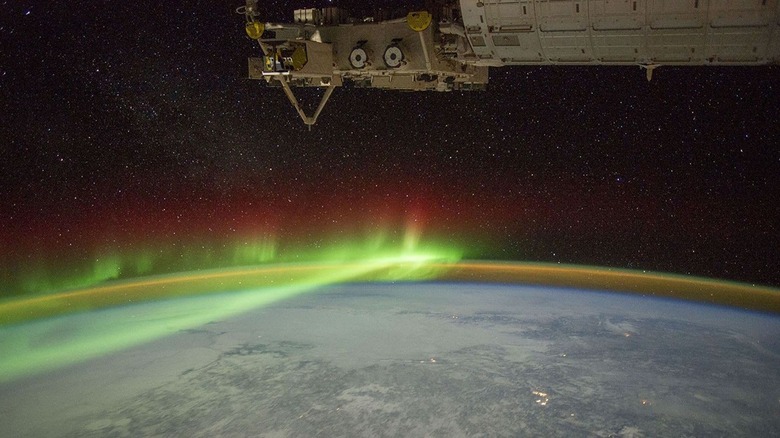
Since then, researchers have been using observations from high-altitude aircraft and spacecraft to study TLEs. Beginning in 2018, a European Space Agency scientific instrument on the International Space Station (ISS), known as the Atmosphere-Space Interactions Monitor (ASIM), has been recording red sprites and other TLEs that are too fast and small to detect with ground-based hardware. Another instrument developed by the Japan Aerospace Exploration Agency, known as Light-1, flies on a small satellite called a CubeSat that was released from the ISS. Light-1 detects high-energy gamma ray flashes from thundercloud tops.
The wide-ranging effects of red sprites
Scientists are studying red sprites and other TLEs to find out the effects they have on the atmosphere and what they can tell us about the inner workings of thunderstorms. Analyzing where in a thunderstorm TLEs are most likely to occur can lead to improved safety planning for airlines flying routes where TLEs are common. Additionally, these energy discharges can cause chemical reactions in the upper atmosphere that affect how much energy is absorbed, reflected, and radiated. Plugging this information into climate models can improve projections of future warming.
TLEs also release electrical charges into the ionosphere, a layer of the atmosphere ranging from 50 to 400 miles above the surface that is filled with charged particles. The ionosphere is important to long-range radio transmissions, including signals from GPS satellites. Some frequencies of radio waves pass through the ionosphere while others are bounced off of this layer to reach distant locations. Energy from TLEs passing into the ionosphere can thus disrupt communications.
The ISS and ASIM are expected to continue collecting data until the station's scheduled decommissioning in 2030. Meanwhile, researchers are working on new and improved instruments that are more sensitive and able to detect faster events to collect more data on TLEs. In a few decades red sprites have gone from a rumor to confirmed scientific fact. The next decade may yield even more insight into these mysterious flashes that have been so elusive.