

How A 1960's Physicist Predicted The World Is Going To End On November 13, 2026
Predictions for the end of civilization come around fairly regularly. Many of us who were alive during 2012 can recall the misinterpretation of the Mayan calendar which suggested the end was nigh and led to a sense of impending doom. Just last year was spent dodging the rapture that had been forecasted by TikTok prophets. This year, the Doomsday Clock was set the closest to midnight it has ever been. So, it perhaps comes as no surprise that we're hurtling towards another deadline for humanity on November 13, 2026, which is appropriately a Friday. What might be a bit more unsettling is that this prediction was made by a physicist using mathematical models and population data.
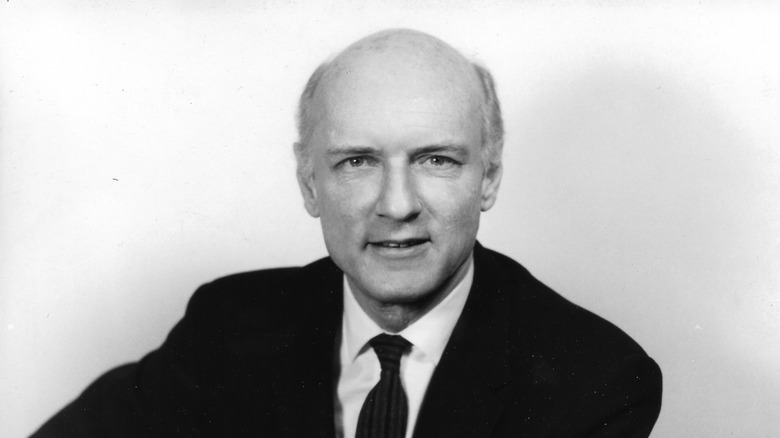
Heinz von Foerster was born in Vienna on November 13, 1911. His familial and social circles were composed of a vast array of artists and intellectuals, perhaps spurring him to a multidisciplinary approach in his studies that brought together physics and philosophy. As early as his teen years, he became involved in the Vienna Circle — a group of intellectuals from a variety of academic backgrounds who professed that there were no essential differences between the hard and soft sciences. Later, von Foerster would go on to earn his doctorate in physics in 1944. He survived a large-scale global catastrophe while working in a radar lab in Berlin during World War II. Though ethnically Jewish, von Foerster hid this information for the duration of the war before coming to the United States in 1949.
The equation that sparked decades of debate

Von Foerster became interested in computational biology early on in his career, founding the Biological Computing Lab at the University of Illinois in 1958. This field brings computational and mathematical methodology into the study of biological systems. Employing such methods, von Foerster published his controversial doomsday prediction in the journal Science in 1960. In his model, "doomsday" occurred when the world's human population grew to infinity, and we would be "squeezed to death."
Prior to this paper's publication, models of population growth (e.g., the model created by Thomas Malthus) were exponential. In other words, the population growth (i.e., birth rate) would be proportional to the existing population. Whereas von Foerster and his colleagues asserted that population growth is, in fact, hyperbolic. With this model, he argued that population growth actually accelerates as it grows due to communication and the human ability for cooperation. In such a model, the population approaches infinity: doomsday.
Obviously, population growth will not actually become infinite. This is an example of mathematical singularity, which is the point when an equation essentially breaks down. In von Foerster's equation, this singularity was met in the year 2026. However, this was meant a bit more metaphorically than it has sometimes been interpreted. Supposedly, in an attempt at humor, von Foerster selected his birthday as the precise date. The real goal of the paper seemed to be the assertion that we might need to attempt social control over population growth to avert catastrophe.
Math and metaphor
The 1960 publication initiated a rich and, at times, petty debate. In 1961, demographic researcher Ansley J. Coale submitted a letter to Science, which stated that most demographers interpreted von Foerster's entire paper as a joke and insisted that the theory could not withstand scrutiny. In a cheeky response, von Foerster and colleagues explained that their equation was meant to illustrate that human population growth is not simply defined by mortality and fertility as might be acceptable for an organism like the fruit fly. They then suggested that Coale should have a physicist help him understand the equations if he still felt confused.
The debate appeared at least partially rooted in the fact that von Foerster and his colleagues in the Biological Computing Lab were outsiders to population research. They were engineers and physicists, not demographers, and their vastly different approach to population models shook up the field while remaining difficult to interpret. Nonetheless, their model continues to inspire discussion.
Now, we have population data that von Foerster did not. These do not align with his predictions, and we are not likely to be "squeezed to death" in 2026, as he iconically put it. Additionally, advances in technology, such as genetically modified organisms, have allowed us to grow our resources for food beyond what von Foerster could have imagined at the time. This could perhaps be an example of his theory, however. Maybe it is our ability to work together in groups that has degraded the equation.