

Inside Artemis II: What Living Aboard NASA's Lunar Spacecraft Really Looks Like
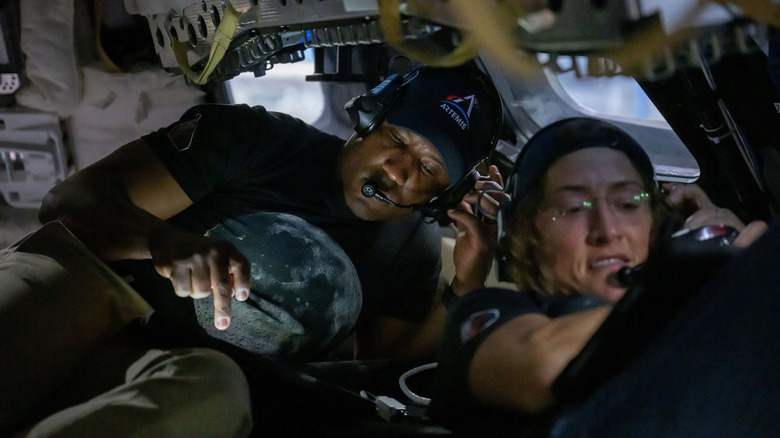
Have you ever been on a long road trip with friends or family? Chances are, the cramped quarters quickly led to conflict of some sort — shouts of "You're on my side!" ringing out over the carefully curated playlist. Now, imagine being on this type of road trip with three of your coworkers for 10 whole days. Also, picture that you are expected to work during these travels. Oh, and this road trip is going to be in outer space.
That is the reality for the four astronauts who are operating the Orion spacecraft for the NASA mission Artemis II. With the goal of providing new scientific insight, this mission will mark the closest humans have been to the moon since 1972. The Orion is currently the only spacecraft that can travel to deep space with a human crew. Each design element has been meticulously planned, from the launch abort system meant to rescue the crew in the case of launch mishap, to the space-saving exercise contraption.
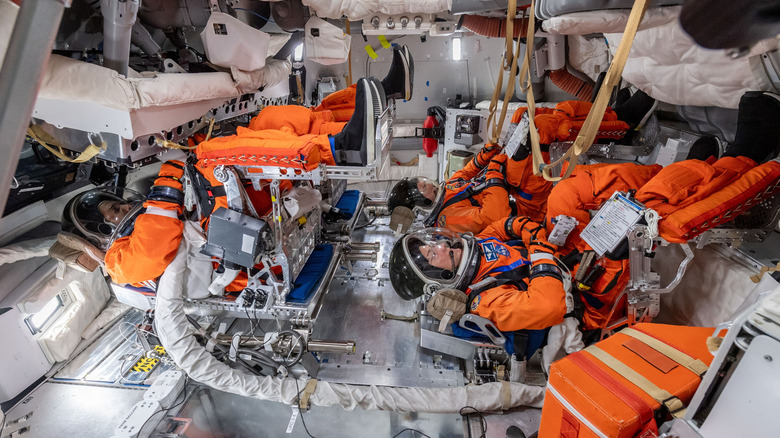
The portion of Orion that will house the crew is 330 cubic feet and has been described as the size equivalent of two minivans. This area needs to accommodate work, sleep, exercise, meals, and waste disposal, which are a lot of tasks for such a tiny space. However, in creating such a multipurpose area, the designers do have a unique advantage: When in orbit, the astronauts will not have the pesky constraint of gravity to deal with.
The space inside Orion
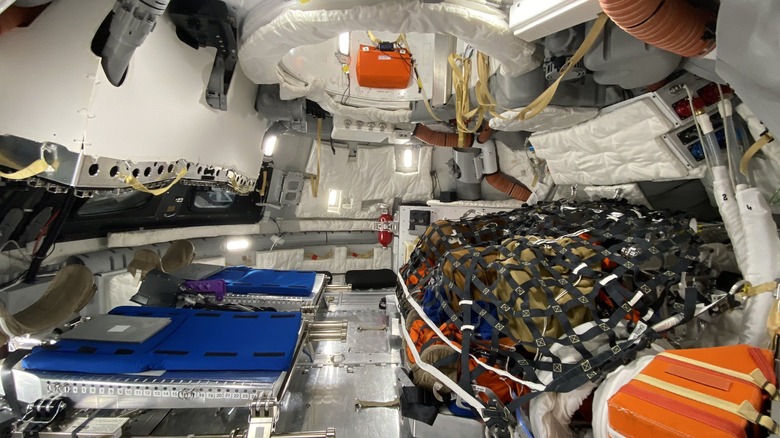
Without gravity, the crew can float around the space and make use of its entirety. Imagine how well you could organize a studio apartment if you were able to place things on the ceiling. Astronaut Christina Koch has stated that she is counting on the bigger feel that using the space "in microgravity in 3D" will provide. The lack of gravitational compliance has allowed for some architectural choices that are otherwise unusual.
In the case of Orion, the toilet rests in what looks like a small compartment under the floor. This whole bathroom space is roughly five cubic feet. That means cramped quarters, especially for mission specialist Jeremy Hansen, who has a height of 6 feet, 2 inches. If you're wondering where the shower would go, astronauts cannot shower in space. The crew will rely on liquid soap and dry shampoo to stay clean.
Beside the toilet compartment is the small exercise machine. Regular strength training is necessary while in space. Lack of gravity means the muscles frequently employed to keep you upright are not used. Such long-term lack of muscle use can lead to atrophy (muscle tissue loss). Due to the cramped quarters, the exercise device is compact, taking up less space than a typical carry-on suitcase. The device is known as a flywheel and consists of a bar attached to a cable. The weight of resistance is determined by the amount of force exerted by the astronauts. Each crew member will exercise for 30 minutes daily.
Meals and sleep on Orion
The crew members each have a specialized meal plan based on their individual dietary needs and personal preferences. These meals can then be rehydrated through a water dispenser on board or heated with a warming plate. Some options include shrimp cocktail and cashew chicken curry as well as chocolate pudding for dessert.
Sleeping in microgravity might sound like a particular challenge, and the crew members each have eight hours to do so fitted into their daily schedule. Sleeping bags attached to the walls will prevent them from floating around during rest. Last year, the astronauts were able to explore a model of the space and discuss sleeping arrangements. In a video shared by The New York Times, Koch called dibs on the tunnel portion of the ceiling, saying that she plans to sleep "hanging like a bat."
While these quarters might appear exceedingly small, they are actually a significant improvement from previous such missions. In fact, this area is nearly 60% larger than its equivalent in the Apollo spacecraft. Just imagine a road trip to space with your coworkers on that ship! Fortunately, the crew members received training to prepare for such close proximity, including sleepovers at the Johnson Space Center. This mission is certainly a historic endeavor, and hopefully, camping in space will be a worthwhile experience for the crew, despite the malfunctioning toilet at the beginning of their travels.