

Why People Are Wrapping Their Car Keys In Aluminum Foil
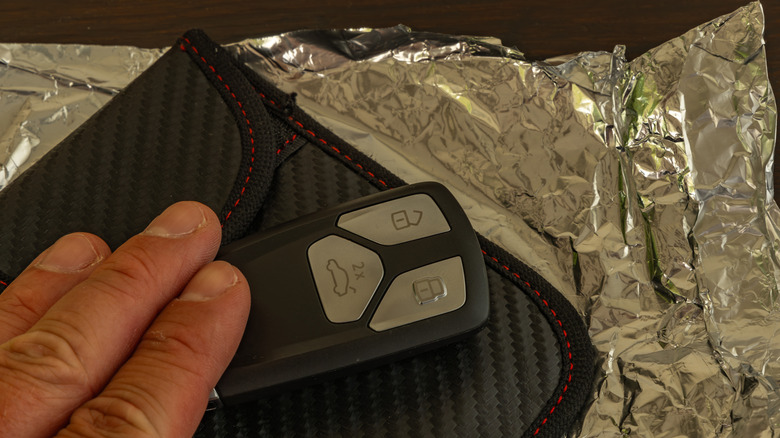
Have you ever seen someone wrap their car keys in aluminum foil? This may seem like a strange question, but like many other seemingly peculiar tin foil experiments, this particular type of aluminum foil science project has the potential to be very handy: People who do it are actually building a Faraday cage as a hack to prevent car theft.
A smart key, or a keyless system, constantly sends out a radio-frequency identification (RFID) signal to the car, which tells the car's systems to unlock when the driver is near. This can be a problem, because some car thieves have learned to intercept the smart key's RFID signal with a relay device. This hijack allows them to unlock the car and drive it away just like they were using the proper key. In some cases, cars can be gone in just 20 seconds. There have also been instances where thieves walk around the target's home with their devices as they try to locate the signal from the car keys. "Although they didn't physically come into the house, you don't feel safe," car theft victim Abbie Brookes-Morris told the BBC in 2025.
This is where the aluminum foil comes in. When a person wraps their smart keys in the stuff, they're effectively creating a Faraday cage — a closed shield covering that cancels electromagnetic signals, including RFID. This prevents signal interception and therefore stops aspiring car thieves.
The science behind the aluminum foil method works, but it can be easy to get wrong
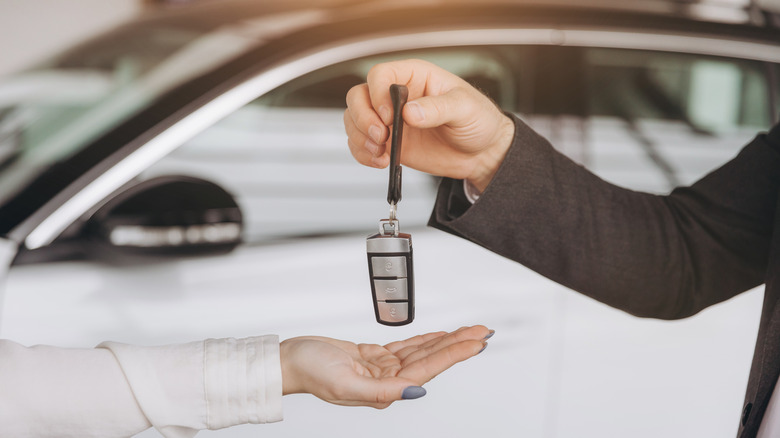
There's a wide variety of signal-hijacking relay devices out there, some of which are disguised as harmless handheld gadgets like bluetooth speakers. This makes it understandable that a prevention system like wrapping the smart key in aluminum foil can be alluring. However, it should be noted that the foil system is far from foolproof.
Foil Faraday cages only work if they're thick enough and completely enclose the device, so you need to cover the key fob in multiple layers of the stuff and make sure that the "cage" is completely secure. As such, it may be better as a temporary hack than a regular safety measure.
Some keyless entry systems actually have built-in sleep modes that stop them from emitting their RFID signals. For those who don't have the ability to disable the keyless system and are looking for a long-term security solution, however, there are special signal-blocker key pouches and containers available. Using your car's built-in security systems in conjunction with additional theft deterrents like steering wheel locks can also work. You can also simply keep your car keys in the middle of your home instead of by your front door, so potential lurking thieves can't hijack the RFID signal so easily.