

This Jellyfish Look-Alike That Never Floats Alone
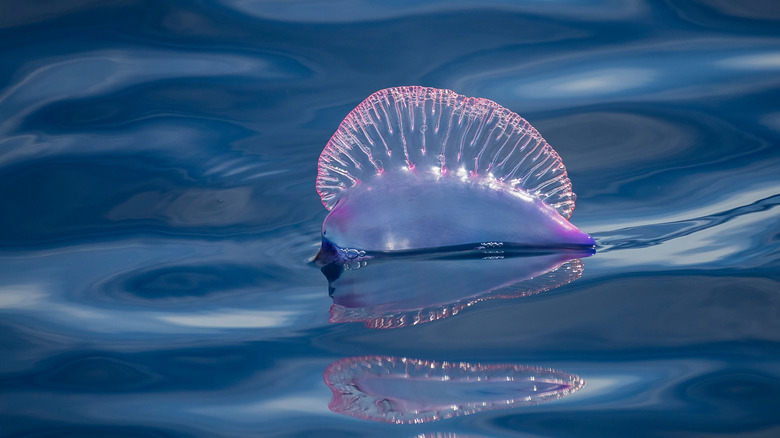
The Portuguese man-of-war is one of the most interesting creatures in the ocean, and that is saying something, as the ocean is filled with sci-fi–adjacent species that make terrestrial animals look mundane. It even has a fish named after it that constantly swims alongside its long tentacles. However, the man-of-war is often misunderstood, since it is one animal but multiple multicellular organisms. The air-filled bladder that rises above the surface and enables flotation gives the appearance of a single jellyfish — their evolutionary cousins, stemming from the same phylum of Cnidaria (the branch of the phylogenetic tree that is also home to anemones).
While they resemble jellyfish, they function very differently. Portuguese men-of-war are dependent on the current, and that pointy membrane protruding from their floating bladder functions as a sail. This is where they get their name, as the man-of-war was a type of Portuguese ship with a large sail. Additionally, although each Portuguese man-of-war is one animal, they are composed of a colony of multicellular organisms known as zooids. This type of creature is called a siphonophore, a grouping of distinct organisms that remain fused together.
The life cycle of a man-of-war begins when an egg and sperm from mature colonies meet and form a larva. While their larval development has not been directly observed to date, we know that this stage consists of a pneumatophore, which is the bubble-like piece we can observe floating through the water, and a protozooid that contains a tentacle.
The zooid dream team
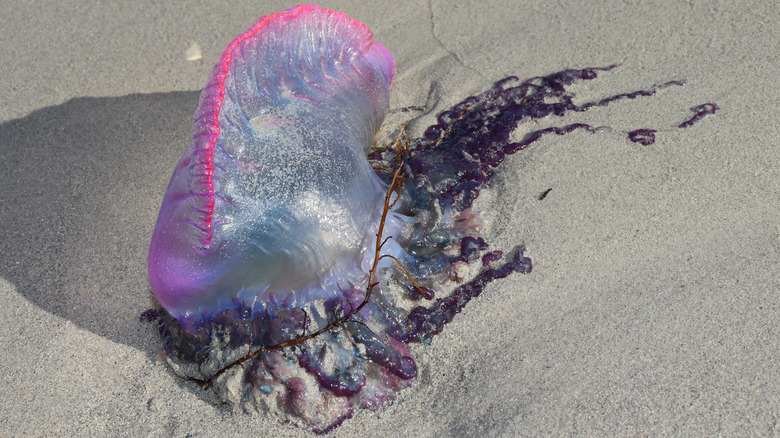
From the larval stage, the colony grows and expands. Each zooid is asexually produced and branches off from the initial organism. Where it gets especially interesting is that these zooids can serve vastly different functions and rely upon each other to maintain life as a fully functional animal. One of these groups of zooids, known as dactylozooids, forms the long tentacles that resemble those of their jellyfish cousins. Think of these zooids like the hunters of the colony. To capture their prey, they utilize nematocysts, which are stinging organelles that inject poison to paralyze the fish they will feed upon. After capturing prey, the muscles of dactylozooids contract and deliver their catch to our next group: the gastrozooids.
Gastrozooids essentially serve as chefs that supply the whole colony with necessary sustenance. When brought food by the hunters, gastrozooids release incredibly powerful digestive enzymes that break off pieces of the meal to be engulfed. A digestive system shared throughout the colony then supplies those nutrients to the others. This efficient catch and devour method is vital, as they remain at the whim of the ocean and wind, unable to simply track down prey.
The last group of zooids are the gonodendra, which facilitate reproduction. These have structures called gonophores that can release either sperm or eggs, depending on the sex of the man-of-war. The gonodendra actually break away from the larger structure to come in contact with their counterparts in the ocean. And the cycle begins again.
The buddy system
Although the Portuguese men-of-war look so squishy and huggable, if you see one, the best idea is to stay very far away. While their venomous stings are typically not toxic enough to kill a human, they are superbly painful. Even deceased colonies that have washed up on the shore are dangerous, as you can still experience a sting from the dead tentacles. For many unfortunate fish in the ocean, avoiding these tentacles is incredibly difficult, since they are an average of 30 feet long. Some can even reach 100 feet. Because these creatures thrive in warm water, rising ocean temperatures brought about by climate change will only make them more difficult to avoid.
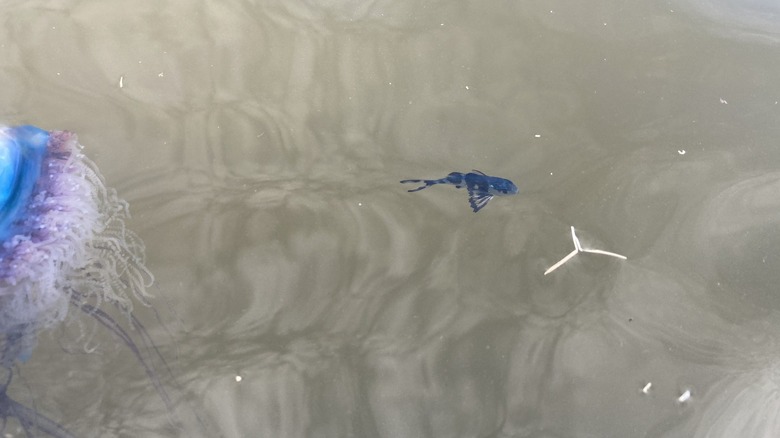
You might then assume that all marine life has evolved to steer clear, but there is one group of fish that constantly seeks to swim alongside these venomous animals. The aptly named man-of-war fish spends its thrill-seeking juvenile years swimming under these toxic tentacles. Although they are not wholly immune, they can withstand significantly more venom than other fish species. Additionally, their unique flexibility and agility allow them to dodge the powerful stings while gaining some readily available access to food by snacking on the man-of-war's smaller tentacles. Hiding under the umbrella of deadly stinging appendages also affords them some level of protection from predators. However, once the man-of-war fish has matured to adulthood, it descends to deeper waters, as its peculiar swimming buddy continues to ride the ocean currents.