

How To 'Hypnotize' A Shark, According To Science
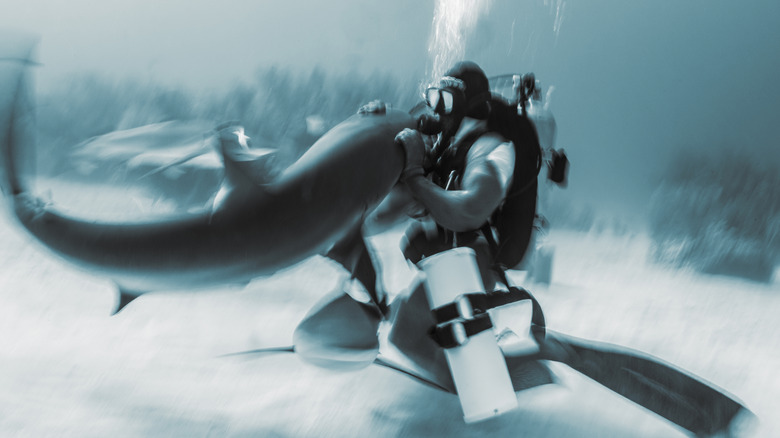
Sharks are less dangerous than movies like "Jaws" would lead us to believe. Only around six people die from sharks every year, while around 760,000 people die from mosquitos. In fact, death by mosquito is often more drawn out and painful than a relatively fast shark attack. As a result, expert divers are generally less afraid of sharks than landlubbers are, since they're familiar enough with the large fish to recognize warning signs in their behaviors. But sharks still occasionally give divers a chomp to see if they're good to eat. Fortunately, experts know that hypnotizing a shark is as easy as flipping it around on its back.
Many divers "hypnotize" sharks in order to disarm the ones that get too close for comfort. In scientific terms, the practice is called inducing "tonic immobility." In layman's terms, it's essentially flipping sharks onto their backs to paralyze them. Once flipped over, the shark's entire body relaxes and its breathing slows for up to 15 minutes. This provides marine biologists a window of time to capture sharks, record data, and place tags and trackers on endangered sharks, and it allows recreational divers to escape. After 15 minutes, scientists usually either flip the shark back over or allow it to right itself on its own.
Orcas have been observed inducing tonic immobility for an easy meal. It's not surprising that orcas have learned how to use the trick for their gain, especially since the giant dolphins are among the smartest animals in the world. They're also clever enough to use the hunting strategy in the most energy-efficient way possible. By preventing their prey from righting itself, orcas ensure that the shark stays immobile for long enough to suffocate, since sharks need to continuously move in order for oxygenated water to pass through their gills.
The strange sensory quirks of sharks
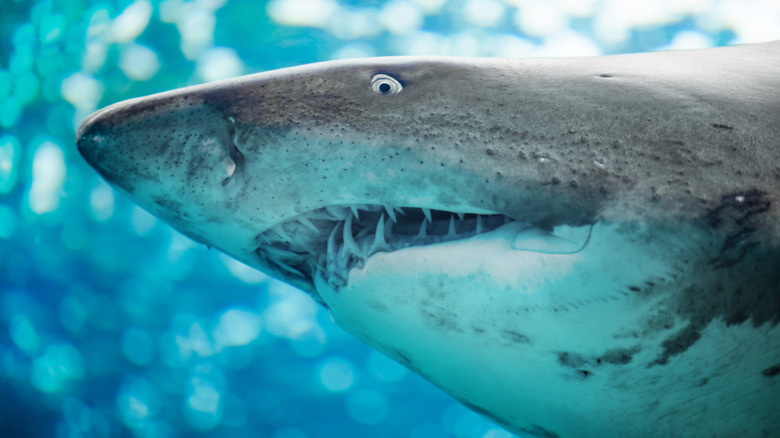
Flipping a shark upside down is easier said than done, so divers can first induce a more temporary form of hypnosis by gently massaging a shark's snout. After enduring a quick back-and-forth rub to the snout, many sharks fall into a stupor and their muscles relax. The reason for their sudden complacency is due to a sensory overload.
Sharks have a famously strong sense of smell, but they can also detect electric stimuli and temperature changes in the water using sensory organs on their noses called ampullae of Lorenzini. These sensory organs are intimately linked to the behavioral lifestyle of sharks, which relies on a keen sense of direction to find prey and potential mates. Overstimulating these critical receptors is therefore comparable to a human getting pepper sprayed or even flash banged. And some shark species are more sensitive to the effect than others. The good news is that the notoriously aggressive tiger shark can easily be lulled into a trance with a quick massage to the nose; the bad news is that great white sharks are all but immune to it.
Thus, scientists have a pretty good idea why rubbing a shark's nose will put it in a daze. Yet the hypnotic effect of "shark flipping" remains a mystery. The strongest theory relates to that innate selachian skill of orientation. All the aforementioned sensory organs, combined with a shark's need to remain on the move in order to breathe, generate a shark's perception of its surroundings. Perhaps flipping a shark upside down is comparable to flipping a compass upside down: you can only correct your bearings — or your consciousness — once you've flipped your instruments right-side up again.