

The Myth About Microwaves People Need To Stop Believing
Since its invention in the mid-1940s, the microwave oven has arguably evolved into an essential household appliance. In fact, according to data reported in 2022 by the U.S. Energy Information Administration, almost every home in the U.S. has one or more microwaves. Indeed, convenience reigns when it comes to fitting in a meal within a hectic schedule. This doesn't mean microwaves aren't without controversy. One common myth that keeps circulating online is that microwaves can cause cancer.
Before the microwave oven became commonplace, households relied on traditional ovens or stoves to cook food. Rather than using gas or electricity alone, microwave ovens heat up food with the help of microwaves, which is a form of non-ionizing electromagnetic radiation. Microwaves are absorbed by foods to help generate the heat needed to cook them, and are only emitted when the microwave oven is in use.
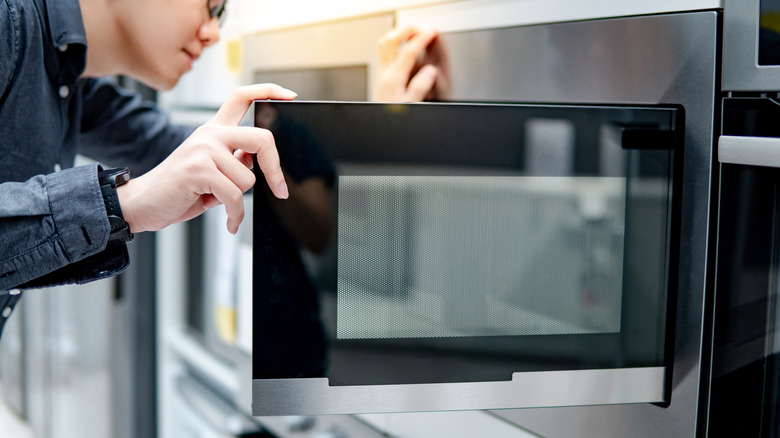
Microwaves have long been proven to be safe for heating foods when used as directed. While industrial-grade microwave radiation may be powerful enough to cause tissue damage in cases of extreme heat, you do not have to worry about radiation harm from your household microwave oven, partially because of the mesh on the door. But it's important to understand, there is currently no scientific proof that microwaves can cause cancer.
Why microwave ovens are not linked with cancer
The National Cancer Institute says that most forms of non-ionizing radiation do not cause cancer in humans. Yet it's the term "radiation" that leads many people to erroneously link microwaves with cancer. Indeed, there are certain forms of ionizing radiation that may increase the risk of cancer with long-term exposure, including X-ray technology. Unlike non-ionizing radiation, ionizing forms do have the potential to cause cellular damage, but when used in small amounts for a medical or dental checkup, for example, the cancer risk is small.
If you're still skeptical to use a microwave oven due to its non-ionizing radiation, know that this is unlikely to be the only item in your environment emitting this type of energy. In fact, according to the Centers for Disease Control and Prevention (CDC), people are bathed in this type of radiation every single day! Your smartphone, television, and many other everyday items also use this type of energy. Radio waves, ultraviolet radiation, and everything in between (including all the light you see) are considered non-ionizing radiation.
The next time you use a microwave oven or are in the vicinity of one, you can rest easy knowing that there is no scientific proof of any cancer links associated with this appliance. The only caveat? If you attempt to use a broken or extremely damaged appliance, there could be a risk that the radiation may leak out and cause burns to your skin and eyes if you're standing too close. You'll also want to follow other microwave safety facts, such as following all cook time directions on food labels, and using dishes that are deemed microwave-safe only.