

Scientists Say Older Couples Shouldn't Sit Together On Planes. Here's Why
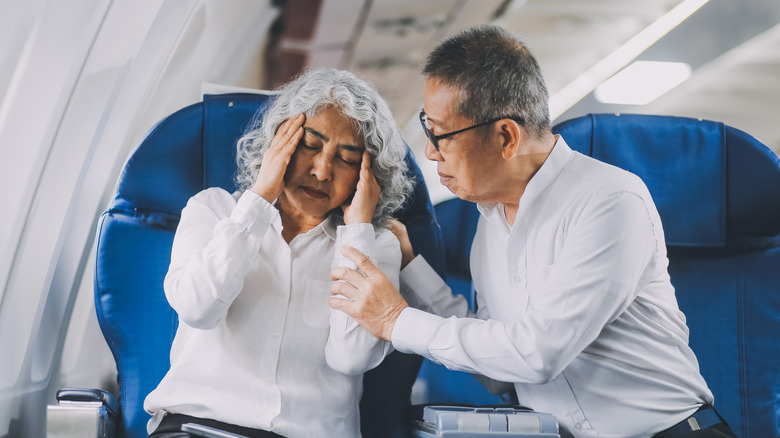
Let's say that your elderly relatives from far away are coming to visit you. They're looking forward to the flight, keen to experience it together and maybe have a cup of coffee (or a glass of wine) on the way. And then, as they're boarding, they're informed that their seating has been changed and they have to sit apart for safety reasons.
According to a new study published in AIP Advances, this might actually be a policy worth exploring, thanks to the certifiable benefit of separating senior people in planes. This is not because they're annoying when they sit together or anything, mind you. There's actually a valid safety reason for the suggested approach. Since older people simply aren't as mobile or dexterous as younger folks, a number of them seated in the same area or placed randomly in the cabin might lead to bottlenecks in a scenario that requires rapid evacuation. The study's results indicate that a flight's evacuation speed would dramatically improve if the seating of all passengers over 60 would be evenly distributed in the plane.
Back in the day, planes could fall apart in the sky thanks to one of the worst math blunders of all time. As such, it's understandable that researchers are keeping tabs on airplane safety – even if the results indicate that grandpa and grandma might end up sulking because they have to sit eight rows apart.
The science of separating seniors in planes
As types of transportation go, air travel is not only very safe, but it actually keeps getting safer. Still, there are lots of intricacies that go into making flying safe that the public might not be immediately aware of. For instance, did you know that planes don't fly over Antarctica for a very particular safety reason, or that airplane oxygen masks don't last as long as you'd think?
The seating study is a prime example of just how many factors can influence airplane safety today. The researchers were specifically studying how long it would take to evacuate an Airbus A320 plane during a dual-engine fire incident that necessitated an evacuation. During different simulations using various types of passenger placement, the study found that evacuation could take as long as 218.5 seconds if passengers over 60 are sitting in the plane randomly — in other words, in the way they might end up being seated in a normal situation. Yet, with a more controlled method where the senior passengers are deliberately separated across the seating, this time could be driven down to 141 seconds.
This is still not ideal, of course. Perhaps the biggest takeaway of the study isn't its indication that older people should sit apart, but the fact that the Federal Aviation Administration requires that passenger planes can be evacuated in 90 seconds ... yet, none of the study's 27 simulations was even close to achieving that time.