

A Bottle Of This Hydrating Beverage Has More Potassium Than A Banana

When you think about potassium, bananas often at the front of your mind. These widely available fruits are among the most notable sources of potassium, and they are often more affordable compared to other fruits and veggies. Despite such benefits and their potassium-rich reputation, bananas are not your only option if you're looking to get more of this mineral in your diet. Citrus fruits, sweet potatoes, tomatoes, and cantaloupe are examples of other potassium sources you can stock up on. There's even a natural drink you can consider that happens to have even more potassium per bottle compared with a whole banana. If you guessed orange juice, you're close, but there may be an even better option: coconut water.
It's important to understand how bananas and coconut water compare when considering similar portion sizes. According to the U.S. Department of Agriculture (USDA), a one-cup serving of banana has about 489 milligrams of potassium, while the average banana has about 411 milligrams. Taking the same one-cup serving, coconut water doesn't have quite as much potassium as an entire banana. As the USDA notes, each fluid ounce of coconut water has 49.5 milligrams of potassium, which adds up to nearly the same amount of potassium as bananas per one-cup serving. With that said, since the average bottle or can of coconut water contains more than a cup, the potassium content is much more, if you drink the entire container. Another consideration is that the exact nutritional profile of coconut water can vary by brand, so it's important to read the labels carefully. You might see that some brands have more potassium per one-cup serving, but this isn't always the case.
Benefits of drinking coconut water, with some caveats
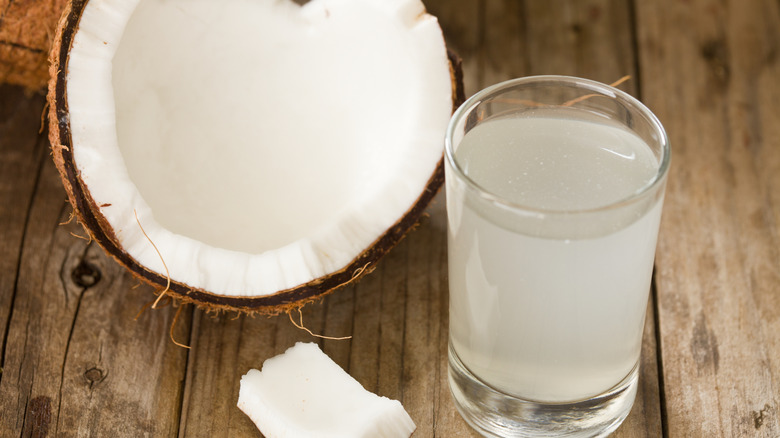
Potassium plays vital functions in human health, including heart and muscle function, as well as blood pressure regulation. Still, most people do not get enough of it in their diets. According to the National Institutes of Health, most adult males need at least 3,400 milligrams of potassium per day, while adult females require 2,600 milligrams per day (and slightly more when pregnant or breastfeeding). This all underscores the importance of getting enough potassium in your daily diet. If you need a lot more potassium than a banana can provide, then drinking a bottle of coconut water could help you obtain more of this mineral, in theory. Coconut water is especially coveted for rehydrating after a sweaty workout to help you replenish lost electrolyte levels. This primarily includes potassium, but also small amounts of magnesium, phosphorus, and sodium.
But before you completely switch over from bananas to coconut water for the sake of potassium, it's better to integrate this beverage into a healthy diet rather than focus on one food item. Although bananas contain magnesium and phosphorus, they can also offer other key nutrients like folate. Steer clear of coconut water brands that contain added sugars, as these can negate the potassium-rich benefits.
While a bottle of coconut water can supply a lot of potassium, it's wise to talk with a doctor about any underlying health conditions before adding it to your regular diet. You need to take care with high sources of potassium if you have kidney disease. In such cases, a doctor will likely recommend restricting potassium, rather than consuming more of it. On the flipside, some conditions such as inflammatory bowel diseases might make you more potassium deficient.