

The Final Breathing Pattern Doctors Often See Before Death
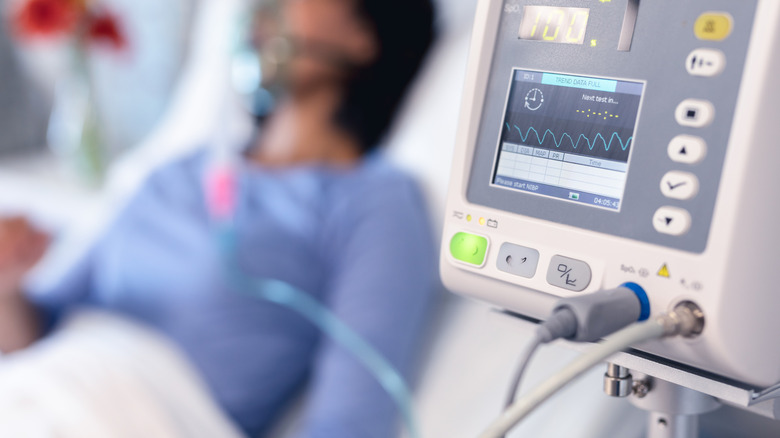
Death is often a process that occurs over time. Some common signs pop up in the time preceding the end of a human life, including changes in heartbeats and breathing. As losing a loved one is a time filled with uncertainty, it can be distressing to witness these signs, especially if their cause and function are unknown. Fortunately, such things have been thoughtfully studied, and there are some stereotyped behaviors that provide insight into the sounds and physical feelings of one's last moments. One such example is the breathing pattern that frequently emerges prior to death, known as Cheyne-Stokes respiration.
This distinct breathing pattern alternates between periods of slow and deep breaths, fast and shallow breaths, then no or very shallow breathing (apnea or hypopnea, respectively). One cycle takes at least 40 seconds and typically lasts between 45 and 90 seconds. Understandably, these periods of apnea can be quite troubling to others, as they wait to see if breathing will resume or whether it has ended entirely. However, one's final breath usually offers its own distinction, known as agonal breath and characterized by gasping. While commonly seen in dying patients, Cheyne-Stokes respiration is also associated with heart failure and stroke, and typically occurs during sleep.
The discovery of this breathing pattern

As long ago as 400 B.C., Hippocrates is thought to offer an early description of Cheyne-Stokes respiration. In observing the patient Philiscus in the days before his passing, Hippocrates wrote a report of his peculiar breathing pattern in "Of the Epidemics," stating, "The respiration throughout, like that of a person recollecting himself, was rare, and large." While this is a noteworthy account, Hippocrates does not include the period of quick, shallow breathing that is also associated with this pattern.
The first account that would become relevant within the medical lexicon did not appear until the early 19th century. Born in 1777 to a father who worked as a physician, John Cheyne was already helping his father's practice by tending to patients by the age of 13. At just 15 years old, Cheyne began medical school, graduating at the age of 18. He would offer widespread contributions to his field, largely in pediatric neurology. In 1818, the prodigious surgeon chronicled the irregular breathing of a patient, which persisted throughout the last several days of his life.
The second seminal description of Cheyne-Stokes respiration would be published by the Irish physician William Stokes in 1854, nearly two decades after Cheyne's death. The term for this breathing pattern was later coined in 1889 by George Alexander Gibson. However, it would become popularly known in 1954, when the Soviet Union stated that Joseph Stalin was exhibiting Cheyne-Stokes respiration. The day after this news was released, Stalin died.
The current understanding of Cheyne-Stokes respiration

Although this phenomenon has been documented for a very long time, there are still many aspects of the underlying physiology that are yet to be known. Researchers suggest that this pattern of respiration occurs due to poor internal signaling and/or regulation related to levels of carbon dioxide in the body. As we exhale, carbon dioxide is released. Therefore, high levels of carbon dioxide detected in the blood can trigger hyperventilation. If carbon dioxide levels become lower than a certain point, this triggers apnea.
As we die, our bodily functions begin to deteriorate. This could lead to difficulties in maintaining certain homeostatic setpoints. If you will recall, heart failure and stroke are also common causes of Cheyne-Stokes respiration. That is likely because these two conditions affect the pathways involved in respiratory control. For instance, heart failure leads to a heightened sensitivity to carbon dioxide, which could contribute to overcompensation and, therefore, these characteristic fluctuations in breathing. In the case of stroke, damage to areas of the brain that control breathing could lead to instability and the disruption of properly functioning feedback systems.
Treatment options for Cheyne-Stokes respiration are limited, typically involving oxygen supply or continuous positive airway pressure therapy. However, physicians usually focus on addressing the underlying cause (e.g., heart failure). This is generally more effective for long-term measurements. Maintaining properly functioning respiration is important for overall health, and further treatment options to address Cheyne-Stokes respiration require further research.