

The Popular Summer Fruit That Has More Potassium Than A Banana
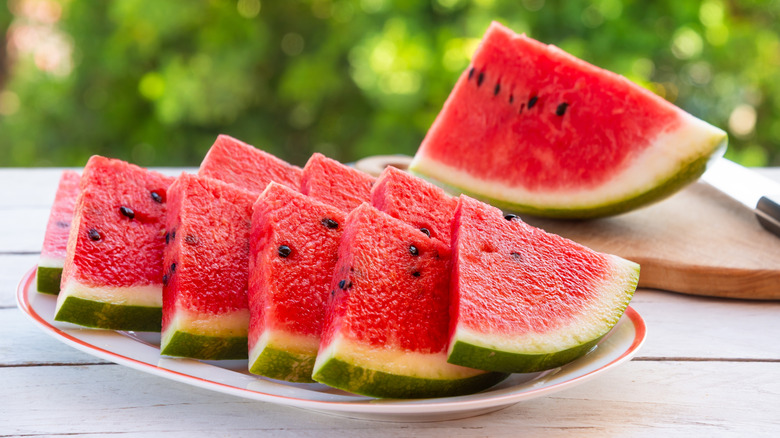
When someone mentions getting potassium from their diet, most of us will automatically think of the trusty banana. After all, it is the go-to source for that crucial mineral, isn't it? Well actually, it isn't particularly special in the potassium stakes, and there is one popular summer fruit that exceeds the potassium-level-per-serving of a banana — the super-hydrating watermelon.
An average medium-sized banana contains 375 milligrams of potassium, putting it in the same range as a portion of dried apricots, raw spinach, or potatoes. However, two wedges of watermelon, which is a reasonable standard portion — especially on a hot day — provides a significantly larger potassium hit: 640 milligrams. A likely reason that bananas are unfairly given the potassium crown is due to their high potassium content per 100 grams compared to other fruit and vegetables. However, when adjusted for a typical portion, they slip much lower down the rankings, since most of us stick to just one banana per day.
Watermelon, however, lends itself to large portions much more easily, and can be served as part of a meal either as an appetizer or dessert, or can be added to smoothies and cocktails to give them a refreshing and tasty boost. This means that getting your fill of potassium in the summer months could be easier if you focus on watermelon rather than bananas as a primary source.
Why is it so important to get potassium from food?

Potassium is one of the major essential minerals in our body, alongside other metals such as calcium, magnesium, and sodium. Since we don't produce potassium, we must get it from our diet, meaning that knowing which foods are potassium-rich is crucial for a healthy body. While there is no official recommended daily intake for potassium, The American Heart Association suggests that women should aim for around 2,600 milligrams per day, with men targeting 3,400 milligrams. It is thought that most of us fail to reach that target from our diets.
Potassium is an electrolyte that plays an important role in regulating processes involving the heart and other major organs. It helps control muscle contractions — including the hardest working muscle, the heart — and balances blood pressure. It is also involved in hydration, regulating the amount of fluid that enters the cells, and preventing cells from becoming dehydrated. In summer, hot weather and the sweating that it leads to can cause potassium to be lost, meaning that finding potassium in a classic summer fruit is a blessing.
Watermelon lives up to its name with its ability to hydrate, since it is made up of 92% water. Combining the water content with the high potassium levels creates a natural pairing of fluids and the electrolyte needed to regulate them, making watermelon the perfect healthy snack to keep your body happy during the warmer months. When you are finished eating, don't throw the rind straight in the trash; check out these uses for watermelon rind instead.