

The 'Old-School' Baby Boomer Habit That's Actually Backed By Science
People have been complaining about the "new" generation for millennia. As early as the 4th century B.C. Aristotle wrote scathingly about the young adults of his time, saying, "Young people are high-minded because they have not yet been humbled by life, nor have they experienced the force of circumstances." Such an observation could have easily come from the lips of a boomer today. Although looking at the past with rose-tinted glasses is a timeless feature of getting older, there are some old-school habits from earlier generations that were legitimately healthier for growing youngsters. Specifically, they used to play outside.
Research has found that outdoor play has been increasingly replaced by indoor, sedentary lifestyles. This is easily observable in everyday life: Fewer kids can be seen exploring nature, riding bikes, throwing rocks at trains, and wandering around the neighborhood unsupervised. Obviously, this decrease comes with fewer risks of bodily harm, however, the sedentary lifestyle that has replaced such activities, could come with greater risks to overall childhood development.
In 2015, Canada released the Position Statement on Active Outdoor Play after a review of 18 studies that examined the effects of outdoor play on children. The research team's findings were clear: Outdoor play is critical in fostering a child's healthy development. The statement identified eight distinct areas of research surrounding the issue, including the effects that spontaneous outdoor play has on risk-taking, physical health, social skills, and the ability to learn on one's own. Thus, it would appear that playing outside has wide-reaching impacts on a child's growth and all that time spent staring at a screen is doing more harm than just hurting their eyes.
Why outdoor play is so good for a growing child
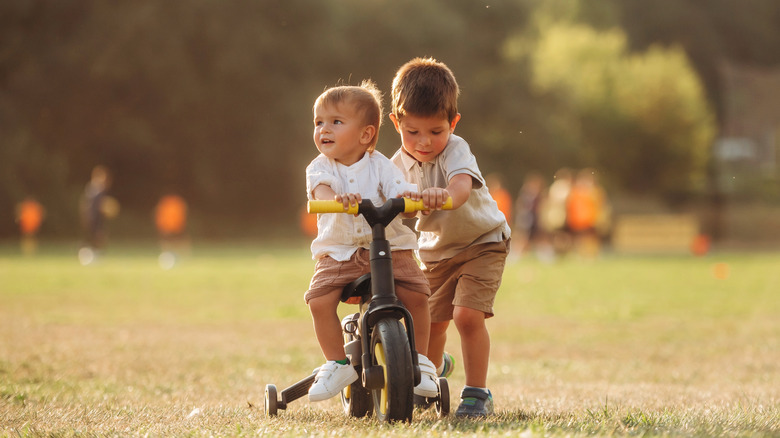
Research into the benefits of outdoor play can be broken down into three categories: physical development, mental development, and social development. The physical boons are obvious, since outdoor exercise helps build a healthy body. But there are some less-obvious physical benefits, as well. For example, vitamin D deficiencies among children are on the rise, likely due to more time spent indoors, even as new research suggests that vitamin D has a large role to play in the aging process. Furthermore, a recent study from the University of Texas at Austin suggests that increased rates of childhood obesity could be partially explained by decreasing rates of outdoor play.
Outdoor play is critical in cognitive health, especially when children can engage with nature in unstructured settings. Allowing a child to play and explore in the natural environment has been shown to enhance emotional regulation, encourage autonomy, and increase empathy. It also has benefits in the classroom: nature-based play leads to increased attention spans, focus, and engagement. And it's not just true for children. The research suggests that outdoor activities offer cognitive benefits for all age groups, which may explain why tai chi is so good for seniors' brains and why adults' memories are weakened by too much screentime.
As many baby boomers are apt to point out, the social interactions between neighborhood kids have all but disappeared in today's modern age of virtual hangouts. Studies have shown that spending time in public places develops in children a shared sense of belonging, interpersonal social skills, and greater social confidence. Indeed, the benefits of outdoor play are wide-reaching, so perhaps it's time to do as the kids would say and "go touch grass."