

Red Poop Might Not Mean What You Think It Does

While some markers of health may be obtained from medical professionals through blood or imaging tests, there are many signs you can look out for in between doctor's visits. Some of these can literally be found in the toilet. Needless to say, seeing red poop can understandably make your heart skip a beat, as bloody stool can be linked with a variety of medical concerns. Before you panic, though, it's worth knowing that certain foods you eat can sometimes cause unexpected changes to your poop without necessarily being serious. Red poop is, in fact, one such phenomenon, as it's sometimes associated with eating raw beets.
Just as different urine colors reveal a lot about your health, varying stool colors can also provide some clues as to whether something might be out of the norm. Generally speaking, any shade of brown is considered normal for stool, although it's also possible to see green from time to time. The precise color depends on the foods you eat and the amount of bile produced by the liver. Medications and supplements may also influence stool color, as well as underlying health issues, while blood in the stool can be either red or black in color. In these cases, red indicates lower intestinal tract bleeding, while black or tarry stools can be signs of problems in the upper intestinal tract.
A bright red stool can indeed be attributed to intestinal bleeding, but beets are another possible cause. This has to do with betanin, a type of pigment that naturally occurs in beets. While this red color can technically affect anyone's stool, you might be more likely to see red poop from eating beets if you have underlying gastrointestinal conditions, low stomach acid, or food sensitivities that might impact betanin's absorption. Overall, red poop from beets is not considered harmful, and any effects on the stool resolve on their own.
How to determine if red poop is indeed beet related
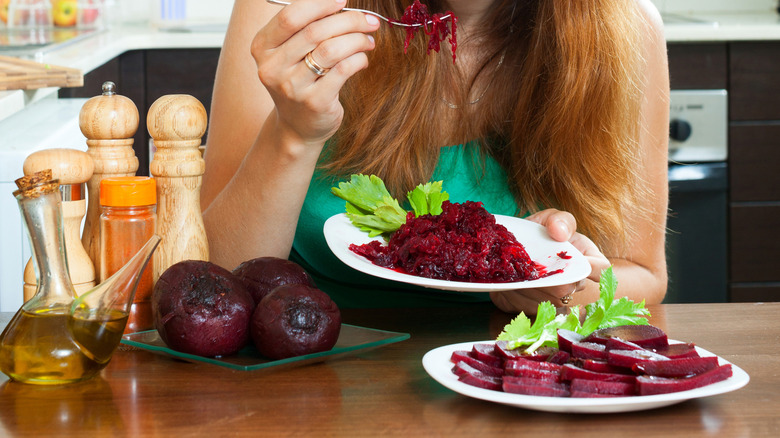
There are admittedly weird things that happen when we poop, but red coloring is not something many people might expect. If you eat beets and notice red poop the next time you go, chances are the two are connected. This is especially the case if you've recently eaten a beet-heavy meal. While less common, it's even possible to observe reddish-colored urine (beeturia), too. Another telling sign? Your poop might be red for up to 48 hours after eating raw beets, only to resolve on its own after this timeframe.
That said, it's not just beets that can make your poop change into a bright red color. Cranberries, cherries, tomato juice, rhubarb, and anything with red food coloring are all possible offenders thanks to their red pigmentation.
On the other hand, seeing any unexplained bright red blood in the toilet is likely linked to an underlying medical concern, rather than beets. This is especially the case if the problem persists for longer than a couple of days after you last ate beets or large amounts of other red-pigmented foods. It's always a good idea to report any ongoing stool changes to a doctor, or if you have serious concerns about an acute and unexplained change in your poop color. Experiencing chronic cases of poop floating instead of sinking are also worth checking out.