

Trump's 'Mini-Stroke' Rumor Might Actually Be Based In Science
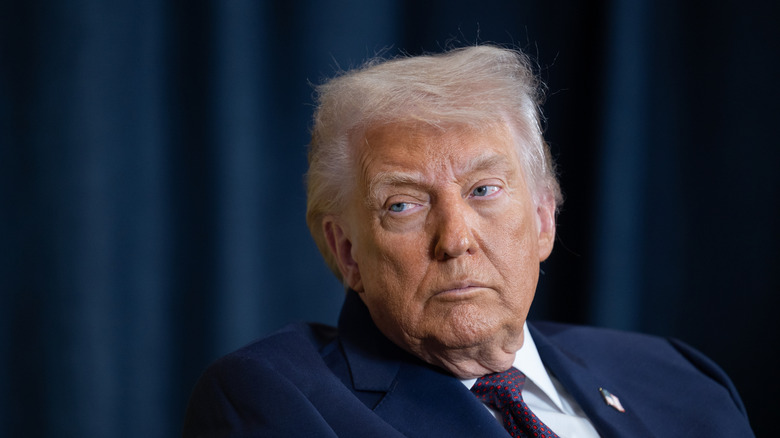
President Donald Trump's health has always been in question, but recent months have raised more alarm bells than ever. Official spokespeople insist that Trump maintains a clean bill of health, while many outside experts point to a laundry list of symptoms related to age-related disease. Potential signs of the 79-year-old president's decline include unconfirmed reports of incontinence, dementia, and cardiovascular disease. That last one is perhaps most exemplified by Trump's apparent facial drooping, which especially caught the public's attention during a 2025 9/11 memorial appearance. Facial drooping on one side of the face is often caused by a transient ischemic attack — also known as a mini-stroke.
The 2025 headlines weren't the first time that speculation surrounding Trump's possible history with strokes arose. As far back as 2020, during his first term as president, Trump released a tweet insisting he never had "a series of mini-strokes." His attempt to stomp out the rumor did the opposite, and many media sources have been pointing out signs and symptoms that suggest the president experienced mini-strokes (and even a full stroke) ever since. The rumor grew even further in late 2025 after Trump's mysterious, unexplained MRI scan.
As mentioned, the biggest hint that Trump may have experienced a series of mini-strokes is his facial drooping observed at several public appearances, the most recent of which was in March 2026. However, the drooping doesn't appear to be permanent. This inconsistency makes it impossible to conclude the president has facial paralysis as the result of a stroke. Furthermore, the symptoms of mini-strokes usually resolve after 24 hours. Indeed, mini-strokes, or transient ischemic attacks (TIAs), are unlike full strokes because they only block blood flow to the brain for a couple of minutes. Nonetheless, mini-strokes are often precursors to full strokes, and many of the symptoms overlap.
Beyond facial paralysis: Other symptoms of strokes and mini-strokes
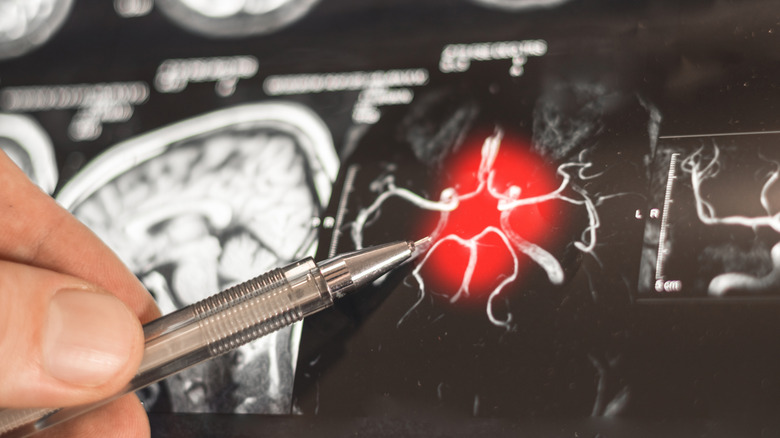
Facial drooping can be caused by a range of conditions besides a mini-stroke, including stress, nerve inflammation, and certain types of infections. However, if the "mini-stroke" rumors are true, it could explain why Trump displays so many symptoms of a full stroke, since mini-strokes, or transient ischemic attacks (TIAs), greatly increase the risk of a stroke. In fact, one in three people who have had a TIA later experience a stroke.
The symptoms of a TIA include slurred speech, difficulty communicating, a lack of coordination, blindness in one or both eyes, and dizziness. While Trump has displayed some such symptoms, it's unlikely that they're all explainable by multiple, publicly-occurring TIAs. Instead, many of these symptoms could be explained by his advanced age. For example, the loss of balance and coordination accelerates after age 50, as the body starts to age more quickly at that point, and some experts theorize that the 79-year-old president's slurred speech and apparent inability to follow conversations could be explained by dementia. Trump's lack of exercise and poor daily diet probably don't do him any fitness favors, either.
Strokes cause more permanent side-effects than TIAs, however, since blood flow to parts of the brain is blocked by a blood clot or burst blood vessel for long enough to kill the affected brain cells. This causes chronic conditions that last more than 6 months, such as lasting facial paralysis or weakness, difficulty communicating, memory loss, and personality shifts. Many experts claim that Trump displays most of these side-effects, and some also point to his foot dragging as an additional sign of a stroke. Trump's declaration that he didn't have a mini-stroke brought the public's attention to the possibility, and his symptoms of a full stroke only further kindles the rumor. Nonetheless, the rumors remain in the realm of speculation.