

Scientists Think We Can Hide Earth From Aliens. Here's How
We may receive a commission on purchases made from links.
The possibility of life beyond Earth has long captured our imagination. The discovery of life elsewhere in the universe would fundamentally change humanity; however, some people have concerns over what would happen if an extraterrestrial civilization found Earth. Researchers have found thousands of exoplanets, planets orbiting stars other than our sun, by studying tiny dips in starlight that happen when planets move in front of their star. In 2016, scientists at Columbia University proposed a way to hide Earth from aliens by using powerful lasers to mask the brightness decrease that happens when Earth crosses the sun.
In a paper published in the Monthly Notices of the Royal Astronomical Society, Columbia researchers David Kipping and Alex Teachey described a system that uses controlled emissions of a laser aimed at stars where an alien civilization might live. They calculated that sending out a continuous laser emission of 30 megawatts for approximately 10 hours once per year could compensate for the dip in visible light from Earth transiting the sun.
Is anybody out there?
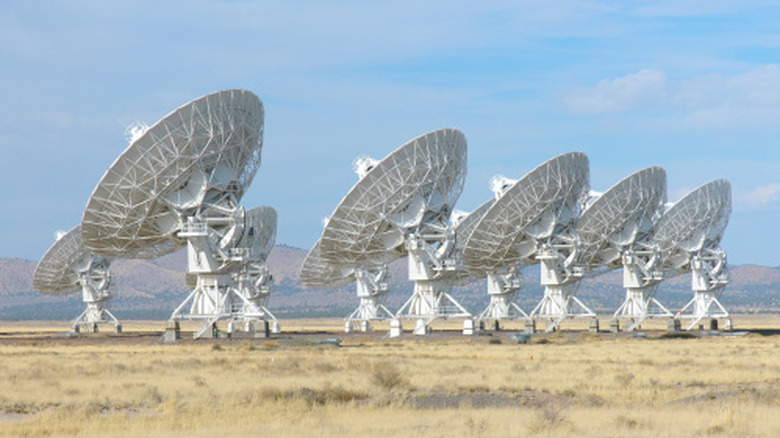
While humanity has pondered the possibility of extraterrestrial life, our ability to search for it is relatively new. Starting in the 20th century, the Search for Extra Terrestrial Intelligence Institute (SETI) monitored radio waves in the hopes of finding alien civilizations. However, SETI has not yet discovered evidence of distant life despite the presence of many potentially habitable worlds. This is a driving force behind the Fermi Paradox, an idea by physicist Enrico Fermi from the 1950s that basically asks, where is everybody?
One possible answer is that everyone is staying quiet. The Dark Forest hypothesis, popularized in part by Chinese science fiction author Liu Cixin's novel of the same name, proposes that being detected by other civilizations is too dangerous to risk. "Star Trek" may portray a universe of alliances and rivalries that mirrors nations on Earth, but Cixin's novels and the 1996 film "Independence Day" paint a far less rosy picture. Contact with aliens could be disastrous, and the transit method would be just as useful for extraterrestrial species as it has been to our search for exoplanets.
Seeking new civilizations

Between 1995 and 2005, researchers found exoplanets by analyzing how orbiting planets shifted the radial velocity of stars. Scientists started using the transit method, watching for decreases in light intensity, in 2005. Between 2005 and 2015, most of the discoveries made using transits were accomplished by NASA's Kepler mission. A more recent NASA project known as the Transiting Exoplanet Survey Satellite has discovered thousands more exoplanets and a European Space Agency surveying mission called PLATO that is scheduled to launch in early 2027 is expected to add to the total.
However, while the laser-based method Kipping and Teachey proposed could be used to hide us, it could also be used as a sort of beacon. Instead of using lasers to hide Earth's presence, we could modify how light changes during transit in a way that is clearly the work of intelligent life. This could give us another way to search for intelligent life out there, but only if other civilizations wanted to be found.
With thousands of known planets orbiting other stars, efforts to comb through old data using AI to find transits we missed, and future missions on the calendar, humanity's knowledge of the universe is rapidly expanding. However, while we continue to search the skies, humanity can either broadcast its existence or try to keep a low profile.