

Why Death By Boa Constrictor Might Be One Of The Most Painful Ways To Die
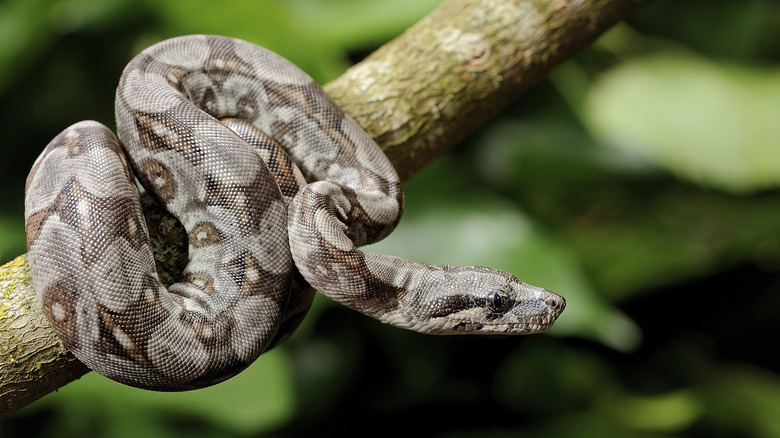
Death by boa constrictor is exceedingly rare, but that doesn't make it any less terrifying. The few recorded cases of humans succumbing to the crushing power of the giant serpent almost always occurred when pet owners were killed by their own snakes. For example, a Nebraskan man was found dead in his home in 2010 with his 9-foot pet boa wrapped around his neck. More recently, a Pennsylvania man suffered the same fate in 2022, this time "strangled" by his 18-foot pet boa. But "strangled" isn't exactly the right term, since boa constrictors squeeze so hard that they stop blood flow altogether.
A 2015 research article published in the Journal of Experimental Biology demonstrated that boa constrictors don't wait for their victims to suffocate — their killing strategy is much faster. Victims of crushing snakes die from blood constriction. Major arteries and veins that deliver blood to the brain and heart are squeezed so tightly that circulation is almost entirely cut off. Without freshly oxygenated blood, the heart stops beating. Soon thereafter, the victim dies of cardiac arrest.
Crushing snakes such as the boa constrictor don't subdue their prey with chemical weapons possessed by venomous species that can kill in minutes, such as other snakes, spiders, and even sea creatures like the blue-ringed octopus, which delivers its own kind of brutal death. Instead, they do exactly as their name implies: They wrap their powerful bodies around their victims to prevent escape and then squeeze. The entire process isn't exactly a quick one, but once you realize you're trapped, it's probably too late. Once a boa constrictor starts to wrap itself around you, death is only minutes away. For centuries, scientists assumed that victims died by suffocation, and many news sources today still mistakenly report that victims were "strangled" or "suffocated."
The slow, powerless experience of getting squeezed to death
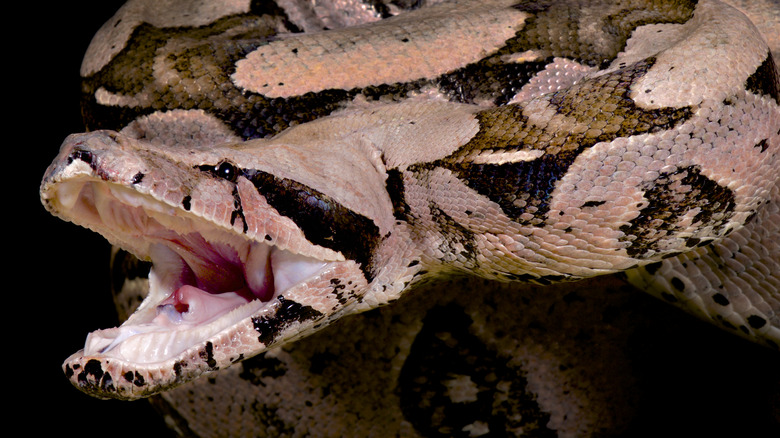
Boa constrictors are native to Central and South America, where their typical diet is composed of local birds and mammals. They're ambush predators, laying in wait on tree branches or in the undergrowth for a meal. When a victim passes by, the boa grabs them in its powerful jaws and holds it in place. Immediately, the snake begins coiling its body around the prey to restrict its movement. Adult boas typically weigh around 30 to 60 pounds, though some individuals can reach well over 100 pounds. It's thus easy to imagine how difficult it would be to free yourself from the heavy, coiling body of a boa before it manages to trap you in its vice.
The initial engagement with a boa is the only part of the process that's quick. Once the snake has restricted its prey's movement, it seems to lose urgency. Experimental studies with rats have estimated that boa constrictors typically take around 6.5 minutes to kill their prey. Even more disturbing, the snake is able to detect the pulse of its victim and adjust its pressure accordingly. When it feels its victim's heart stop, the snake relaxes its body and begins to swallow its prey.
Victims lose consciousness quickly in the grip of a boa constrictor, since the restricted blood flow to the brain causes them to pass out within a few seconds of the process. This means that a boa's prey only experiences the ambush and initial stages of the squeeze. For claustrophobic people, this fact is hardly any consolation. But for others, perhaps getting constricted by a 100-pound snake is preferable to the months-long agony of dying by rabies or the excruciating and deathly diseases spread by mosquitoes. Fortunately, we don't have to choose.