

The Ocean Condition That Makes Shark Encounters More Likely
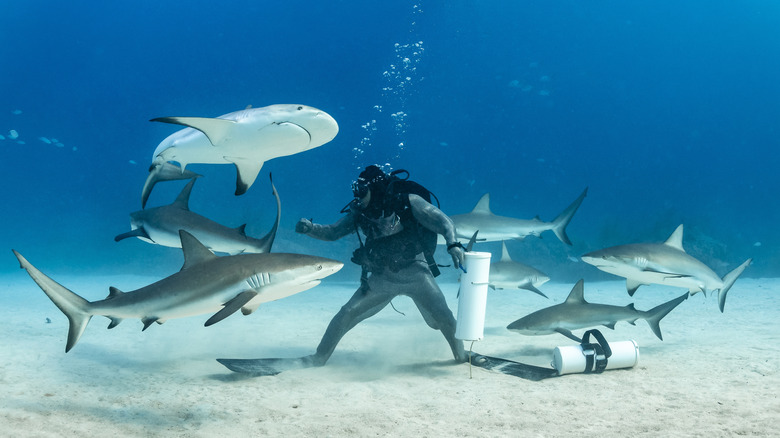
Seismologists can forecast earthquakes, and meteorologists can forecast storms on the daily. They're not always correct in their predictions, and few people even know what a 30% chance of rain actually means. Nonetheless, predictive, applied science saves lives by using statistics to warn communities when it's time to stay inside. But can it be used to prevent shark attacks? Meteorologists Dr. Greg Skomal and Joe Merchant believe that they can determine the risk of a shark attack by looking at the weather. According to their research, specific wind conditions, called simply a "sea breeze," may tell us when sharks are congregating — and looking for a meal.
Sea breezes that draw nutrient-rich water to the surface attract producers, such as plankton and algae, which then in turn attract predators. Most of the first predators to arrive are smaller fish, but their presence eventually draws the apex predators, like sharks, to congregate. The more that fish gather, the more that fish come. The whole thing is something of a chain reaction, but it needs more data to confirm if the idea is verifiable. Ironically, the sea breeze conditions that Skomal and Merchant believe attract shark attacks are the same conditions that make for an ideal breezy day at the beach.
Skomal and Merchant's research began in 2015 after shark attacks off the coast of the Carolinas left at least 11 people with serious wounds and missing limbs. So, the research team traveled to the Bahamas and other locations on the Atlantic coast to collect data and place trackers on the big fish. By comparing weather conditions, water temperature, and shark movement, the team hopes to find a pattern in the numbers. This attempt for "shark forecasting" is timely, too: Many experts are warning that shark populations and attacks have increased in recent years.
Understand the ocean, understand its sharks

Sharks aren't typically dangerous. In fact, marine biologists often hypnotize large aggressive sharks simply by flipping them over onto their backs. And yet, attacks do happen. They can leave victims with a missing arm or a large chunk missing from their leg. Sometimes people die. Critically, attacks happen right in shark territory — the entire ocean. To pinpoint where a single hungry sharks is would be like finding a needle in a haystack. If you find the shark's food, however, you just have to wait for the sharks to show up.
Merchant is confident that his "sea breeze" theory is correct, and not without reason. There is indeed a correlation between strong sea winds near the coast and shark attacks. Out of the 10 officially recorded shark attacks off the Carolinas in 2015, two occurred during a day of exceptionally strong, beachward ocean winds. What species of shark was behind each attack is unknown, but all are predicted to be one of any of the largest local species, including the blacknose shark, the tiger shark, and the bull shark. Some attacks could also be from great white sharks (which tend to congregate in specific parts of Massachusetts), whose locations help indicate where a feeding frenzy or congregation is forming.
There's a lot of data to consider, and the influence that ocean breezes have on shark attacks is still unknown. For now, the researchers have focused on the East Coast of the United States, where the Gulf Stream helps create distinct areas of cold and warm water. The theory may prove only applicable to the unique conditions on the East Coast, while weather elsewhere may be a poor predictor of shark attacks. Nonetheless, the more we study sharks and their habitat, the hydrosphere, the more we'll know when it's time to stay out of the water.