

Why Astronauts Find It Hard To Poop In Space
Life in space isn't easy. The microgravity makes a lot of things taken for granted here on Earth exceedingly difficult. Burping, for example, is nearly impossible, since gravity is needed to allow gases to rise. There are no technological solutions for the inability to burp in space — astronauts just fart a lot more. The good news is that the bathrooms on spaceships are equipped with advanced tools to make pooping in space easier. Easier, but not easy.
Peggy Whitson is an astronaut who spent more time in space than any other American, with a record 665 days on the ISS. According to Whitson, going "number two" in microgravity is something she doesn't miss. In an interview with Business Insider, Whitson said, "Number two is more challenging because you're trying to hit a pretty small target." In space, careful aim is critical. Miss your target and feces may end up floating around your head. Whitson says the crew nicknamed floating feces "brown trout," and any brown trout that escape have to be chased down and bagged.
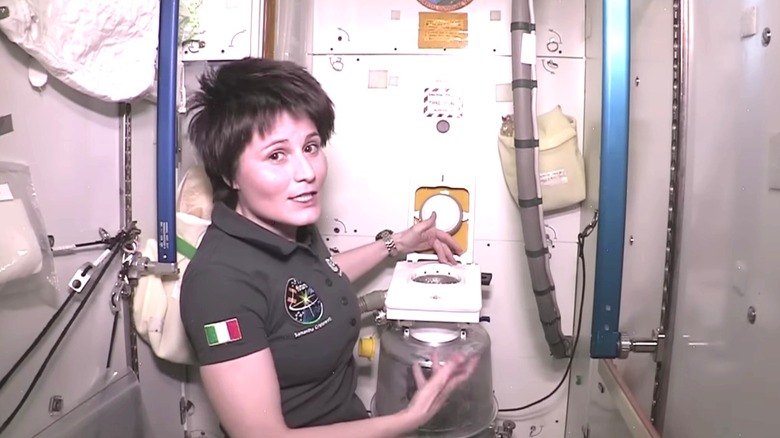
Judging from a video tour provided by the European Space Agency, the hole on the ISS's toilet is indeed small, about the diameter of an orange. To use it, astronauts open the lid and then place a plastic bag in the center. The inside of that bag is their target. In the past, crewmembers strapped themselves in, but many found that it was hard to position one's rear end directly over the hole while restrained, so many ships now use footholds and handles. Finally, the astronaut can make their deposit. Afterwards, poop bags are sucked into a reservoir that eventually gets ejected into space.
When gravity fails in space, technology steps in
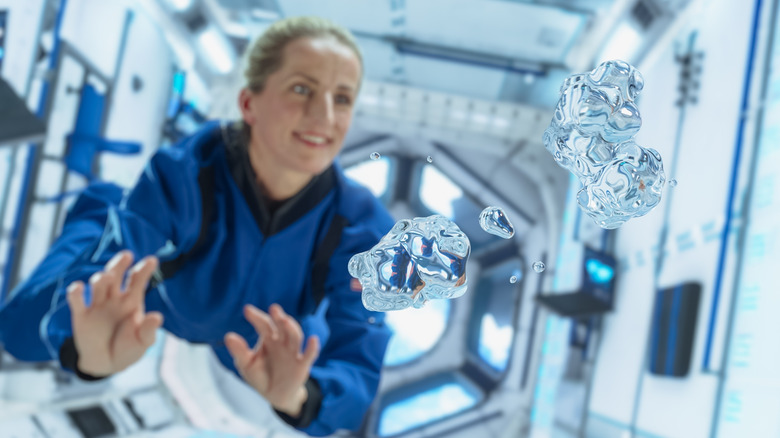
Many bodily functions depend on Earth's gravity to work properly. That's partly why the microgravity experienced on the ISS can wreak havoc on the body. Besides not being able to burp, astronauts also lose muscle and bone mass, their immune systems weaken, and the lack of atmosphere exposes them to space radiation. It's also why a trip to Mars would be a monumental challenge: The human body simply wasn't built for space.
But space agencies like NASA and ESA have a solution for seemingly everything. For example, when an astronaut first arrives at the ISS, their blood and other bodily fluids migrate from their legs to their brains, posing risks of eye problems. To remedy this, the ISS is equipped with a Chibis. The Chibis is a pair of suction pants made out of mostly rubber that can draw fluids back to the legs for new arrivals. It's kind of like vacuum-sealing leftovers to make them more compact. In fact, vacuums and suction are used for many devices on the ISS, including the toilet.
Unlike poop, pee doesn't get ejected into outer space. Instead, astronauts pee directly into the aforementioned vacuum hose, where it gets saved for recycling. Every drop of water is important on a space ship, so drinking recycled pee comes with the territory. The ISS toilet also uses suction, but if a crew member breaks the seal between their behind and the hole, that suction is sometimes not enough to prevent wayward fliers. Such is the biggest challenge when pooping in near-zero gravity: there's no "down" direction for turds to go. No wonder astronauts find it hard to go number two.