

Scientists Are Puzzled At The 'Zombie Fish' Phenomenon In Lake Superior
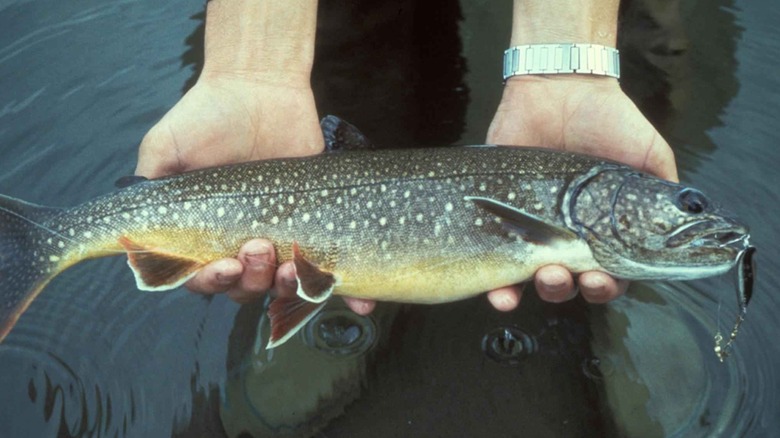
The siscowet, a type of trout found in Lake Superior, is in trouble. At least, it appears that way. Scientists have noticed an alarming number of severely underweight siscowets in Lake Superior, and that's not a good thing for a fish that haunts deep, dark, and frigid waters. Some researchers call them "zombie fish," due to the affected Siscowets' gaunt, stretched bodies and their occasionally deformed spines. Surveys have revealed that up to 37% of the subspecies is affected, and in one survey, 50% of the siscowets from a deep-lake haul were "zombified." It looks like there's a famine lurking in the deep waters of Lake Superior. The only problem with that theory is that all other lake trout are thriving.
In the 1960s, Lake Superior's trout population was on the brink of extinction. The culprit was the invasive lamprey, a parasitic fish that latches onto its victim using a circular, tooth-filled mouth that looks like a miniature sandworm from "Dune." Accidentally introduced to the Great Lakes from the Atlantic Ocean, the lamprey quickly dominated the new freshwater environment and nearly wiped out many of Lake Superior's native species. Fishing hauls were reduced to just 2% that of previous years' hauls. Luckily, thanks to efforts by the Great Lakes Fishery Commission, the lamprey population was eventually brought under control in an example of times scientists successfully fought back against invasive species.
It took decades for trout populations to recover from the lamprey invasion, and the half-century pause on fishing and harvesting was finally lifted just two years ago. Such good news makes the discovery of "zombie fish" all the more alarming, especially for the scientists scrambling to come up with answers. Whether a geological event, such as oxygen depletion, a disease, or the return of the lampreys is responsible is unknown.
The origin of the zombie fish: More theories than answers

Researchers have many hypotheses to explain the "zombie fish" phenomenon, but without more data, they can only speculate. Perhaps the likeliest explanation is the simplest: The fish could be skinny simply due to lack of food. The subspecies of siscowets affected by the condition have been found in the deepest and coldest waters of the lake, some over 1,000 feet deep. Conditions at such depths are extreme, with near-freezing temperatures and barely any light, and food sources are limited to only a few smaller fish species that share the icy depths of the lake. If the populations of those smaller prey fishes are dying off, it could explain growth issues among their predators, the siscowets.
Another reason could be disease. Lake Superior scientists plan on conducting a health assessment in June to determine if a bacterial, fungal, or viral infection is emaciating deep-lake Siscowets. Toxic contamination of the lakebed could also be to blame, since many of the zombie fish were found with slightly elevated levels of mercury in their blood and tissues. However, Lake Superior is the cleanest of the Great Lakes, and its heavy-metal contamination levels are quite low. Plus, small amounts of mercury bioaccumulation can be found in all its fish, so why only siscowets are "zombifying" remains a mystery.
There is one thing scientists do know: Why zombie zombie siscowets end up in deep waters. The simple answer is they don't have the buoyancy to swim higher. Typically siscowets use their plump bodies to dive up and down in search of prey at different depths. However, it's possible that as siscowets become emaciated, they sink towards the deep lakebed where food options are limited. Until scientists can determine the cause, the cycle of sinking siscowets will continue.