

The Prehistoric Insect That's Pure Nightmare Fuel
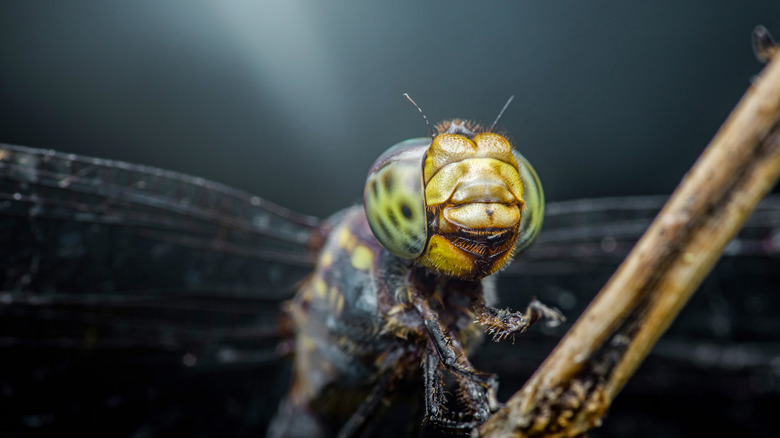
Today's insects are generally pretty underwhelming when it comes to size. The largest living insects wandering Earth today can generally fit in the palm of your hand, but go back in time a couple hundred million years, and the story is vastly different – in fact, many animals actually used to be way bigger. That was a time period when giant insects ruled Earth, and the largest among them was the ancient cousin to today's dragonflies with a wingspan over 2 feet wide: Meganeuropsis permiana.
This enormous beast of a bug was discovered via a giant fossilized wing found in the Permian rock in central Kansas in the 1930s. The estimated length of this single wing was around 13 inches, making the bug's total width over 2 feet. We don't know what these ancient insects ate, but since mammals and dinosaurs weren't around yet, we can guess it was other insects. If these big bugs were still around today, they would probably hunt like modern dragonflies, preferring small prey no bigger than their heads. So your dog would probably be safe, but don't let your hamster play outside.
These freakishly large flyers were around for about 50 million years from the end of the Carboniferous period to the end of the Permian. They — along with 90% of all other life at the time — met their end in the Great Dying, one of the worst mass extinction events in Earth's history, and no insect has yet to rise to their heights.
Monster insects of the Carboniferous period
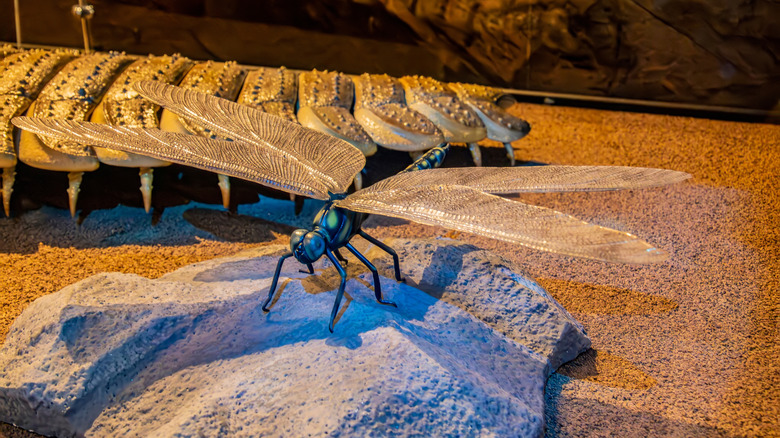
The Carboniferous world was completely alien to the world of today. If the preceding period, the Devonian, was distinguished by its aquatic life, the Carboniferous was remarkable for its diversity of insect species, specifically super-sized insects. In other words, Meganeuropsis wasn't the only big bug on the block.
One of the most intimidating was the nightmarish, prehistoric arthropod Arthropleura, an ancestor to modern centipedes and millipedes that could grow to over 8 feet long, 18 inches wide, and weigh over 100 pounds. If this monster were like some of its modern descendants, it would be a poisonous hunter and the subject of old wives' tales. However, based on recent fossil discoveries, researchers are pretty sure that Arthropleura was a detritivore, cleaning up dead plants and animals.
Another prehistoric nightmare-inducing creature from the Carboniferous was Pulmonoscorpius. Whereas the largest modern scorpions tend to fit in the palm of your hand, Pulmonoscorpius was the size of a cat or small dog. On the one hand, this may mean that it wasn't as venomous as it's smaller cousins, since bigger scorpions tend to be less venomous, but on the other hand, it's small pincers could indicate that it relied on venom to immobilize its prey. Thankfully, we don't have to find out!
Why did Carboniferous insects get so big?
For decades, the leading theory for why these Carboniferous insects grew to such gigantic proportions was the abundance of oxygen in the atmosphere at the time. The idea centers around how insects breathe. Instead of the bellows-like lungs mammals use, insects essentially have holes on their body that allow their organs to be directly supplied with ambient oxygen. The theory went that with more oxygen in the Carboniferous air, insects could power more growth and metabolism. And given oxygen's toxicity, larger insects would receive less oxidative stress than their smaller counterparts.
New research published in Nature pushes back on this idea. Scientists looked at the number of tracheoles (the tubes that supply oxygen to insects' muscles) across 44 species of flying insects and found that regardless of size, the tracheoles only made up around 1% of the insects' body volume. Since a 0.5-gram aphid has the same relative volume of tracheoles as a 7-gram beetle, it shows that modern insects don't use more oxygen in proportion to body size as they grow larger, meaning that ancient insects likely didn't either.
So, if oxygen didn't drive insect gigantism, what did? The leading theory is lack of predators. Dinosaurs didn't evolve until the Triassic period around 250 million years ago, so there was nothing around to make a meal out of a giant bug. And once dinosaurs showed up, it was better for bugs to be not so noticeable.