

Not A Sphere, Not Flat: The Weirdest Possible Shape For A Planet
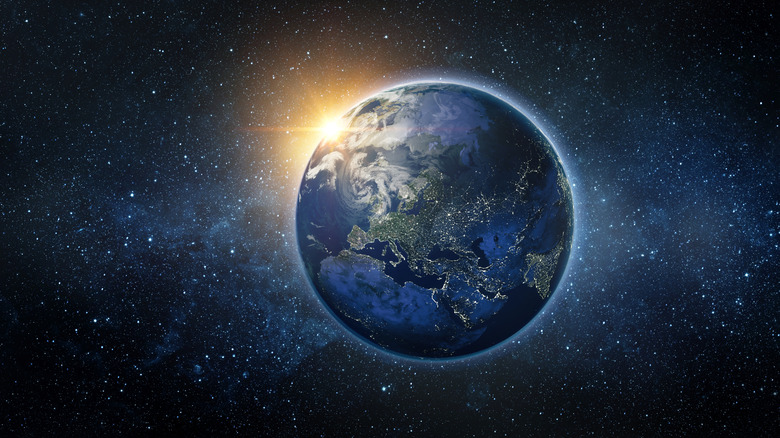
If you ask people what shape our planet is, most will answer that Earth is round (although a few might try to convince you it's actually flat). Going as far back as ancient Greece, humanity has understood that Earth is round, with scientists more recently determining that its not a perfect sphere. However, is it possible for planets to be something other than an imperfect sphere? What about a world that looks like a giant donut? Mathematics show that such a planet could technically exist, though the chances of a space donut forming naturally or lasting for very long are essentially zero.
A planet taking on a shape other than a spheroid would take a tremendous amount of outside force. One example is WASP-12b, a gas giant that orbits its star so closely that the star's gravitational force has made the planet egg-shaped. However, a donut shape, or a torus as its known in mathematics, would be far more complicated. It's thought that a torus could be formed by coalescing debris from a disintegrated planet, though such an arrangement would be highly unstable.
Why planets are spherical
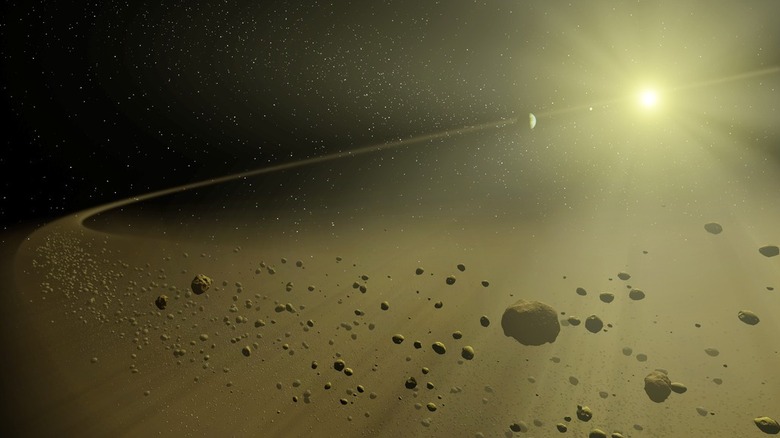
Planets are round for one reason: gravity. Over time, dust and gas particles condense to form planets. As planetary bodies grow, their mass increases, which translates into stronger gravitational pull. While asteroids and bodies like Mars' moons Phobos and Deimos can be shaped like potatoes, once a body has enough mass, the gravity makes it spherical. Having enough mass to be spherical is one of the criteria for defining what is a planet.
During formation, planetary bodies also start spinning. Earth rotates on its axis once per day, giving us our familiar day and night cycle. This spin translates to a speed of more than 1,000 miles per hour at the equator and far slower closer to the poles. This causes the planet to bulge slightly at the equator and flatten at the poles, making the surface about 13 miles farther from the planet's core at the equator. Centrifugal force from Earth's rotation and the tiny increase in distance from Earth's center also makes gravity very slightly weaker at the equator.
Spinning donuts in space
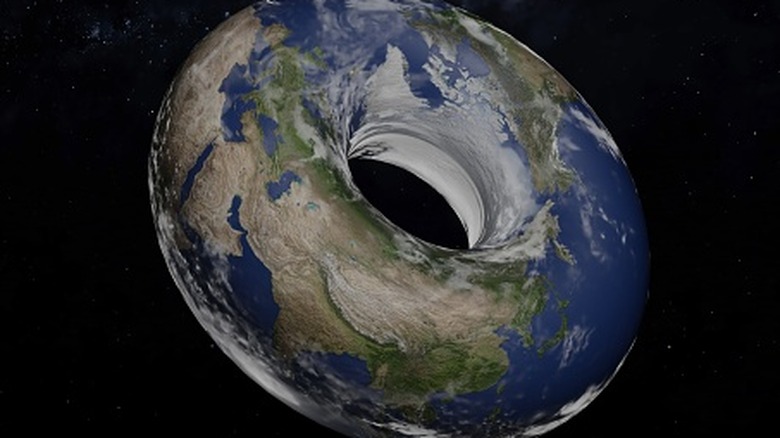
Rotation and centrifugal force is what would make a donut-shaped planet possible. Gravity pulls inward so to stay a toroid such a planet would need to spin very fast. Instead of rotating once every 24 hours, a donut world would need to complete a rotation in the span of a few hours. Just like on Earth centrifugal force would make gravity weaker at the equator, though the difference would be significant. The force felt at the equator would be roughly half of that at the poles.
Differences in gravitational forces would lead to significantly higher mountains, clouds, and ocean waves at the equator than at the poles. The planet's rapid rotation would would also affect air circulation as we see with the Coriolis effect on Earth. The faster rotation speed would lead to more intense winds and greater temperatures between hot and cold regions.
However, a donut-shaped planet would be highly unstable. Even small accumulations of mass at different parts of the torus would make it unstable. And the speed of rotation would have to be just right. Too fast and centrifugal force overcomes gravity, causing the planet to fly apart. Too slow and the torus would collapse into an ellipsoid. So while a donut-shaped planet is mathematically possible, the chances that one could form naturally are practically zero. Outside of a few rare exceptions, planets are mostly round.