

How AI Has Been Transforming Cancer Research In 2026 So Far

Artificial intelligence has become ubiquitous in the lives of many people who reside in industrialized societies. According to the Pew Research Center, 63% of adults in the United States use AI several times a week or more, with 31% of those adults claiming to use AI several times per day. We encounter AI frequently in our daily lives, through customer service chatbots, fitness trackers, and even our emails that identify certain material as spam. With such universality, it is not surprising that there is a very big push to use AI in healthcare innovation and research. Notably, multiple reviews published this year have highlighted AI tools in pancreatic, prostate, and breast cancer. There are many emerging uses of these tools, including early diagnostic detection, targeting of drugs, and mutation identification.
One potential benefit of AI use in cancer treatment worth noting is the early detection of pancreatic cancer. This form of cancer is particularly deadly, and incidence rates have been increasing. A complication of pancreatic cancer is that it is very difficult to detect early on, as imaging largely appears normal during the early stages, so it is often undetected until it has already spread. However, early detection is incredibly important to improve outcomes. Research published this year revealed that an AI tool known as Radiomics-based Early Detection MODel (REDMOD) provided early detection for the most common form of pancreatic cancer at twice the rate of the current radiological methods. While not perfect, this nonetheless presents promising improvements in diagnostic materials.
General uses of AI in cancer research
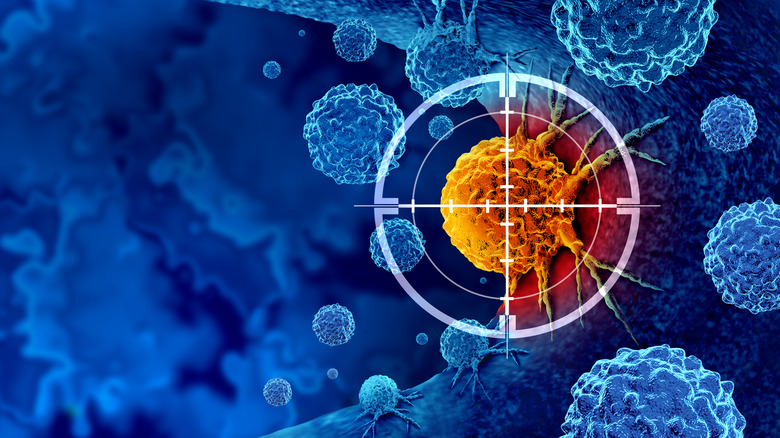
In addition to improved cancer detection, AI methods have shown potential in targeted therapies involved in cancer treatment. Because AI can be used to combine and analyze many datasets efficiently, there is an opportunity to improve the identification of cells and proteins that would be useful to focus treatment towards. Additionally, AI models can be used to help predict how one drug might interact with targets or with other medications being taken by the patient.
Once a potential target for medication has been identified, AI could also assist in drug design. Computer models could present new molecular structures and refine their chemical properties in order to enhance their effectiveness. Additional models can be used to predict how well a particular compound might bind to the targeted biological site. These tools could help streamline the process of drug discovery and improve safety in testing.
These innovations present opportunities to improve personalized medicine. Many varied outcomes of cancer are affected by differences in tumor cell mutations. AI models have been implemented to analyze imagery of these tumors and use the presenting phenotype to inform and predict gene mutations. Such tools are particularly useful when there is little tumor tissue to analyze, and this is a faster process than genetic testing. Therefore, such methods could help improve patient-specific care as well as increase efficiency.
Limitations and controversies

Of course, it is important to remember that these methods are evolving, and they are far from perfect. Therefore, the use of AI certainly does not preclude the need for additional research methods in science. After all, the data used to inform AI models has only become available due to basic and clinical research. Furthermore, many of these methods still require extensive validation. So, while these emerging techniques can help streamline and inform research practices and treatment, much more analysis is needed to determine their accuracy and efficacy.
For instance, while REDMOD showed increased early detection of pancreatic cancer, it also flagged some images as cancerous when they were not. Out of 430 control cases, REDMOD flagged 81, which is a false positive rate of nearly 19%. Additionally, although cancer was correctly detected in 73% of the images from patients who had received a cancer diagnosis, it is also worth noting that the sample size of cancer patients was significantly smaller than that of the control group, at 63 compared to 430, respectively. Thus, further analysis will continue to be necessary, even with these tools.
Along with the limitations described, many are concerned about how training these AI models could affect patient privacy. Another challenge is ensuring that the algorithms are well-rounded to prevent bias. Therefore, while these innovations are promising, many limitations persist and must be addressed. Premature reliance on these models could lead to greater health disparities.