

What Might Happen If You Were Sucked Into Space
Movies and TV have led us to believe that if a spacecraft hatch suddenly blows, the astronauts inside are sucked out of the ship. Sometimes, the main character manages to survive. Most of the time, at least one hapless astronaut is pulled through the hatch and left floating in the inky vacuum of space. As with all things Hollywood, this classic depiction of a space ejection isn't scientifically accurate. To predict what really happens when you get "sucked" into space, the Australian Space Agency crunched some numbers in a 2023 blog post and confirmed that you don't get sucked into space at all: You get pushed.
The main force acting on an astronaut during a large breach is air friction as gases rush to escape the aircraft. For example, the International Space Station (ISS) is internally pressurized with breathable air to allow its occupants to move freely, without needing tubes or tanks to live comfortably — one of the details people might not know about living on the ISS. Kept at around 1 atmosphere in pressure and 72 degrees — and composed of 21% oxygen and 78% nitrogen — the air inside the ISS is virtually identical to that of Earth's atmosphere in terms of composition and temperature. As the hot and crowded air molecules collide with the walls of the craft, they exert an outward pressure.
If a hatch-sized breach were to occur on the ISS, over 10,000 pounds of air would suddenly whip out into space, as the air particles rush to escape the high-pressure craft. That rush would be strong enough to carry a person along with it. However, the air in the tiny Apollo space capsules weighed about 11 pounds, so a breach would have felt like a light breeze. It certainly wouldn't have been enough mass to push you into space, and it certainly wouldn't have been very cinematic.
The short-lived experience of space without a suit
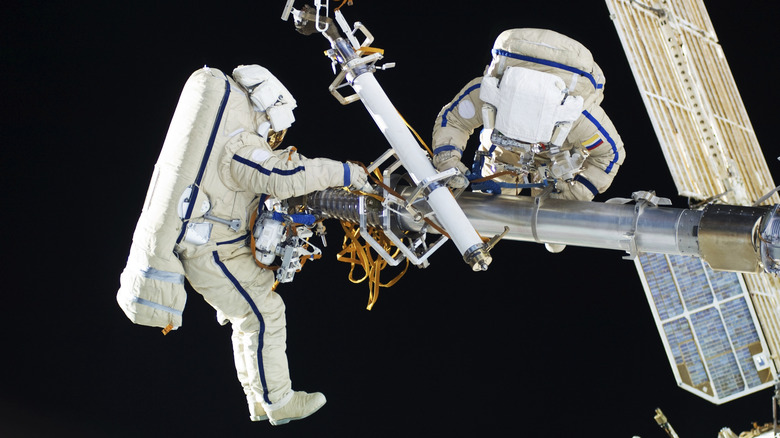
Once you get pushed into space, the air from the ship that took you there immediately dissipates and freezes. However, there is a chance that debris was pushed out of the ship alongside you, so you'd have to be lucky enough to not get smacked by the chaos. If you do survive the initial ejection, however, you wouldn't have much time before your lungs fail and rupture. The same gases that ripped you out of the spaceship in the first place would also rush out of your lungs and cause you to suffocate.
But suffocation isn't even one of the worst ways to die in space. In fact, if you were suddenly ejected into space without a pressurized suit, the pressure difference between your body's internal pressure and the zero-pressure of space would cause nitrogen bubbles to form in your blood and tissues. The experience would be like an extreme version of getting the bends, which occurs when scuba divers ascend too quickly from the high-pressure deep water to the low-pressure ocean surface. As the nitrogen gases in your body expand, they blow up your tissues like a balloon, causing your organs to rupture.
Exposed to the vacuum of space, the liquid water in your body also turns from a liquid to a gas. And when water turns from a liquid to a gas, it boils. Yet, even as you boil alive by your own bodily fluids, you'd also feel the extreme chill of space. Depending on proximity to the sun and other planets, outer space is typically hundreds of degrees below freezing. The good news is that without air, you'd probably lose consciousness within 15 seconds of exposure to space and die shortly thereafter from suffocation. Again, not very cinematic.