

The Perfect Espresso Shot Does Exist, According To Science
Steamed milk, sweeteners, and other flavorings are what give your preferred coffee shop its unique taste. But without a good dose of espresso these drinks will fall flat. True espresso fans, the few who sip from tiny steaming cups, know the difference between a mediocre shot and a great one. Making the perfect shot of espresso is an overarching goal for many baristas. Dialing in the perfect shot can take lots of practice and is often seen as a sort of art. However, science has uncovered the forces at work when crafting a perfect espresso shot.
In a 2026 study published in the journal Royal Society Open Science, scientists developed a mathematical model that describes how water's movement through a bed of coffee grounds influences espresso quality. The model is based on equations used to describe how water percolates through sediments in an aquifer or how gases move through magma. The researchers found that the size of coffee grounds play a significant role in how a shot of espresso turns out.
Crafting the perfect shot of espresso

The principles of making espresso are deceptively simple. You take a small amount of finely ground coffee, pack it into a form called a puck, and force hot water through it at high pressure. During this process, known as extraction, water acts as a solvent, dissolving the oils, acids, and sugars in ground coffee beans that give espresso its crucial caffeine and characteristic flavors.
However, this seemingly simple process can take practice to get right. Too little extraction yields an underwhelming shot, while extracting too much produces a bitter and overpowering espresso. There are a few factors involved in getting the right balance in extraction. The first is water temperature, with an ideal range of 195 to 205 degrees Fahrenheit. Next is the pressure at which water is forced through the puck of coffee. This is typically around 9 or 10 bars (1 bar, or ~14.5 psi, is slightly less than air pressure at sea level).
In addition to setting temperature and pressure, a barista can also change the amount of ground coffee used (known as the dose, weighed on a scale), how thoroughly and evenly the coffee is tamped into the puck, and lastly, the size of the ground used. Fine-tuning dose, tamp, and grind are part of the art of espresso, but ground size and how it influences the way water moves through the puck is the science.
Finer grind means slower flow
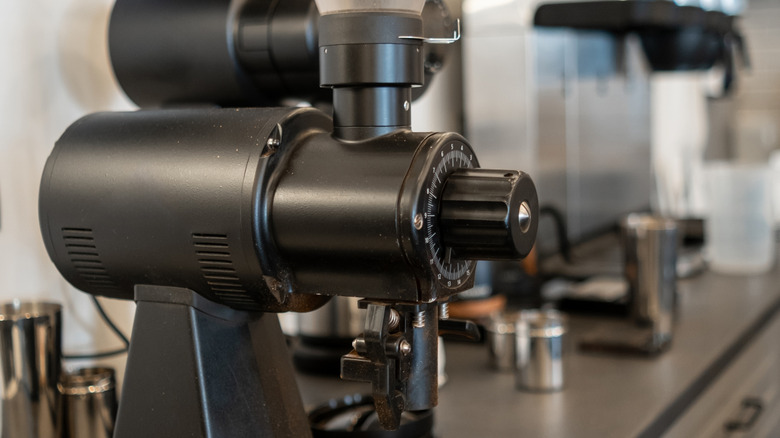
Scientists used the Forchheimer equation, a mathematical representation of the way fluids flow through a porous material under different pressures, to develop a model of how pressurized water moves through a coffee puck to make espresso. Their model was based on similar models that are used to analyze fluid flow in soils and rocks. It showed that larger coffee grounds made for a puck with higher permeability, allowing water to move through more quickly, while finer grounds did the opposite. The amount of time that water is in contact with coffee grounds controls flavor, with an optimal extraction time being somewhere around 25 to 30 seconds.
The researchers then validated their model using samples of coffee. They used settings 1 to 11 of a commonly used coffee grinder to grind samples of two varieties of coffee beans. They then measured the particle sizes in each sample using high-resolution digital cameras. Then the researchers packed coffee samples to create pucks and measured how water moved through them using multiple X-ray cross sections.
Their tests showed that the model accurately described how water flows through coffee grounds. These findings show how the size of coffee grounds influences permeability and flow rate. Being able to determine optimal ground size could help dial in the parameters behind a perfect shot of espresso, something many of us can appreciate.