

Albert Einstein's School Report Card Debunks This Common Myth
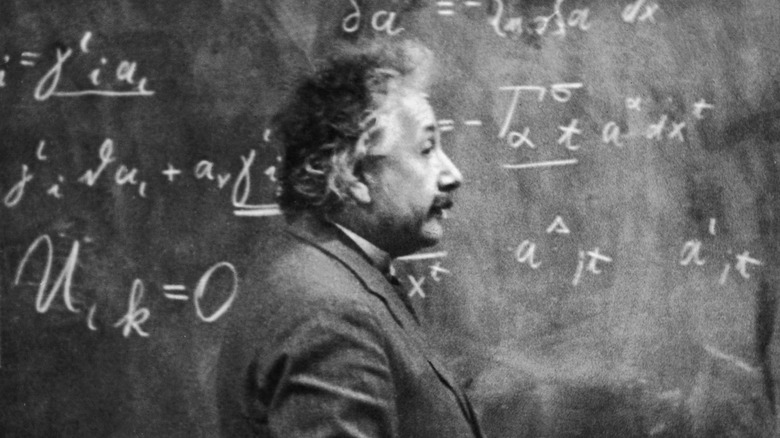
Albert Einstein, the renowned physicist who propagated major breakthroughs in scientific research, has become an icon in many ways. From his wild hair likely informing the aesthetics of the eccentric scientist, to his portraits and occasionally misattributed quotes that line the walls of many schools, he has been heralded as an inspirational underdog. In the 1976 film "Rocky," Adrian (Talia Shire) addresses her brother's doubts in the amateur boxer's abilities, saying, "Einstein flunked out of school twice ... Beethoven was deaf. Helen Keller was blind. I think Rocky's got a good chance." However, records indicate that this is not actually true. Einstein did not fail in school, and he generally achieved average or higher grades, particularly thriving in physics and mathematics.
While his grades were generally fine, Einstein was not always thought to be a good student (and there were some problems he couldn't solve). He tended to struggle with authority, particularly in the strict school that he attended in Munich, the Luitpold Gymnasium (now named the Albert Einstein Gymnasium in his honor). His sister, Maja, would offer a description of his distaste for the school, saying that the "military tone" and "worship of authority" ingrained in student life did not sit well with him. So, when his parents left for Italy in 1894, suggesting that he finish out his education in Munich, Einstein would instead elect to drop out of the school on claims of mental exhaustion and leave Germany. Although he left this school at 16 years old, he would continue to pursue an education.
Einstein's preparatory school grades
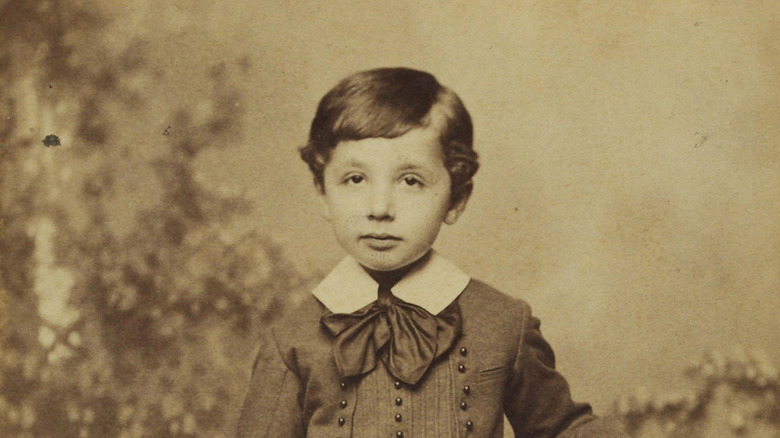
An exact account of Einstein's grades while at the Luitpold Gymnasium is unavailable, as they were destroyed during World War II. However, the principal during Einstein's years as a student would tell the press in 1929 that his grades had been good. At the school, grades were represented by the numbers one through six, with one being the highest mark. The principal would say that his grades had fluctuated between one and two, finishing his time at the school with a one in mathematics.
After leaving Germany, a family friend helped arrange for Einstein to take the entrance exam for the Federal Technical Institute in Zurich, typically abbreviated as ETH. However, convincing the ETH administration to let him take this exam was a difficult task, because Einstein was only 16 years old and had no degree. While the director of ETH expressed his opinion that Einstein should finish his schooling in Germany, he did permit the young genius an opportunity to take the exam. This, Einstein failed.
He did well on portions of the exam that were science-based, including physics and mathematics. However, he came up short in the language portions. At least partially, this could be due to the fact that this was a Swiss institution, and therefore local residents would have grown up speaking both German and French. Whereas Einstein exhibited a notable weakness in French. Nonetheless, he was able to attend Aargau, a Swiss preparatory school that directly admitted to ETH upon graduation.
Aargau and university
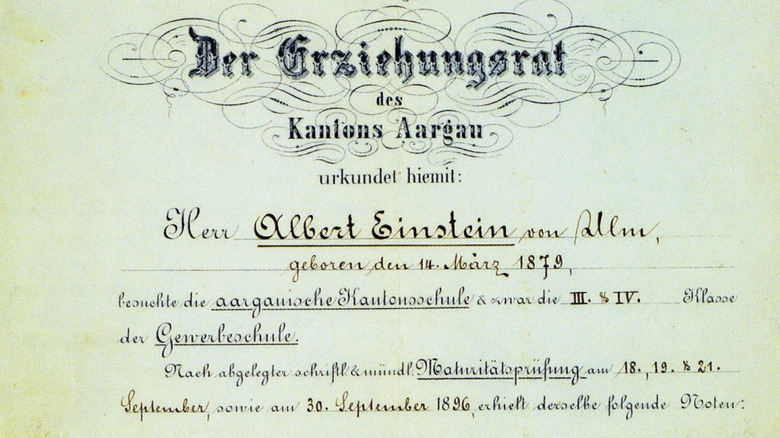
Compared to the German style of education he had previously experienced, Einstein found his time at Aargau much more pleasurable. Although this portion of Einstein's life might be another from which confusion arose regarding his academic performance. At Aargau, the same grading metrics were initially used as at the Luitpold Gymnasium, with one representing the highest marks and six representing the lowest. But midway through his education, the grading system reversed such that a score of six indicated the highest marks. Once again, he excelled in mathematics and physics, but performed averagely in chemistry, drawing, and violin. The only course for which he scored poorly was French.
Although Einstein's grades remained high in the sciences at ETH, he did develop a conflict with the professor of physics there, and would describe trying to educate himself further in the subject outside of the classroom. During this pursuit, his interest in college math courses declined, and he would rely on a classmate, Marcel Grossman, to supply him with notes from classes he had skipped. This same friend would help Einstein get a job after graduating, a struggle that Einstein attributed to the resentful physics professor.
Einstein was a decent student who excelled in the subjects of his interests. He received great educational opportunities and help from friends and mentors along the way. However, he did face some setbacks, which could serve as encouragement to continue pursuing your academic goals even if you aren't at the top of the class.