

The 92-Foot Dinosaur Discovered By Accident In China
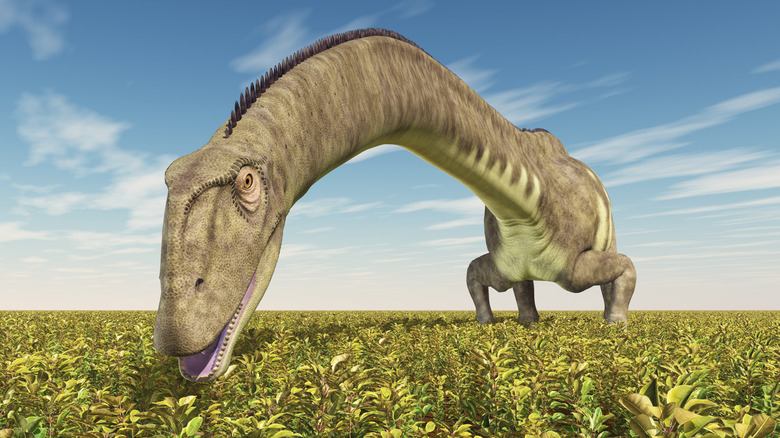
Sauropods are the biggest land animals to have ever existed, with the largest dinosaur dwarfing today's land animals and measuring well over 100 feet in length, from tail to nose. And because many sauropods were the size of a house, their bones were the size of furniture (and their dinosaur eggs looked like they were the size of a football). Scientists have found sauropod femurs as long as twin-sized beds and vertebrae that stood 9 feet tall. Usually, these finds are composed of only one or two fossilized bones. But in 2026, Chinese paleontologists announced the discovery of a sauropod fossil with a whopping 18 bones. Not only is the fossil a new species, but it's from a new genus, as well.
The new fossils were found accidentally at a construction site in the Sichuan Basin in central China, where an abundance of dinosaur fossils have been unearthed in stunningly preserved condition for decades. After the excavation, the paleontologists got to work to figure out where the fossilized bones fit on the tree of life. Judging by its massive proportions and the geological layer it was found in, the fossilized dinosaur was a sauropod. Among the 18 bones were vertebrates, claws, a fibula, and a gigantic scapula (the shoulder blade). That scapula was a major key to identifying and estimating the size of its owner, since sauropods depended on their massive shoulders to support their massive bodies.
After months of analysis, the Chinese research team behind the discovery announced that the fossils were those of a new species of sauropod, and not a small one. The researchers estimate the newly-named "Tongnanlong zhimingi" dinosaur to have had a body length of around 85 feet, while other sources estimate its length between 75 and 92 feet. There are a lot of uncertainties since the Tongnanlong zhimingi fossil is the only representative of its kind.
How scientists reconstruct an extinct giant from just a few bones
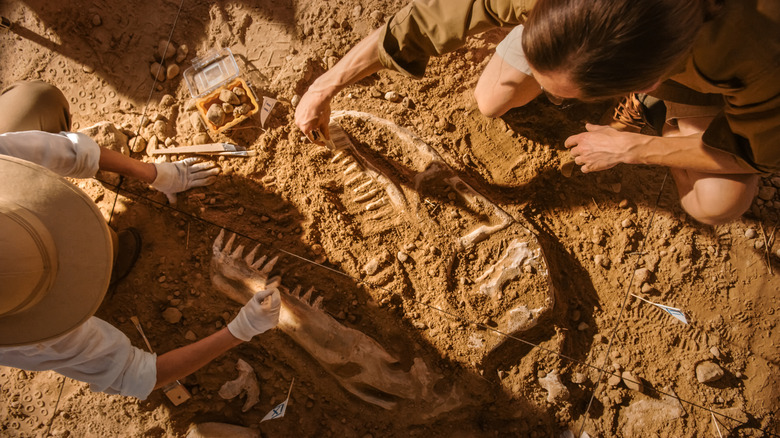
Paleontologists might not have a complete sauropod fossil, but they do have an abundance of fossilized bones to pick through for clues about their size. Because these plant-eating sauropods were so successful and reigned for so many millions of years, their presence in the fossil record is extensive. For some sauropod species, size and morphological features are easy to guess. For example, Dreadnoughtus schrani, a member of the record-breaking titanosaur clade, was found in a 70% complete fossil in 2024, while Camarasaurus lentus remains one of the most-studied sauropod species with many fossil specimens to study.
But the newly-discovered 92-foot sauropod, Tongnanlong zhimingi, isn't quite as easy to piece together. It's clearly a sauropod based on the bone size and structure, but other qualities of its bones don't fit in other sauropod genera (a genus is a taxonomic rank of closely related species that share a recent common ancestor). Without any close relatives to compare to, paleontologists' turn to the broader taxonomic rank of family to estimate its size. Because the fossilized bones are lightweight and filled with air pockets, the researchers concluded that Tongnanlong zhimingi must be a member of the Mamenchisauridae family of sauropods.
Mamenchisauridae dinosaurs were giant sauropods whose fossils had previously only been found in East Asia. But with the discovery of the 147-million-year old fossil of Tongnanlong zhimingi in central China, it's clear that Mamenchisauridae likely had a broader range than originally thought. It's even possible that Mamenchisauridae dinosaurs had a continental reach, but more specimens will be needed. Fortunately, new discoveries seem to occur every day. Tongnanlong zhimingi was found by workers (accidentally) at a construction site, which indicates that many more fossils are still waiting for discovery.