

How 'Rogue Holes' Are Reshaping What We Know Of The Ocean
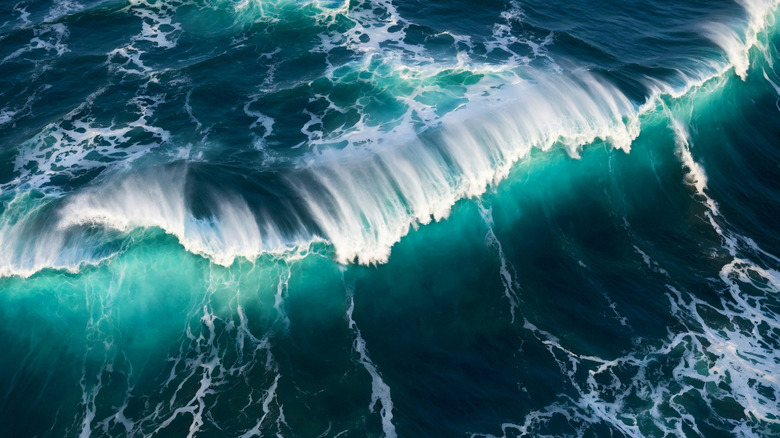
Imagine sailing through the ocean. You are so far out on the water that no land is in sight, even if you squint. Suddenly, there appears to be a steep drop-off in the water up ahead, like a cliff. The water in front of you seems to disappear into an abyss. But a gap did not abruptly open up in the world; you are witnessing a phenomenon known as a rogue hole. And if you are seeing this, you are joining the few people who have observed this anomaly dating back to sailors of centuries past. In fact, while science has shown this curious oceanic occurrence to be possible and even likely, it has never been measured in real time in the open seas.
Earth is dominated by ocean waters, representing 71% of the planet's surface. However, there is still so much that we do not understand. In fact, much of the ocean has yet to be explored, with only 28.7% of the seafloor having been mapped to date. Of course, as we are a terrestrial species, the ocean is not easily accessible to us and remains a source of great danger. But sailors have traveled far and wide across the seas, relying on their vigilance to survive in the unpredictable waters before satellites could warn of oncoming storms, and have observed phenomena only recently beginning to be verified by scientists. Like many ocean mysteries, rogue holes remain something we are unable to forecast.
Rogue Waves
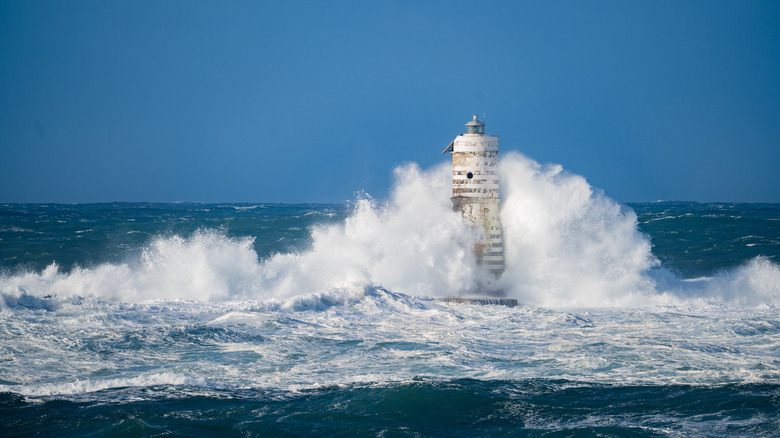
To talk about rogue holes, we have to discuss their related oceanic spectacles, rogue waves. Sudden, towering waves have been described and warned of for centuries. In 1498, Christopher Columbus described a wave that rose as high as the masts of his ship and lifted the vessel to a shocking height. In 1861, a massive wave collided against a lighthouse off the coast of Ireland, shattering glass panes in the light room and sending lamps crashing down the stairs. In 1942, the famous ship, "Queen Mary," was hit by a wall of water that was estimated to rise to 75 feet.
But these were often dismissed and thought to be exaggerated accounts. It was not until 1995 that such a monstrous wave was finally measured and confirmed. An offshore gas platform sat in the North Sea with a laser attached to measure the height of nearby waves. And it caught one that was enormous: over 85 feet high.
This type of wave differs from other large wave phenomena, like tsunamis. Rogue waves are not the product of geological events that would allow them to be somewhat predictable. While regular, bigger waves typically form after one wave catches up to another, causing them to combine and increase somewhat in height, rogue waves occur when there is a non-linear exchange of ocean wave energy. As one wave steals the energy of the other, its subsequent height becomes a matter of multiplication as opposed to addition.
Rogue holes
The revelation of the very real existence of rogue waves opened up the possibility that rogue holes could also exist. Where rogue waves are the non-linear interaction of the peaks, perhaps rogue holes could be the non-linear interaction of the troughs. However, if rogue waves are uncommon, rogue holes must be exceedingly rare. While the European Space Agency was able to detect many rogue waves from 2001 to 2003 using radar data, rogue holes were not observed.
In 2011, some researchers managed to prove the possibility of rogue holes. Using the mathematical model of nonlinear Schrodinger's equation to manipulate the conditions of a water tank, they were able to produce a rogue hole. While promising, this still does not necessarily prove that rogue holes exist in the real world.
Another study published in the journal Nature in 2016 reinforced this possibility by using actual wave measurements with mathematical models; the researchers were able to simulate the formation of rogue holes and rogue waves. However, while rogue waves could be explained with linear equations, rogue holes could only be revealed through nonlinearity. This indicates that rogue holes could indeed form under real-world conditions.
Nonetheless, while rogue waves have been measured, rogue holes have not. Therefore, plenty of room is left to explore these fascinating oceanic anomalies. Moreover, neither of these phenomena can be predicted by satellite data thus far, unlike tropical storms and tsunamis. Future studies regarding such events could inform safety measures on the open seas.